What a standing wrestling dummy is, how it works, what it's realistically useful for, and what to look for before buying one — for wrestling, BJJ and MMA training.
Home Gym Goals Editorial TeamPublished: September 2026 · Last updated: September 2026~16 min read
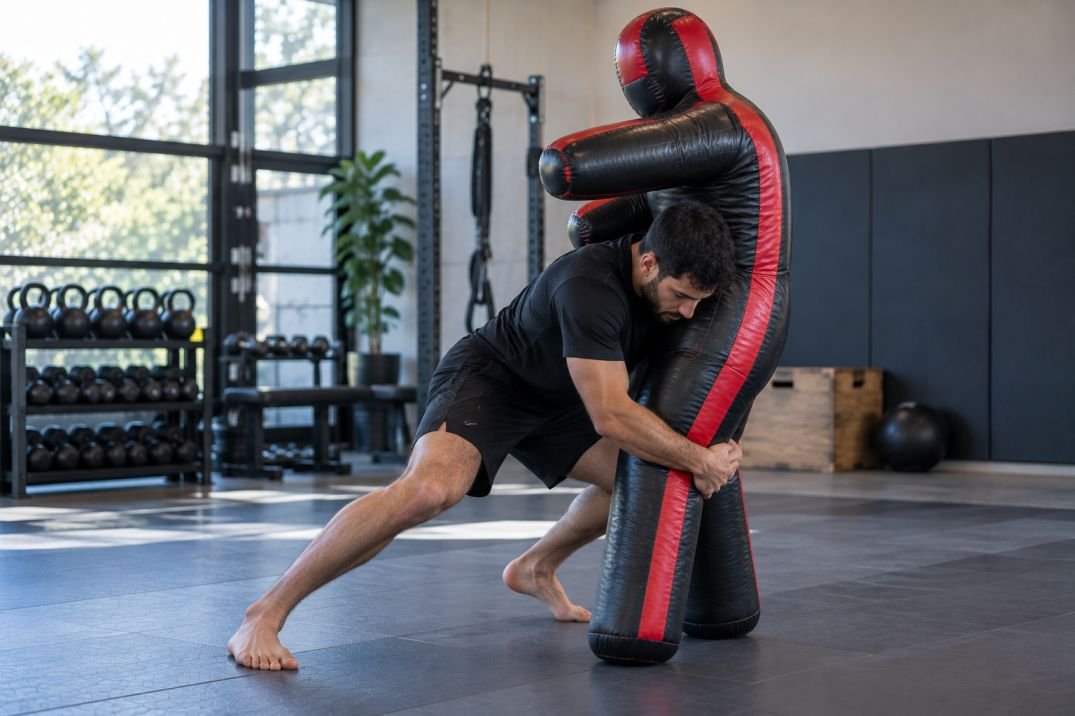
Standing wrestling dummies stay upright between reps, making them a common choice for solo standing practice.
Most grappling dummies are designed to be worked with on the ground — carried, positioned and drilled from a lying or seated start. A standing wrestling dummy is a different category: it's built to stay upright, giving solo practitioners a target for the standing phase of wrestling, BJJ and MMA training that a floor-oriented dummy generally can't offer in the same way.
Standing dummies have become a popular option for wrestlers, grapplers and MMA athletes who want to work on stance, entries and takedown mechanics without needing a partner every session. This guide covers what a standing wrestling dummy actually is, how it works, what it's realistically useful for, and what to look for if you're deciding whether one fits your training.
What Is a Standing Wrestling Dummy?
Quick answer
A standing wrestling dummy is an upright training dummy designed to simulate a standing opponent for wrestling, grappling, BJJ, MMA, and related martial-arts practice. Depending on its construction, it can provide a target for practicing movements such as stance work, entries, takedown mechanics, positional transitions, and other controlled solo drills. It cannot reproduce the reactions, resistance, balance, timing, or unpredictability of a live training partner.
How Does a Standing Wrestling Dummy Work?
The basic concept is straightforward: a human-shaped body, held or built to remain in an upright position, so a solo practitioner can drill standing movement against a stationary target. Beyond that shared concept, designs vary considerably.
Upright body position — the dummy is shaped and constructed to represent a standing opponent
Weighted or stabilized base, or another standing mechanism — different products achieve "standing" differently; some rely on a stable base, others on how the dummy is positioned or leaned
Human-like target — proportions generally approximate a person for realistic distance and grip practice
Ability to remain standing during controlled practice — the core feature that distinguishes it from floor-oriented dummies
Not every standing dummy uses the same base, filling or stabilization system — designs vary between manufacturers, so it's worth checking exactly how a specific product achieves and maintains its standing position before buying.
What Is a Standing Wrestling Dummy Used For?
At a high level, standing dummies support the standing phase of grappling training — the part of a session that happens before (or instead of) ground work.
Stance and movement practice — rehearsing a balanced, ready position
Controlled entry practice — working on the setup phase of an entry without a partner
Takedown movement patterns — general mechanics rather than live application
Body positioning — practicing where your hips, chest and head sit relative to a target
Hand placement — rehearsing grips and hand-fighting positioning
Clinch positioning — practicing upper-body control from a standing position
Wrestling-specific movement — footwork and level-change drilling
Grappling transitions — moving from a standing position toward a takedown or ground entry
Solo repetition — building volume without needing a partner every session
This is a high-level overview rather than a technique-by-technique breakdown — for detailed drills, see our dedicated Wrestling Dummy Drills and Wrestling Takedown Drills guides [ARTICLE TO CREATE].
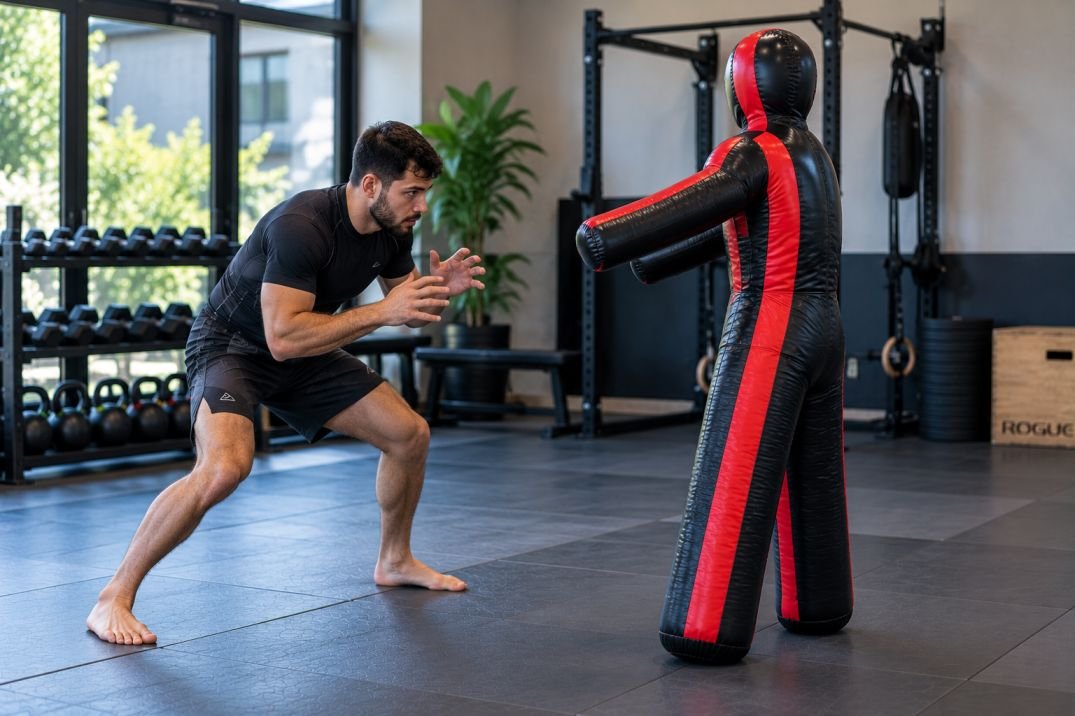
Image · Standing training posture
A standing dummy gives solo practitioners a target for stance, entries and standing movement.
Standing Wrestling Dummy vs Traditional Grappling Dummy
A concise comparison. For a deeper breakdown, see our dedicated Grappling Dummy vs Wrestling Dummy comparison [ARTICLE TO CREATE].
Feature
Standing Dummy
Traditional Grappling Dummy
Starting position
Upright
Typically ground-based (lying or seated)
Training orientation
Standing exchanges
Ground positions and transitions
Standing practice
Primary use case
Limited or not the intended use
Ground practice
Limited, depending on design
Primary use case
Takedown practice
Entry mechanics from a standing target
Typically used after the takedown, on the ground
Storage
Depends on base and design; can require more clearance while set up
Often easier to lay flat or store compactly
Space requirements
Needs standing clearance around the dummy
Needs floor space for ground movement
Ideal user
Wrestlers and grapplers focused on standing entries and stance work
Grapplers focused on ground positions, guard and submissions
Can You Use a Standing Wrestling Dummy for BJJ?
Yes, depending on the dummy's design and intended use. A standing dummy can support the standing portion of BJJ training — the entries and positioning that precede the sport's ground game.
Standing entries — rehearsing the setup for a takedown or trip
Takedown concepts — general mechanics rather than live application
Positional movement — footwork and distance management
Transitions — moving from standing toward a ground entry
Solo repetition — building volume between classes
A standing dummy does not provide live resistance or realistic reactions, which are central to how BJJ standing exchanges actually play out. For BJJ-specific standing drills, see our Wrestling Dummy for BJJ guide [ARTICLE TO CREATE], or explore the Home Gym Goals BJJ dummy hub for the wider category.
Can You Use a Standing Wrestling Dummy for MMA?
A standing dummy can support parts of MMA training that happen in a standing position — general grappling practice, takedown entries, clinch positioning and transition concepts, all performed solo and without contact.
It can't reproduce a training partner's striking defense, reactions or resistance, and it isn't a substitute for live sparring under coaching. Treat it as a supplement for solo repetition of standing mechanics, not a replacement for MMA sparring.
Standing Wrestling Dummy for Takedown Training
An upright target can be useful for rehearsing the general mechanics and movement patterns associated with takedown entries, independent of live resistance.
Stance — maintaining a balanced, ready position
Distance — practicing how close to get before committing to an entry
Level-change concepts — dropping level using the legs
Entry positioning — where hands, head and hips should be through an entry
Body alignment — keeping structure through the movement
Controlled repetition — building volume without needing a partner every rep
For a full breakdown of takedown drills and fundamentals, see our Wrestling Takedown Drills and Takedown Training: A Beginner's Guide[ARTICLE TO CREATE].
Standing Wrestling Dummy for Home Training
The main appeal of a standing dummy at home is convenience — solo practice and repetition without needing to schedule around a partner's availability.
Convenience — available whenever you want to train
Solo practice — no partner required for movement-based drilling
Repetition — building volume on stance and entry mechanics
Space requirements — standing dummies generally need clearance to move around, not just floor space
Storage — consider how and where it will be kept when not in use
Noise — repeated contact can be audible in shared or upstairs spaces
Flooring and mats — a suitable training surface matters for both safety and dummy longevity
Home training with a standing dummy is supplementary — it's a way to add repetition between sessions, not a replacement for coached or live training.
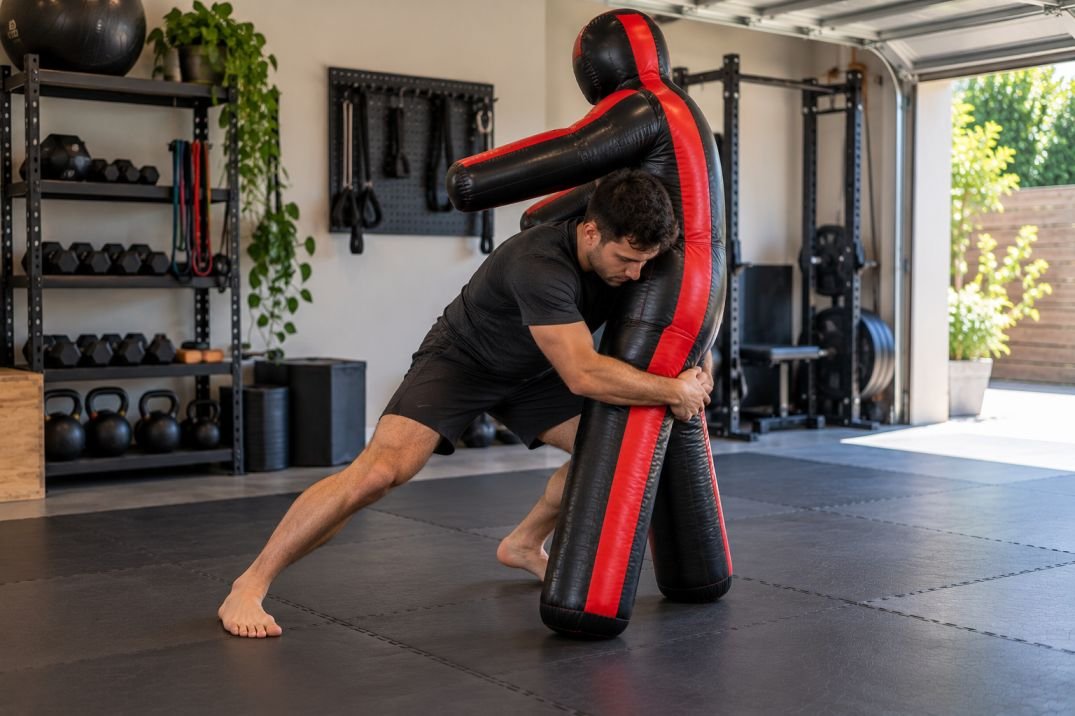
Image · Mat and space setup
Standing dummies need clearance to move around, not just floor space to sit on.
What Makes a Good Standing Wrestling Dummy?
These are the characteristics worth checking, without ranking any single material or construction as universally best.
Stable Standing Design
The dummy should be able to hold an upright position through the kind of controlled movement you intend to practice.
Appropriate Size
Sizing should suit your training goals and available space — see the sizing section below for a high-level view.
Appropriate Weight
Weight affects how the dummy handles and feels — see the weight section below for more detail.
Durable Outer Construction
The outer material should hold up to repeated contact over time without excessive wear.
Suitable Internal Filling
Filling affects firmness and feel, and requirements vary by product.
Realistic Shape
A human-like shape supports more realistic distance and positioning practice.
Reliable Seams and Closures
Seams and closures under repeated stress should be checked periodically for wear.
Suitable Base or Stabilization System
Whatever mechanism keeps the dummy upright should be appropriate for your floor type and training intensity.
Appropriate Training Surface
A suitable mat or flooring protects both the dummy and the practitioner during use.
What Size Standing Wrestling Dummy Should You Get?
Sizing decisions generally come down to your own height, the type of training you plan to do, the space you have available, and the specific dummy's proportions. A size that closely matches your typical training partners' height range is often a reasonable starting point, but this varies by individual goals.
Always check the manufacturer's sizing details for a specific product rather than assuming sizes are standardized across brands. For a complete breakdown of sizing considerations, see our dedicated What Size Grappling Dummy Should I Buy? guide [ARTICLE TO CREATE].
How Heavy Should a Standing Wrestling Dummy Be?
Weight affects stability, how the dummy handles during movement, and general training feel. Heavier dummies can feel more realistic for certain drills but may be harder to reposition; lighter dummies are easier to move but may behave differently during contact.
There's no single universal weight recommendation — it depends on the training you intend to do and the specific product's design. For a complete breakdown, see our dedicated What Weight Grappling Dummy Should I Get? guide [ARTICLE TO CREATE].
Filled vs Unfilled Standing Wrestling Dummy
Filled
Unfilled
Setup
Ready for use out of the box
Requires filling before use
Weight
Generally heavier as shipped
Weight is user-controlled
Shipping
Bulkier and heavier to ship
Easier and often cheaper to ship
Customization
Fixed by the manufacturer
User chooses filling material and amount
This is a basic overview rather than a complete comparison — see our dedicated Filled vs Unfilled Grappling Dummy guide [ARTICLE TO CREATE] for the full breakdown.
How Is a Standing Wrestling Dummy Filled?
Filling requirements vary by design — some standing dummies arrive pre-filled, while others need to be filled by the user with a specified material or amount. Always follow the specific manufacturer's guidance for a given product.
Inspect seams — check regularly for wear or fraying
Inspect the base — confirm the standing mechanism remains stable
Check closures — zippers, laces or straps should stay secure
Monitor filling — settling or shifting filling can change how the dummy feels and stands
Clean according to manufacturer instructions — different outer materials have different care needs
Store appropriately — away from moisture and excessive heat
Stop use if damaged — a compromised seam or base is a safety issue, not just a cosmetic one
How Much Space Do You Need for a Standing Wrestling Dummy?
Beyond the dummy's own footprint, you'll want ceiling clearance appropriate to its height, floor space to move around it during drilling, a suitable mat underneath, and somewhere to store it when not in use. Universal dimensions aren't reliable here — always check the specific product's dimensions before assuming it will fit your space.
Is a Standing Wrestling Dummy Worth It?
It depends on how you plan to use it. A standing dummy is genuinely useful for solo practitioners, wrestlers, BJJ practitioners and MMA athletes who want additional repetition of standing mechanics outside of class, and for home-gym users building a more complete solo training setup.
It's less useful as a sole training method, because it cannot reproduce live resistance, reactions, timing, balance, grip fighting, unpredictability, or coaching feedback — all of which are central to actually developing takedown and standing grappling skill against a real opponent.
Who Should Buy a Standing Wrestling Dummy?
Good fit for:
People with suitable training space at home
People who want standing-focused solo practice
Wrestlers building repetition outside the wrestling room
Grapplers and BJJ practitioners working on standing entries
MMA trainees drilling standing mechanics solo
Consider alternatives if:
You mainly want ground-only practice — a traditional grappling dummy may suit that better
Your available space is extremely limited
You expect the dummy to replace live training rather than supplement it
Home Gym Goals option
Standing BJJ Grappling Dummy from Home Gym Goals
Readers specifically looking for a standing BJJ or grappling dummy can explore the Home Gym Goals Standing BJJ Grappling Dummy. The details below reflect what's stated on the current product listing.
In stock
$149.00 – $199.00
The listed product is a standing, human-shaped training dummy described as suitable for BJJ, MMA, boxing, wrestling and kickboxing. According to the current listing:
Design — standing, human-shaped construction
Available sizes — 4FT, 5FT and 6FT
Available colors — Blue, Black, Red, Yellow (White also listed under additional information)
Material — nylon, leather, fabric and cotton, with synthetic leather as the main outer material
Filling — cotton and mixed materials
Closure type — lace-up
Listed weight — approximately 2 kg
Listed applications — BJJ, MMA, boxing, wrestling and kickboxing
Listed features — described as durable, comfortable, anti-slip and quick-dry
Customization — the listing indicates customized colors and logo printing may be available for suitable orders
The listing describes the dummy as suited to practicing punches and striking combinations, takedown entries, clinch work, grappling movements and submission positioning, and notes it's intended to allow technique repetition without always requiring a live partner. Shipping costs, delivery times, and warranty and return terms depend on the destination and the store's current policies — check the product page directly for current details before ordering.
Direct answers to common questions about standing wrestling dummies.
What is a standing wrestling dummy?
An upright training dummy designed to simulate a standing opponent for wrestling, grappling, BJJ, MMA and related martial-arts practice, useful for stance, entry and takedown-mechanics drilling.
Are standing wrestling dummies good for wrestling?
They can be a useful supplement for solo stance, movement and entry repetition, though they can't reproduce a live partner's resistance or reactions.
Can you use a standing dummy for BJJ?
Yes, depending on the dummy's design — it can support standing entries and takedown concepts that precede BJJ's ground game, though it doesn't provide live resistance.
Can a standing wrestling dummy help with takedown training?
It can help with general mechanics like stance, distance, level changes and entry positioning, practiced solo and without live resistance.
What is the difference between a standing dummy and a grappling dummy?
A standing dummy is built to remain upright for standing-phase practice, while a traditional grappling dummy is typically oriented for ground-based positions and transitions.
Are standing dummies good for home training?
Yes, for solo repetition of standing mechanics, provided you have adequate space and a suitable training surface. They supplement rather than replace coached or live training.
Do standing wrestling dummies need to be filled?
Some arrive pre-filled and ready to use, while others require the user to fill them — this varies by product, so check the specific listing.
How heavy should a standing wrestling dummy be?
This depends on the training you intend to do and the specific product's design — there's no single universal weight recommendation.
How much space do you need for a standing dummy?
Enough ceiling clearance for its height, floor space to move around it, a suitable mat, and storage space when not in use — check the specific product's dimensions.
Are standing wrestling dummies worth it?
They're genuinely useful for solo repetition of standing mechanics, but less useful as a sole training method since they can't reproduce live resistance, reactions or coaching feedback.
Can a standing dummy replace a training partner?
No. It cannot reproduce a live partner's resistance, reactions, timing, balance or unpredictability.
What should I look for when buying a standing wrestling dummy?
A stable standing design, appropriate size and weight, durable construction, suitable filling, and manufacturer guidance on setup, space and care.
Shop Grappling & Training Equipment
Explore the full range when you're ready to build out your setup.
Experience: [VERIFIED EXPERIENCE] — add verified experience once available. Do not publish with placeholder text or invented credentials, testing claims or certifications.
This guide provides general educational information about standing wrestling dummies for wrestling, BJJ and MMA training. It is not a substitute for coached or live training. A standing dummy cannot reproduce a live partner's resistance, reactions, timing, balance or unpredictability. Product details for the Home Gym Goals Standing BJJ Grappling Dummy reflect the listing at the time of writing — always check the current product page for up-to-date pricing, specifications, shipping, warranty and return information before purchasing. Explore more at Home Gym Goals.