
Grappling Dummy Filler: Best Materials and Options
If your dummy arrived unfilled, or you're wondering whether to buy one that is, the real question isn't "what's the best filler" — it's which materials are compatible with your specific dummy, and what trade-offs each one brings in firmness, weight and how long it holds its shape. Here's how to think through the options.
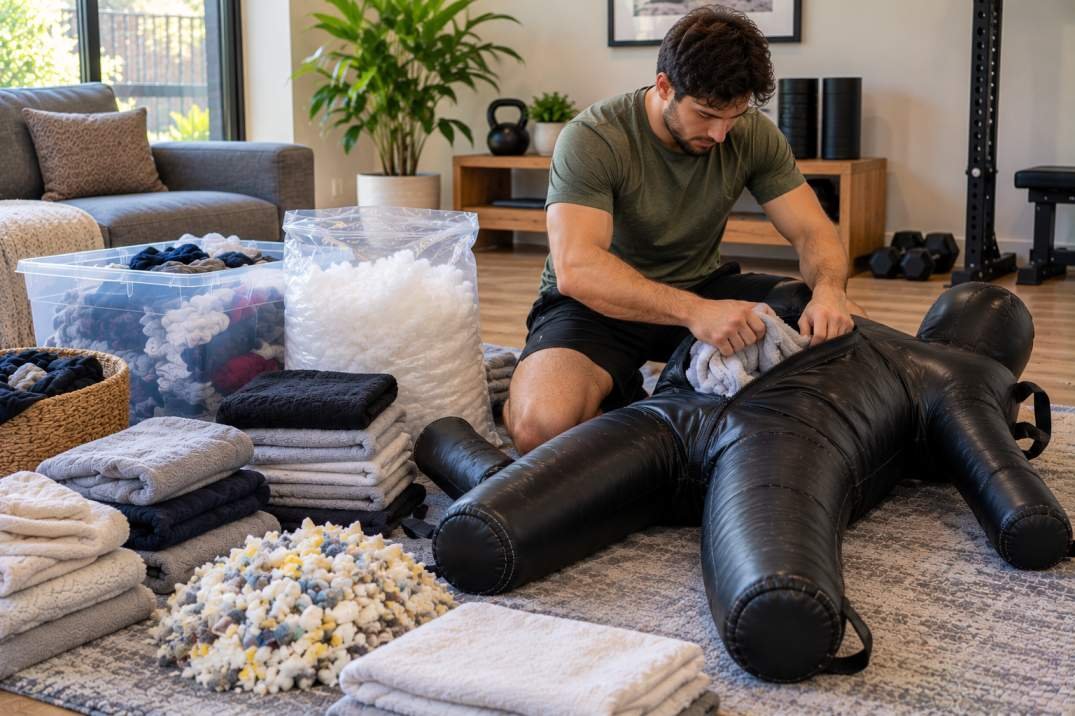
There is no single best filler for every grappling dummy. The right material depends on the dummy's construction, manufacturer instructions, desired firmness, weight and availability. Soft textile materials are commonly considered for compatible unfilled dummies, but the manufacturer's filling guidance should always take priority over general recommendations.
Never place objects or materials inside a dummy that could damage the shell, create hazardous pressure points, or conflict with the manufacturer's instructions. Not every filler works with every dummy — check compatibility before filling.
What Is Grappling Dummy Filler?
Grappling dummy filler is the material placed inside an unfilled dummy to give it shape, weight and firmness. It's a different question from the dummy's outer shell — the cover material the dummy is constructed from. Choosing the filler is different from choosing the dummy's outer material: the shell is what you grip and train against, while the filler is what gives that shell its internal shape, density and feel. For more on the shell side of this, see best material for a grappling dummy.
Some grappling dummies are sold pre-filled and ready to use; others are sold unfilled or partially filled and designed for the buyer to fill themselves. Which category a specific dummy falls into — and what filler it's compatible with — is set by the manufacturer, not by the general category of "grappling dummy." Always check the product listing or manufacturer instructions before assuming either way.
What Can You Fill a Grappling Dummy With?
A high-level look at commonly considered filler categories. Not every material is suitable for every dummy — this is a starting point for research, not a blanket endorsement.
Old Clothing
Commonly available and reusable; can compress and settle unevenly over time depending on volume and fabric type.
Towels
Denser and more uniform than loose clothing in many cases; behavior varies by thickness and how tightly packed.
Blankets
Can add bulk quickly; density and compressibility depend heavily on the specific blanket material.
Fabric Scraps
Useful for filling smaller gaps or fine-tuning density, but inconsistent as a sole filler on their own.
Foam
Type-dependent characteristics; some dummies are specifically designed around foam construction, others are not.
Shredded Textiles
Can offer more even distribution than whole garments, depending on shred size and material.
Soft Household Textiles
A broad category — suitability depends on the specific material's density, moisture behavior and manufacturer compatibility.
Purpose-Made Filling
Manufacturer-approved filling products, where available, are generally the most predictable option for a specific dummy.
Manufacturer-Approved Options
Always check whether the manufacturer specifies or supplies a recommended filler before substituting your own.
Best Grappling Dummy Filler Materials Compared
General characteristics only — actual behavior depends on the specific material and the dummy's construction.
| Filler Type | Availability | Firmness | Weight Potential | Compression/Settling | Cost | Main Consideration |
|---|---|---|---|---|---|---|
| Old clothing | High — often already on hand | Soft to medium, depending on packing | Moderate; requires significant volume | Can settle and compress over time | Low | Consistency varies with how tightly it's packed |
| Towels | High | Medium, more uniform than loose clothing | Moderate to high depending on thickness | Some settling, generally more even | Low–Moderate | Thickness and folding method affect density |
| Blankets | Moderate–High | Varies widely by material | Can add bulk quickly | Depends heavily on blanket type | Low–Moderate | Material composition varies a lot between blankets |
| Fabric scraps | Moderate | Variable, good for fine-tuning | Low to moderate on their own | Can shift and clump if not distributed carefully | Low | Best used to supplement another main filler |
| Foam (type-dependent) | Moderate — check compatibility first | Firmer, more resilient in many cases | Lower weight-per-volume in most cases | Generally less compression than textiles | Moderate | Only for dummies specifically designed around foam filling |
| Manufacturer-approved filler | Depends on product availability | Consistent, by design | Predictable, per manufacturer spec | Behavior verified by the manufacturer | Varies | Generally the most reliable option where available |
Clothing as Grappling Dummy Filler
Clothing is one of the most commonly considered filler options because it's widely available, reusable, relatively inexpensive, and easy to add gradually as you build up the fill. For compatible unfilled dummies, this makes it a practical starting point.
Potential drawbacks include compression over time, uneven settling if not packed consistently, variable density between different garments, and the sheer volume of clothing needed to fill a full-sized dummy. Clothing is not automatically suitable for every dummy — check manufacturer instructions before relying on it as your primary filler.
Towels, Blankets and Other Fabric Materials
Towels tend to be denser and more uniform in shape than loose clothing, which can make for more even distribution, though thickness and how tightly they're rolled or folded still matter. Blankets can add bulk quickly but vary widely in density and compressibility depending on the specific material — a heavy quilted blanket behaves very differently from a thin fleece throw. Fabric scraps are generally more useful for filling gaps and fine-tuning density than as a sole filler, since consistency is harder to control with irregular pieces.
Across all of these, the ability to form consistent limb shapes and resist settling depends on the specific fabric's density and how carefully it's packed — not on the fact that it's "fabric" as a category.
Foam as Grappling Dummy Filler
Foam covers a wide range of types with different softness, resilience, compression and density characteristics, and general foam behavior doesn't tell you whether a specific foam works for a specific dummy. Some dummies are specifically designed and constructed around foam filling; others are built for textile-based filling and may not be compatible with foam at all.
We're not recommending a specific foam type here, since compatibility has to be verified against the individual product's construction and manufacturer guidance. If a manufacturer specifies or supplies an approved foam option, that's the safest starting point.
Mixed Filler Materials
Combining materials — for example, a denser textile base with fabric scraps to fill gaps — can help adjust firmness, improve consistency, make use of available materials, or balance weight against volume. It's a reasonable approach within manufacturer-compatible materials.
Potential problems include uneven density between different sections, inconsistent firmness if materials aren't distributed thoughtfully, and difficulty redistributing the mix later if it settles unevenly. We're not providing a specific stuffing recipe here, since the right mix depends on the individual dummy's construction and what the manufacturer has verified as compatible.
What Makes a Good Grappling Dummy Filler?
"Best" depends on the result you want — evaluate candidate materials against these factors together.
- Compatibility — confirmed suitable for your specific dummy by the manufacturer.
- Safety — no sharp, rigid, or hazardous components.
- Density — affects both weight and firmness.
- Compressibility — how much the material flattens under repeated pressure.
- Consistency — how evenly the material distributes and stays distributed.
- Weight — how much the chosen volume and density will add.
- Firmness — the training feel the material produces.
- Durability — how well the material holds up to repeated compression.
- Availability — how easily you can source or replace it.
- Cost — relative to alternatives.
- Hygiene/storage — how the material handles moisture and long-term storage.
- Manufacturer guidance — the single most important factor when it's available.
How Filler Changes Grappling Dummy Feel
Filler characteristics affect firmness, overall weight, how well the dummy retains its shape over time, how limbs and torso feel under grip, how compressible the dummy is under pressure, and how stable it feels during positional work. A dummy filled densely and evenly will generally feel more consistent to train against than one with uneven pockets of dense and loose material, regardless of which specific filler was used.
Soft vs Firm Grappling Dummy Filling
Softer filling is generally more compressible, may feel less rigid under grip, and can settle differently over time than firmer material. Firmer filling is generally less compressible, may maintain shape more consistently, and can change the overall training feel compared with a softer fill. Neither is universally better — the right choice connects to the dummy's construction, what you're training for, and, above all, the manufacturer's guidance for that specific product.
How Heavy Should a Filled Grappling Dummy Be?
Filler selection affects final weight through a simple relationship: filler density and total fill volume determine the final weight, which in turn affects the training feel. This page doesn't set a target weight — that decision depends on your training goals and body size, and it's covered in what weight grappling dummy should I get. Here, the relevant point is only that your filler choice is one of the levers that determines where the finished weight lands.
Does Grappling Dummy Filling Settle Over Time?
Many fillers compress or settle to some degree with repeated use, which can change the dummy's shape and require occasional redistribution or topping up. How much this happens depends on the specific material, how much was used, the dummy's construction, how heavily it's trained on, and how it's stored between sessions — it's not accurate to say every filler settles at the same rate or to the same degree.
How to Avoid an Unevenly Filled Grappling Dummy
At a high level, avoiding uneven filling comes down to using reasonably consistent material, distributing it gradually rather than in large dense clumps, checking the dummy's shape periodically as you fill it, and following the manufacturer's instructions for the specific product. For the detailed step-by-step process, see how to fill a grappling dummy, which covers the procedure itself in depth.
What Filler Materials Should You Avoid?
Rather than a speculative list of banned materials, evaluate any candidate filler against these risk factors: sharp edges that could damage the shell from the inside, rigid objects that could create hazardous or uncomfortable pressure points, materials that retain excessive moisture, unusually dense materials that could concentrate weight unsafely, materials with chemical or irritant risk, materials prone to degrading quickly, and anything the manufacturer specifically restricts for your dummy.
Bottom line: never place objects or materials inside a dummy that could damage the shell, create hazardous pressure points, or conflict with the manufacturer's instructions.
Can You Use Household Materials to Fill a Grappling Dummy?
Sometimes, depending on the dummy's design and manufacturer guidance. Household textiles are commonly considered because they're inexpensive and already on hand, but not every household material is appropriate — "anything soft" is not the same as "compatible and safe." Check the specific material against the risk factors above and the manufacturer's instructions before using it.
DIY Filling vs Buying a Pre-Filled Grappling Dummy
| Factor | DIY / Unfilled | Pre-Filled |
|---|---|---|
| Cost | Filler cost is often low if using materials on hand | Filling cost is built into the purchase price |
| Convenience | Requires time and effort to fill | Ready to use out of the box |
| Customization | More control over firmness and weight, within compatible materials | Fixed by the manufacturer |
| Weight control | Adjustable by adding or removing filler, where the design allows | Generally fixed at time of purchase |
| Shipping/handling | Lighter to ship unfilled | Heavier to ship, depending on the model |
| Time required | Filling takes time and effort | No filling time needed |
| Consistency | Depends on your filling technique | Generally consistent, manufacturer-controlled |
For the fuller purchasing decision between filled and unfilled models, see filled vs unfilled grappling dummy.
Grappling Dummy Filler for BJJ
For BJJ-oriented ground training, positional practice and transitions, filler choice mainly affects how the dummy feels to hold, move and reposition — a firmer fill can feel more stable for sustained positional work, while a softer fill may feel more forgiving during frequent repositioning. This section is about how filler affects the training object itself, not a drills resource — for BJJ-specific dummy drilling, see BJJ dummy drills.
Grappling Dummy Filler for Wrestling
Wrestling-oriented use may create a preference for firmer, more consistent filling given the more dynamic loading involved in wrestling-style drilling, though suitability for that kind of use is set by the dummy's overall construction, not filler choice alone. For wrestling-specific drilling guidance, see wrestling takedown drills and wrestling training at home.
Grappling Dummy Filler for Beginners
How to Fill a Grappling Dummy
At a high level: prepare the dummy per the manufacturer's instructions, choose a compatible material, distribute the filling gradually and evenly, check the shape as you go, and adjust as needed. That's the overview — the detailed step-by-step process, including distribution technique and finishing steps, is covered in how to fill a grappling dummy.
How to Choose the Right Grappling Dummy Filler
Comparing filled and unfilled options?
Browse BJJ grappling dummies and check each listing's filling specifications before buying.
Common Grappling Dummy Filling Mistakes
- Ignoring manufacturer instructions — the single most avoidable mistake.
- Using incompatible materials — not every filler suits every dummy's construction.
- Choosing filler based only on weight — ignoring firmness, consistency and compatibility.
- Creating dense lumps — leads to uneven shape and inconsistent feel.
- Ignoring settling — assuming the initial fill will stay exactly as packed.
- Overfilling — can stress seams and stitching beyond their design limits.
- Underfilling — leaves the dummy feeling unstable or poorly shaped.
- Ignoring the dummy's construction — assuming any filler works regardless of shell design.
- Failing to inspect the shell — missing early signs of stress or wear from the filling.
- Storing the dummy in unsuitable conditions — moisture and temperature extremes can affect both filler and shell.
Frequently Asked Questions
Direct answers to the questions people ask about grappling dummy filler.
What is the best filler for a grappling dummy?
There's no single best filler for every dummy. It depends on the dummy's construction, manufacturer instructions, desired firmness, weight and availability — check compatibility before choosing.
What do you fill a grappling dummy with?
Grappling dummies may be filled with compatible soft materials such as clothing, towels, blankets, fabric materials, or manufacturer-approved filling products, depending on the dummy's design.
Can I use old clothes to fill a grappling dummy?
Often, if the dummy is designed for textile filling and the manufacturer doesn't restrict it. Expect some compression and settling over time, and check compatibility first.
Can you fill a grappling dummy with towels?
Yes, for many compatible unfilled dummies. Towels tend to be denser and more uniform than loose clothing, though thickness and packing method still affect the result.
Can you use foam as grappling dummy filler?
Only for dummies specifically designed around foam filling. Foam types vary widely in density and compression, so compatibility must be verified for the specific product.
How much filler does a grappling dummy need?
This depends on the dummy's size, desired weight and desired firmness rather than one fixed amount — see what weight grappling dummy should I get for weight-specific guidance.
Does grappling dummy filling settle?
Many fillers compress or settle with use, though how much depends on the material, volume, construction and how the dummy is stored and trained on.
What makes a grappling dummy firm?
Denser, less compressible filler packed consistently generally produces a firmer feel, though the dummy's overall construction also plays a role.
Can I mix different filler materials?
Yes, within manufacturer-compatible materials — mixing can help adjust firmness or use available materials, but uneven density is a real risk if not distributed carefully.
Is it better to buy a filled or unfilled grappling dummy?
It depends on whether you prioritize convenience (filled) or customization and potential cost savings (unfilled) — see filled vs unfilled grappling dummy for the full comparison.
What is the best filler for a BJJ dummy?
There's no universal answer — it depends on the specific dummy's construction and your preferred training feel, evaluated against manufacturer guidance.
Can I change the filling in a grappling dummy?
On some designs, yes, if the dummy allows access to the filling and the manufacturer doesn't restrict it. Check the specific product before attempting this.
What should I avoid using as grappling dummy filler?
Avoid sharp, rigid, excessively dense, moisture-retentive or chemically risky materials, and anything the manufacturer specifically restricts for your dummy.
How does filler affect grappling dummy weight?
Filler density and total fill volume together determine the final weight, which in turn affects the training feel.
Can household materials be used to fill a grappling dummy?
Sometimes, depending on the dummy's design and manufacturer guidance — not every household material is appropriate, so check compatibility rather than assuming any soft material works.
Shop BJJ & Grappling Training Equipment
Compare filled and unfilled options directly against the guidance above before buying.
This guide provides general information to help compare grappling dummy filler options and is not a substitute for a specific manufacturer's product documentation. No single filler is universally best — compatibility, firmness, weight and settling all depend on the individual dummy's construction. Always check the current product listing and manufacturer instructions before filling, refilling or storing any grappling dummy. Explore more at Home Gym Goals.