
Martial Arts Training Dummies: Types, Uses & Buying Guide
A plain-English guide to the whole category — what martial arts training dummies are, the main types, what each is used for, the factors that matter when buying, and how to choose the right one for your training.
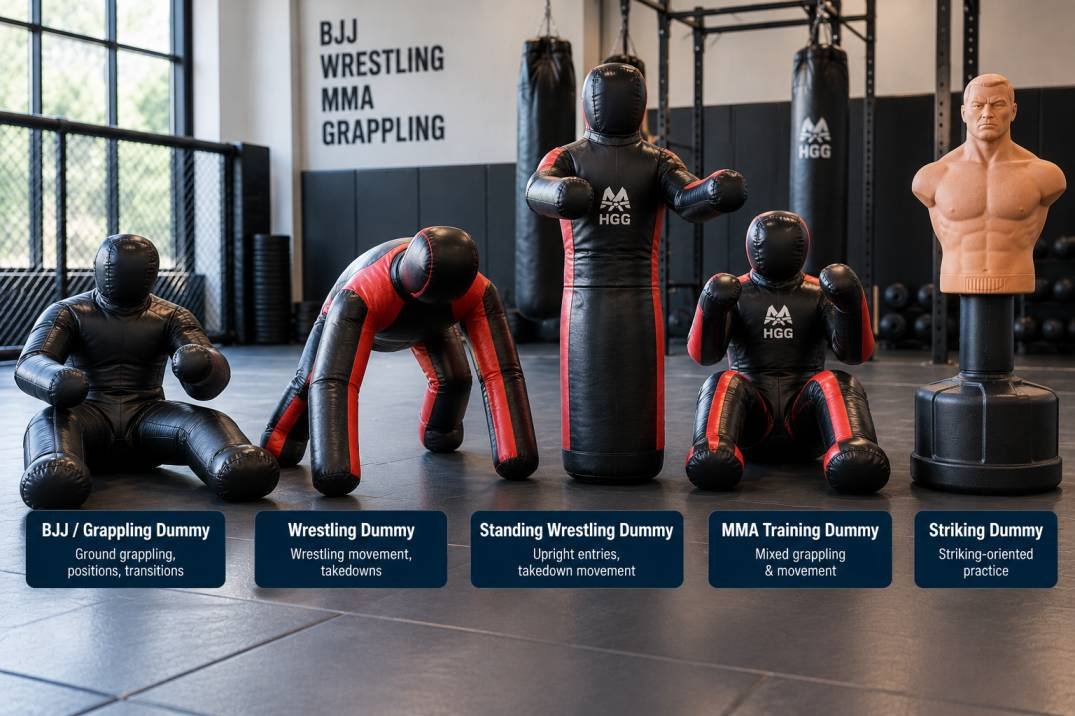
Martial arts training dummies are practice targets designed to help athletes rehearse movements, positioning, techniques and training patterns without a live partner. Different dummies are built for different purposes — grappling, BJJ, wrestling, MMA, standing practice and striking-oriented training. The best type depends on the martial art, the techniques being practised, the dummy's design, available space and the user's training goals.
What is a martial arts training dummy?
A martial arts training dummy is a human-shaped (or partly human-shaped) training tool used for solo practice — rehearsing techniques, repeating movements and familiarising yourself with body positioning without a live partner.
The key thing to understand up front: not all martial arts dummies are designed for the same purpose. Some are built for ground grappling, some for standing and takedown work, some for striking, and some for a mix. "Martial arts training dummy" is a broad umbrella, and the useful question is always which design suits the training you actually do. This guide maps the category; the specialized guides linked throughout go deeper on each type.
What are martial arts training dummies used for?
Broadly, across designs, they support solo, repeatable practice:
- Technique repetition — grooving a movement through volume.
- Movement practice — the motions of your sport, on your own time.
- Positioning — organising yourself around a body shape.
- Transitions — flowing between positions, where the design allows.
- Solo training and drilling — practice without a partner present.
- Training outside class — reinforcing what you learn with a coach.
- Familiarisation with body positioning — building spatial awareness.
Exactly which of these a given dummy does well depends on its design — a standing striking dummy and a ground grappling dummy serve very different sessions.
Types of martial arts training dummies
The main categories at a glance. Terminology varies between manufacturers, so treat these as broad groupings rather than strict standards.
| Dummy type | Main training focus | Typical users |
|---|---|---|
| BJJ / grappling dummy | Ground grappling, positions, transitions | BJJ, submission grapplers |
| Wrestling dummy | Wrestling movement, takedowns | Wrestlers, MMA |
| Standing wrestling dummy | Upright entries, takedown movement | Wrestlers, standing grapplers |
| MMA / grappling dummy | Mixed grappling & movement | MMA athletes |
| Striking dummy | Striking-oriented practice | Boxing, kickboxing, martial arts |
| Specialized designs | Application-specific shapes | Varies by manufacturer |

BJJ / grappling dummies
Generally designed for ground grappling — positional practice, transitions and solo technical repetition. Usually humanoid and mat-oriented. See the BJJ & grappling dummy range for this category.
Wrestling dummies
Built around wrestling movement and takedown-related practice, in standing or ground orientations depending on the design. For how a wrestling dummy crosses over to BJJ specifically, see wrestling dummy for BJJ.
Standing wrestling dummies
Designed for upright practice — standing entries and takedown-related movement. (A dedicated standing-wrestling-dummy guide is planned as a separate resource.)
MMA training dummies
Aimed at mixed martial arts, usually grappling-oriented, with some models supporting multiple training orientations. Capabilities are design-specific, so check what any given model actually supports rather than assuming it covers every MMA technique.
Striking dummies / human-shaped striking targets
These differ from grappling dummies and are generally designed primarily for striking practice. They're a different tool for a different job — this guide focuses on the grappling side of the category rather than heavy-bag-style striking equipment.
Specialized martial arts dummies
Manufacturers sometimes create specialised shapes for specific training applications. These are worth judging on their stated intended use rather than the name alone.
Broad category vs specialized dummy
"Martial arts training dummy" is a category; "BJJ dummy," "wrestling dummy" and "standing dummy" are more specific types or designs within it. A rough semantic hierarchy:
Two caveats: these aren't strict industry classifications, and terminology varies by manufacturer. "Filled," for example, describes a dummy's internal configuration — not its training orientation. Always read the specific product's stated design and intended use.
Martial arts training dummies by sport
Potential dummy uses by discipline — suitability always depends on the training objective and the specific design.
| Martial art | Potential dummy use | Important limitation |
|---|---|---|
| Brazilian Jiu-Jitsu | Ground positions, transitions, submission positioning | No live resistance or reactions |
| Wrestling | Takedown entries, movement, body positioning | Full finishes are design-dependent |
| MMA | Grappling, control, transitions | Can't reproduce striking exchanges or live timing |
| Grappling (no-gi) | Positional and transition repetition | No grip fighting or unpredictability |
| Other martial arts | Varies; only where dummy practice fits the goal | Not every art has a suitable dummy use |
Are martial arts training dummies good for BJJ?
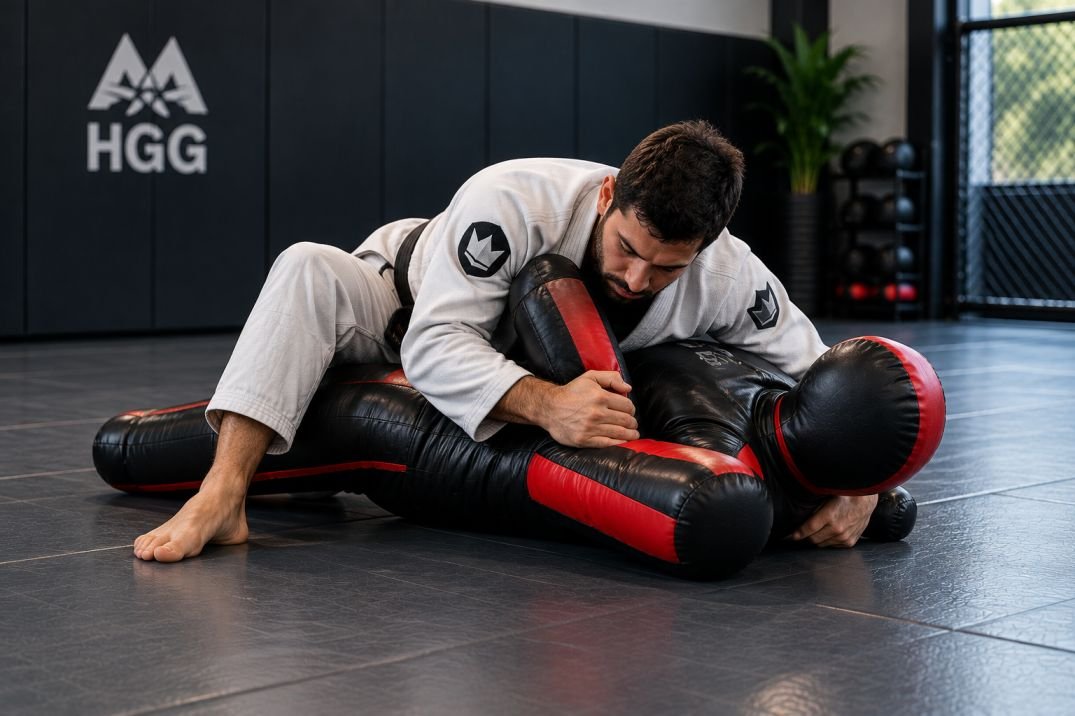
Yes — appropriate grappling/BJJ dummies can be useful for solo BJJ practice, including positional repetition, movement, transitions and technique rehearsal. They give you a body shape to organise around between classes.
This guide stays at category level; for the BJJ specifics, see the BJJ grappling dummy hub and our BJJ dummy drills for structured routines. A dedicated Brazilian Jiu-Jitsu training dummy guide is also planned.
Are martial arts training dummies good for wrestling?
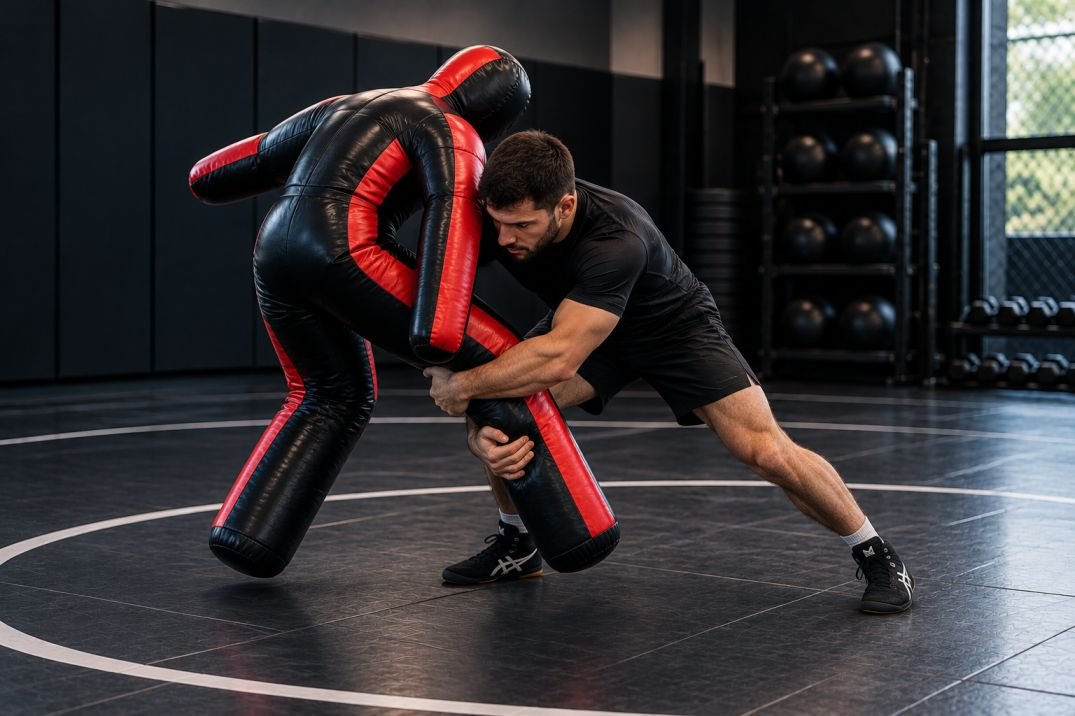
Yes — an appropriate wrestling dummy can help with solo repetition and wrestling-related movement, including standing practice, takedown concepts and body positioning. As always, the design decides how well it suits your specific drills.
For wrestling-focused work, see our wrestling dummy drills and takedown dummy drills; for the BJJ crossover, wrestling dummy for BJJ. (A standing-wrestling-dummy guide is planned separately.)
Are martial arts training dummies good for MMA?
Some dummies can support MMA-oriented grappling and movement practice — ground control, transitions and positional repetition. But don't assume any single dummy supports every MMA technique: striking exchanges, live timing and defensive reactions aren't things a dummy can reproduce. Match the dummy to the grappling side of your MMA training, and keep striking equipment separate. Our MMA grappling drills cover the grappling side.
Standing vs ground-oriented training dummies
One of the most important practical distinctions in the whole category. High-level tendencies below — always confirm against the specific product.
| Feature | Standing-oriented | Ground / grappling-oriented |
|---|---|---|
| Primary position | Upright | On the mat |
| Standing practice | Strong | Varies |
| Takedown work | Strong, if rated | Design-dependent |
| Ground practice | More limited | Often stronger |
| Positional work | Design-dependent | Often stronger |
| Storage | Varies | Varies |
| Space | Needs upright room | Needs mat space |
| Typical use | Standing & takedowns | Ground & positional grappling |
For the full category comparison, see grappling dummy vs wrestling dummy.

What should you look for in a martial arts training dummy?
The factors that decide whether a dummy fits your training. There's no universal "best" figure for any of these — it depends on you and your sport.
- Intended training style — standing, ground, striking or mixed.
- Dummy shape — humanoid and limbed for grappling; upright for standing work.
- Size — relative to your body and your space.
- Weight — affects stability, handling and feel.
- Stability — how it holds position during your drills.
- Outer construction — the cover material and stitching.
- Internal filling — firmness and feel.
- Durability — how it holds up to your training volume.
- Refillability — whether you can top it up as it settles.
- Storage — where it lives between sessions.
- Available training space — the room you actually have.
- Manufacturer guidance — the stated intended use, which defines what's safe.
For a deeper walk-through of these choices, see how to choose a grappling dummy.

Does size matter?
Yes. The relevant considerations are your body size, the intended training, the dummy's proportions, your available space and the manufacturer's specifications. A dummy closer to your own training dimensions can feel more representative; a smaller one is easier to store and move. For the details, see what size grappling dummy to buy.
Does weight matter?
Yes. Weight can influence stability, movement, handling and training feel — a heavier dummy resists movement more but is harder to reposition and store. There's no universal correct figure; it depends on your size, strength and drills. See what weight grappling dummy to get for more.
Filled vs unfilled martial arts dummies
A quick orientation — the dedicated guide goes deeper.
- Filled — arrives ready to use, convenient, less setup.
- Unfilled — requires filling, allows more control over weight and firmness, and may have different shipping and storage implications.
Neither is automatically better — it depends on whether you value convenience or control. For a full breakdown, see filled vs unfilled grappling dummy.
What materials are used?
It helps to separate the outer material (the cover — often synthetic leather, vinyl or canvas, depending on the product) from the internal filler (what gives the dummy its shape and weight). Construction varies widely between products, and there's no single "best" material — it's a trade-off between durability, feel and cost.
For the filler side specifically, see our grappling dummy filler guide. (A dedicated best-material guide is planned separately.)
How are martial arts dummies filled?
A short overview — the detailed how-to lives on the dedicated pages.
- Some arrive pre-filled and ready to use.
- Some arrive unfilled for you to fill yourself.
- Some are refillable, so you can top them up as the filling settles.
- Some have manufacturer-specific requirements worth following.
For the practical detail, see how much filling a grappling dummy needs. (Step-by-step fill and refill guides are planned separately.)
Can a martial arts dummy replace a training partner?
No. This is the most important thing to understand before buying. A dummy cannot reproduce:
- Live resistance and reactions
- Timing and balance against a moving opponent
- Grip fighting and unpredictable movement
- Coaching feedback and decision-making under pressure
A dummy is a tool for repetition and familiarisation. It supplements live training and coaching — it never replaces them.
Are martial arts training dummies worth it?
They can be genuinely worthwhile for solo practice, home training, repetition and supplemental work — especially for athletes who understand their limitations and want to reinforce what they learn in class.
They're less suitable if you expect live resistance, realistic reactions, or complete skill development without partners. Set expectations correctly and a well-matched dummy is a useful addition to a home setup; expect it to replace the mat and it will disappoint.
Martial arts training dummies for home gyms
Practical factors that decide whether a dummy works in your space.
- Floor space and mats — a suitable, safe surface to train on.
- Storage — where it lives between sessions.
- Noise — worth considering in shared or upstairs spaces.
- Dummy weight and portability — can you move it easily?
- Training frequency — how often it'll actually be used.
- A safe environment — enough clear room for the movements.

How to choose the right martial arts training dummy
Work through these in order — each answer narrows the field.
- What martial art are you training?BJJ, wrestling, MMA, or a mix.
- Standing or ground practice?The single biggest design factor.
- What techniques or movements?Match the shape to the drills.
- What size and weight suit you?Relative to your body and space.
- What filling / configuration?Filled for convenience, unfilled for control.
- How much space do you have?Floor, storage and clearance.
- Does the manufacturer support your use?The stated intended use is the limit.
- Budget and maintenance?Including refilling and durability expectations.
Martial arts training dummy comparison
The main types side by side. Nuanced tendencies, not product ratings.
| Dummy type | Main use | Best for | Main limitation |
|---|---|---|---|
| BJJ / grappling dummy | Ground grappling | Positional & submission-position work | No live resistance |
| Wrestling dummy | Wrestling movement | Takedown-related practice | Ground use is design-dependent |
| Standing dummy | Upright practice | Entries & standing movement | Limited for ground work |
| MMA / grappling dummy | Mixed grappling | Ground control & transitions | No striking or live timing |
| Specialized dummy | Application-specific | The stated purpose | Narrower use case |
Explore BJJ and grappling training dummies from Home Gym Goals
Home Gym Goals provides BJJ and grappling dummy options for anyone looking to add solo grappling practice to a home-gym setup. If you've worked out that a grappling-oriented dummy fits your training, the BJJ grappling dummy hub is the place to compare designs and match one to your drills.
Standing BJJ Grappling Dummy
$149.00 – $199.00 · In stock
As one example of a standing-oriented option, the standing BJJ grappling dummy (model WG-D1023) is a standing, human-shaped training dummy the listing describes as suitable for BJJ, MMA, boxing, wrestling and kickboxing. Per the product page, its confirmed details are:
- Design: standing, human-shaped, lace-up closure
- Sizes: 4 FT, 5 FT and 6 FT
- Material: synthetic leather, with nylon, fabric and cotton
- Filling: cotton and mixed materials
- Weight: approximately 2 kg
- Listed applications: BJJ, MMA, boxing, wrestling and kickboxing
Details above reflect the current product listing only. Confirm size, colour, price and availability on the product page before ordering, as listings can change.
Buying decision tree
A fast way to narrow the category down to a type. These are prompts to "consider," not universal rules.
Find the right dummy for your training
Once you know your martial art and whether you train standing or on the ground, the rest is matching the design. Start with the grappling range.
Frequently asked questions
Short, direct answers to the questions people ask about the category.
What is a martial arts training dummy?
A human-shaped training tool used for solo practice — rehearsing techniques, repeating movements and learning body positioning without a live partner. Different designs suit different martial arts and training styles.
What are martial arts training dummies used for?
Technique repetition, movement practice, positioning, transitions, solo drilling and training outside class. The exact applications depend on the dummy's design — grappling, standing or striking-oriented.
What types of martial arts dummies are available?
The main types are BJJ/grappling dummies, wrestling dummies, standing wrestling dummies, MMA/grappling dummies and striking dummies, plus specialised designs. Terminology varies by manufacturer.
What is the difference between a grappling dummy and a martial arts dummy?
"Martial arts dummy" is the broad category; a grappling dummy is a specific type within it, designed for grappling practice. Other martial arts dummies may be built for standing or striking-oriented work instead.
Can you use a martial arts dummy for BJJ?
Yes — an appropriate grappling or BJJ dummy suits solo BJJ practice, including positional repetition, movement and transitions. It supplements live training rather than replacing it.
Are wrestling dummies good for BJJ?
They can be, especially for standing and takedown-related practice; for ground-heavy BJJ a grappling-oriented dummy is often more suitable. It depends on the dummy's shape and intended use.
What type of dummy is best for BJJ?
For ground-focused BJJ, a grappling/BJJ dummy designed for mat work is usually the most natural fit. Match the shape and flexibility to the positions and submissions you want to drill.
What type of dummy is best for wrestling?
A wrestling or standing wrestling dummy designed for the takedown and movement work you do — confirm it's rated for any full takedown or throwing movements you intend to practise.
Are standing martial arts dummies useful?
Yes for standing work — entries, clinch and takedown movement. They're generally less practical for extended ground practice, since upright designs aren't built to be worked with flat on the mat.
Are filled martial arts dummies better?
Not automatically. "Filled" means ready to use and convenient; unfilled gives you control over weight and firmness. Neither is inherently better — it depends on whether you value convenience or control.
Can a martial arts training dummy replace a training partner?
No. A dummy can't provide live resistance, reactions, timing, grip fighting, unpredictability or coaching feedback. It's a repetition tool that supplements live training, never a replacement.
Are martial arts training dummies worth it?
They can be, for solo repetition, home training and supplemental work, provided you understand their limits. They're not worth it if you expect realistic resistance or a full replacement for partners.
What should I look for when buying a martial arts training dummy?
Your training style (standing/ground), the dummy's shape, size and weight, construction and filling, durability and refillability, storage and space, and the manufacturer's stated intended use.
Explore the specialized guides
Once you know your type, these go deeper than this category overview.
This guide provides general category-level information about martial arts training dummies; it is not product-specific advice except where clearly attributed to a verified product listing. Dummy type names are broad categories, not technical standards — actual capabilities, dimensions, weight, materials and intended use vary by product and should be confirmed against the manufacturer's documentation and the live product listing. Use appropriate mats and space, inspect equipment, follow the manufacturer's instructions, use equipment only for its intended purpose, and stop using damaged equipment. Beginners should learn techniques from qualified instructors; a dummy supplements live practice and cannot provide live resistance, reactions or coaching. No equipment is injury-proof. Explore more at Home Gym Goals.