
Filled Wrestling Dummy: Buying and Training Guide
A "filled" listing sounds simple, but what it actually includes — weight, density, filling material, how much is really packed in — varies a lot between manufacturers. Here's what "filled" means in practice, what to check before buying, and how a filled wrestling dummy fits into wrestling, BJJ and MMA training.
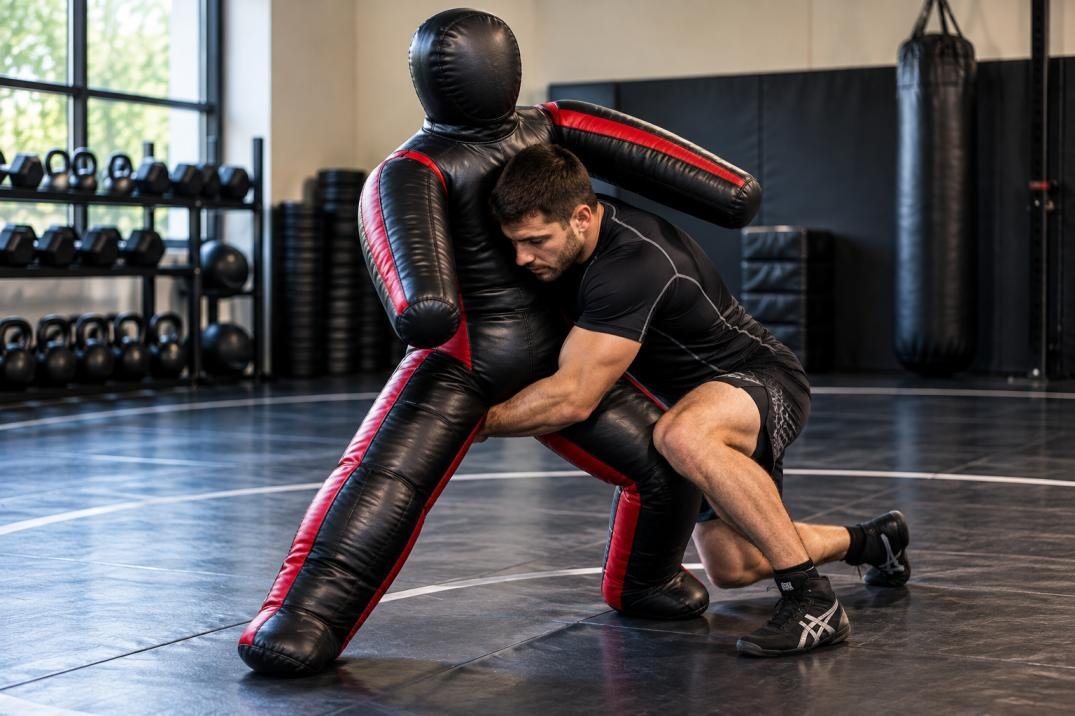
A filled wrestling dummy is a training dummy sold with its body already filled, so it's generally ready to train with out of the box rather than requiring the buyer to fill it themselves. Buyers often prefer this for convenience and a manufacturer-defined starting configuration. The main tradeoff is less control over final weight and firmness compared with an unfilled dummy you fill yourself — and "filled" can mean different things across different manufacturers, so the specific listing still matters.
Not every "filled" dummy has the same weight, density or filling material — always check the individual product listing rather than assuming based on the word "filled" alone. A dummy also doesn't replace live partner training or coaching; treat it as supplemental equipment.
Filled vs Unfilled Wrestling Dummy
| Factor | Filled Wrestling Dummy | Unfilled Wrestling Dummy |
|---|---|---|
| Ready to train | Usually yes | Requires filling first |
| Initial setup | Lower | Higher |
| Weight | Determined by manufacturer specification | Depends on buyer's filling choices |
| Convenience | Higher | More preparation required |
| Shipping | Can be heavier and more costly | Often lighter and easier to ship |
| Storage | Requires space immediately | Easier to store before filling |
| Customization | Usually less | Usually more |
| Main advantage | Convenience | Flexibility |
These are typical patterns, not universal rules — construction and shipping practices vary by manufacturer and model.
What Is a Filled Wrestling Dummy?
A filled wrestling dummy is a wrestling or grappling training dummy sold with its body already filled, rather than requiring the buyer to fill it after purchase. Construction typically includes an outer shell — the material you actually grip and train against — with internal filling that gives the dummy its shape, weight and firmness. Wrestlers, grapplers and home trainees buy filled dummies specifically to skip the filling step and get to training sooner.
Product designs vary significantly between manufacturers — some are built for standing use, some for ground-oriented work, and some for a hybrid of both. Don't assume every filled wrestling dummy shares the same construction, shape or intended use.
What Does "Filled" Mean on a Wrestling Dummy?
Filling is what creates the dummy's weight and form — different manufacturers can use different filling materials, and filling choices affect handling, firmness and total weight. A filled product generally arrives ready for use, subject to the manufacturer's own instructions and any care guidance for that specific model.
Importantly, "filled" isn't a single standardized configuration. Some products are fully filled, some partially filled, some filled to a specified weight, and some sold with a particular filling material as standard while offering others as an option. Always verify the individual product listing rather than assuming a fixed meaning behind the word.
What Can a Wrestling Dummy Be Filled With?
Common categories include textile scraps, foam, fabric, and other soft packing materials, though exactly what's used and how it performs depends on the specific product and manufacturer. No single filling material is universally best — each comes with its own trade-offs in firmness, weight and durability. For a full comparison of filler options, see grappling dummy filler: best materials and options; for the initial filling process on an unfilled dummy, see how to fill a grappling dummy.
Benefits of a Filled Wrestling Dummy
Ready to Train
Less preparation is required before your first session — no sourcing or packing filler material yourself.
Predictable Starting Weight
Where the manufacturer clearly specifies the filled weight, buyers get a clearer picture of what they're getting than with a self-filled dummy of unknown final weight.
Convenience
Useful for buyers who don't want to source filling materials themselves or don't have suitable materials readily on hand.
Faster Setup
The buyer can focus on training once the product arrives, rather than spending a session filling and shaping it first.
Less Guesswork
No need to decide how to fill the dummy initially — that decision has already been made by the manufacturer.
Disadvantages of a Filled Wrestling Dummy
- Heavier shipping — a filled dummy weighs more than the same model unfilled, which can affect shipping logistics.
- Potentially higher shipping costs where the retailer's shipping is weight-based — not a universal rule, but worth checking.
- Less customization — the filling configuration is generally set by the manufacturer rather than the buyer.
- Larger storage requirements immediately — there's no "flat pack" stage before it takes up its full usable volume.
- Potentially higher purchase cost, though this isn't universal — compare listings rather than assuming filled always costs more.
- Fixed or manufacturer-defined filling that may be harder to modify depending on construction.
What to Look for in a Filled Wrestling Dummy
1. Intended Training Use
Confirm whether the dummy is designed for wrestling, takedowns, grappling, BJJ, or MMA specifically — not every wrestling dummy is built to support every discipline equally well.
2. Filled Weight
Weight affects handling, how realistic the dummy feels relative to your own size, and whether it suits your training goals and available space. For weight-selection guidance beyond this buying context, see what weight grappling dummy should I get.
3. Size
Size affects realism, storage needs, handling and how much training space you'll need. See what size grappling dummy should I buy for a dedicated breakdown.
4. Material
Outer material affects durability, surface feel and how easily the dummy cleans up, and different materials suit different training environments. See best material for a grappling dummy for the full comparison.
5. Construction
Check stitching, seams, reinforcement, closures and stress-point durability where the listing provides that detail — only trust product-specific construction claims when they're actually verified in the listing.
6. Filling Material
Check whether the manufacturer identifies the filling type, filling weight, filling density, and whether the filling can be adjusted later if it settles with use.
7. Body Configuration
Check whether the dummy is designed as standing, ground-oriented, or a hybrid of both — this affects which training applications it actually supports.
8. Storage Requirements
A filled dummy occupies its usable volume immediately, unlike an unfilled one that can be compacted before filling. Consider floor space, storage area, and how you'll move or transport it.
9. Manufacturer Information
Prefer listings with clear information on dimensions, weight, material, filling, intended use, warranty and returns — vague listings make it harder to judge whether the product actually fits your needs.
Is a Filled Wrestling Dummy Good for Wrestling?
A suitable filled wrestling dummy can support takedown practice, body positioning work, movement rehearsal, and controlled solo repetitions between partner sessions. For detailed wrestling drilling using a dummy, see wrestling dummy drills and wrestling takedown drills.
Can You Use a Filled Wrestling Dummy for BJJ?
It depends on the specific dummy's body configuration, flexibility and limb positioning. A wrestling-oriented dummy built primarily for standing work may be less suited to ground-heavy BJJ practice than a dummy specifically designed for ground positional training. Not every wrestling dummy is suitable for BJJ — check body configuration and intended use before assuming crossover. For BJJ-specific dummies, see wrestling dummy for BJJ or browse BJJ grappling dummies directly.
Can a Filled Wrestling Dummy Be Used for MMA?
A suitable dummy can support takedown practice, grappling and ground movement, and positional practice relevant to the grappling side of MMA. It does not automatically replace a heavy bag, dedicated striking equipment, or live partner training — MMA combines striking and grappling, and a dummy addresses only the grappling portion.
How to Train With a Filled Wrestling Dummy
At a high level, useful categories include movement rehearsal, takedown mechanics practiced at a controlled pace, positional transitions, controlled repetition drills, solo wrestling movement, and general grappling movement patterns. For detailed, drill-by-drill guidance, see wrestling dummy drills — this section stays at the buying-guide level rather than duplicating that content.
Can a Filled Wrestling Dummy Replace a Training Partner?
No. A dummy cannot reproduce live resistance, reactions, timing, grip fighting, balance changes, unpredictable movement, coaching feedback, or live rolling. It's supplemental training equipment that supports solo repetition and positional familiarity — not a substitute for training with another person.
Should You Buy a Filled or Unfilled Wrestling Dummy?
These are general tendencies, not fixed rules — product construction varies enough that it's worth checking the specific listing either way. For the fuller purchasing comparison, see filled vs unfilled grappling dummy.
What About Shipping a Filled Wrestling Dummy?
Filled products are heavier than their unfilled counterparts, and heavier products can mean higher shipping costs or more limited shipping options depending on the retailer. Packaging may also be larger. Plan your storage space before purchase rather than after delivery. We're not stating specific shipping prices here — verify current shipping policies directly with the retailer or manufacturer for your order.
Is a Filled Wrestling Dummy Good for Home Training?
For many home trainees, the convenience of a ready-to-use setup is a real advantage — no filling step, no guessing at final weight. That said, it isn't automatically suitable for every home: consider available floor space, whether you have a suitable mat, storage between sessions, potential noise or impact considerations for shared or upstairs spaces, and whether your training area is genuinely safe for contact drilling.
Who Should Consider a Filled Wrestling Dummy?
- Wrestlers who want a ready-to-use solo training tool
- Grapplers supplementing partner and coached training
- BJJ practitioners considering crossover training, where body configuration suits their needs
- MMA practitioners working on the grappling side of their training
- Home trainees who don't want to source or manage filling materials themselves
- Beginners supplementing coached training with solo repetition
These are cases where a filled dummy may be useful — not a claim that it's the right choice for every reader in these categories.
Who May Want a Different Training Option?
- Buyers who want fully customizable weight and firmness — an unfilled dummy may suit better
- Those with limited storage who'd prefer to manage bulk before committing to a filled configuration
- Anyone whose primary need is striking equipment rather than grappling practice
- Those expecting live resistance from their equipment — no dummy provides this
- Practitioners who already have consistent, adequate partner training and don't need supplemental solo equipment
Filled Wrestling Dummy Buying Checklist
Comparing filled wrestling and grappling dummies?
Explore the Home Gym Goals BJJ and grappling dummy collection and review each product's current specifications before choosing.
Common Mistakes When Buying a Filled Wrestling Dummy
- Buying based only on the word "filled" — without checking what that actually means for the specific listing.
- Ignoring actual weight — assuming "filled" implies a specific weight without confirming it.
- Ignoring dimensions — leading to storage or training-space surprises after delivery.
- Assuming all dummies have the same filling — filling material and density vary by manufacturer.
- Assuming a wrestling dummy is automatically ideal for BJJ — body configuration matters.
- Ignoring storage space — a filled dummy takes up its full volume immediately.
- Ignoring shipping considerations — heavier filled products can affect delivery logistics.
- Assuming a heavier dummy is always better — the right weight depends on your training goals and size, not a maximum.
- Ignoring manufacturer specifications — vague listings make it hard to know what you're actually getting.
- Expecting the dummy to replace live training — it's a supplement, not a substitute for a partner or coaching.
Frequently Asked Questions
Direct answers to the questions people ask about filled wrestling dummies.
What is a filled wrestling dummy?
A wrestling or grappling training dummy sold with its body already filled, so it's generally ready to use out of the box rather than requiring the buyer to fill it.
What is a wrestling dummy filled with?
Common filling categories include textile scraps, foam, and other soft packing materials, though the specific material varies by manufacturer and model.
Is a filled wrestling dummy better than an unfilled one?
Not universally — filled dummies offer convenience and a predefined configuration, while unfilled dummies offer more customization over weight and firmness. The better choice depends on your priorities.
Are filled wrestling dummies worth it?
For buyers who want to train immediately without sourcing filling materials, many find the convenience worthwhile — but this depends on your specific needs and the product's actual specifications.
Can you use a filled wrestling dummy for BJJ?
Depending on its body configuration and flexibility — a dummy built for standing wrestling work may be less suited to ground-heavy BJJ than one designed specifically for ground positional training.
Can you use a wrestling dummy for MMA?
For the grappling and takedown portion of MMA training, yes, depending on the model — it doesn't cover striking or replace a heavy bag.
How heavy should a wrestling dummy be?
This depends on your training goals, size and available space rather than one universal figure — see our dedicated weight-selection guide for more detail.
Is a filled wrestling dummy good for home training?
Often, for its ready-to-use convenience — but confirm you have adequate floor space, a suitable mat, and storage before buying.
How do you store a filled wrestling dummy?
Plan for its full usable volume immediately, since it can't be compacted like an unfilled dummy — consider available floor space and how you'll move it if needed.
Can a wrestling dummy replace a training partner?
No. It cannot reproduce live resistance, reactions, timing or coaching feedback — it supports solo repetition as a supplement to partner training, not a replacement for it.
Shop BJJ & Grappling Training Equipment
If you're comparing filled wrestling and grappling dummies for home training, review each product's current specifications before choosing.
This guide provides general information to help evaluate filled wrestling dummies and is not a substitute for a specific manufacturer's product documentation. "Filled" can mean different things across different products — always verify weight, dimensions, material and filling type on the current product listing before buying. A training dummy does not replace live partner training or qualified coaching. Explore more at Home Gym Goals.