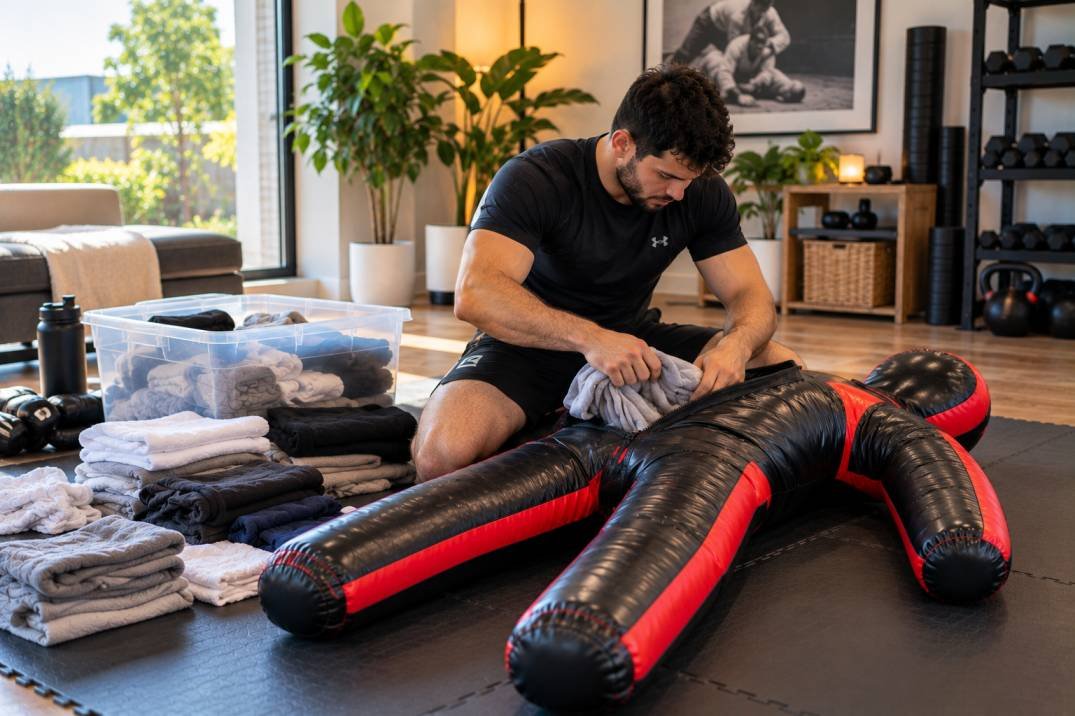
This isn't about filling a dummy from scratch — it's about what to do once a dummy you've already been training on starts feeling soft, lumpy, or hollow in places. Filling compresses and shifts with use; here's how to tell whether that's normal wear or a genuine sign your dummy needs attention, and how to restore its shape and firmness safely.
Home Gym Goals Editorial TeamPublished: August 2026 · Last updated: August 2026~13 min read
Settling is normal wear, not necessarily a defect — the question is whether it needs redistribution, more filler, or neither.
Quick answer
A grappling dummy may need refilling after its internal filling compresses or settles with use. If the dummy is designed to be opened, inspect the filling, redistribute compacted material where appropriate, and add compatible filler gradually until the dummy returns to the desired shape and firmness. Always follow the manufacturer's instructions, since refill access and recommended materials vary by model.
Before you do anything
Not every grappling dummy is designed to be opened and refilled. Never cut open a sealed dummy unless the manufacturer explicitly supports that procedure — check the product manual, manufacturer instructions, and warranty terms first. Use only compatible, non-hazardous filler materials, and stop using a dummy with damaged seams or closures.
Why It Happens
Why Does Grappling Dummy Filling Settle?
Filling compresses and shifts with repeated training over time — from repeated impact and pressure, gravity acting on the material during storage and use, general movement during drilling, and the natural characteristics of the filler itself, which may lose loft or compact under sustained load. Material can also redistribute toward lower sections of the dummy simply through repeated handling and gravity.
Settling by itself is not automatically a sign the dummy is defective — it's a normal part of how most filled training equipment behaves over time. What it can create is softer areas, sections that feel emptier than others, an uneven overall shape, reduced firmness, and a less consistent training feel than when the dummy was new.
Diagnosis
How Do You Know Your Grappling Dummy Needs Refilling?
Noticeably softer areas compared with the rest of the dummy.
Hollow-feeling sections, especially in limbs or the upper torso.
A shape that's become visibly distorted from its original form.
A lower body that feels disproportionately dense compared with the top.
An upper body that feels too empty relative to when it was new.
Limbs losing structure or flopping in ways they didn't before.
The dummy no longer holding its intended shape during normal handling.
A training feel that's changed significantly from what you're used to.
There's a difference between normal, gradual compression that slightly softens the dummy over time, and a genuine need to add more filler because a section has become noticeably hollow or the shape is clearly compromised. If it's the former, redistribution alone may solve it — see the comparison below.
Compatibility
Can Every Grappling Dummy Be Refilled?
No. Some dummies are specifically designed to be filled and refilled, with dedicated access openings and a manufacturer-supported procedure. Others are permanently sealed at the factory and are not intended to be opened. Some models require professional servicing rather than DIY refilling, and unauthorized modification may affect a product's warranty.
Before attempting anything, check the product manual, the manufacturer's instructions, the product specifications, and your warranty terms. Never cut open a dummy unless the manufacturer explicitly supports that procedure — doing so on a sealed design can damage the shell and void any warranty coverage.
Preparation
What Should You Do Before Refilling a Grappling Dummy?
Inspect the exterior for wear, tears or stress points
Check seams and closures for damage
Identify the refill opening, if your model has one
Review the manufacturer's instructions for your specific model
Determine whether the issue is settling or actual damage
Check whether existing filler has simply shifted rather than compressed
Prepare a clean, clear training area to work in
Have compatible filler on hand, if adding material
Keep track of what's removed or added where practical
Make sure the dummy is stable and supported during the process
Process
How to Refill a Grappling Dummy After It Settles
Check the dummy's refill accessAccess differs by model — some have zippers or panels, others may not be designed to open at all. Confirm this before proceeding.
Inspect the existing fillingLook for compacted material, empty pockets, uneven distribution, or filler that's degraded or otherwise no longer suitable.
Redistribute existing filling where appropriateSometimes the dummy doesn't need additional material at all — just moving compacted filler back into hollow areas can restore shape.
Add compatible filler gradually, if neededThere's no universal refill quantity — add small amounts at a time rather than assuming a fixed figure, and reassess as you go.
Shape the dummy as you goCheck overall shape, firmness, balance and limb structure after each addition, adjusting before adding more.
Close the dummy securelyFollow the manufacturer's specific closure method for your model.
Test carefullyUse controlled movements to assess whether shape is restored, firmness feels consistent, and filling stays distributed rather than immediately shifting again.
Should You Add More Filling or Redistribute the Existing Filling?
General possibilities, not universal diagnoses — always weigh these against what you actually observe in your specific dummy.
Problem
Likely Cause
Possible Solution
Soft upper body
Filling has migrated downward over time
Redistribute existing filler first before adding more
One limb feels empty
Localized settling in that section
Redistribute, or add compatible filler if the design permits
Entire dummy feels softer
General compression across the whole fill
Consider a gradual refill with compatible material
Uneven overall shape
Uneven distribution rather than total volume loss
Inspect and redistribute before adding anything new
Persistent abnormal shape
Possible structural or construction issue
Inspect seams and construction; consult the manufacturer
Risk
What Happens If You Overfill a Grappling Dummy?
Adding too much material can produce an overly rigid feel, an unnatural or distorted shape, excessive stress on seams, reduced training realism, difficulty maintaining the dummy's intended position, and unnecessarily high weight. Add filler gradually and reassess often rather than committing a large amount at once.
Risk
What Happens If You Underfill a Grappling Dummy?
Too little filler after a refill can leave the dummy with a collapsing or unstable shape, poor structural integrity, an unrealistic training feel, difficulty practicing positional movements that depend on a solid target, persistent soft spots, and general instability during handling.
Filler Type
Does the Type of Filler Affect How Often a Dummy Needs Refilling?
Conceptually, yes — different fillers have different density, compressibility, resilience and settling behavior, so some materials tend to hold their shape longer under repeated use than others. This page doesn't rank specific materials against each other; for that comparison, see grappling dummy filler: best materials and options.
Frequency
How Often Should You Refill a Grappling Dummy?
There's no fixed schedule — refill frequency depends on how often the dummy is used, the filler type, how much it compresses under your specific training load, the dummy's construction, how it's stored, and the firmness you want to maintain. Rather than following a calendar, check the dummy periodically — after noticeable changes in feel or a stretch of heavy use — and address settling when you actually observe it rather than on a preset timeline.
Scope
Should You Refill the Dummy Completely or Only Add More?
Refilling doesn't necessarily mean removing everything and starting over. Three situations are common:
Existing filling is usable and simply settled — redistribution alone may be enough.
Existing filling is compressed or unevenly distributed — redistribution plus a modest top-up of compatible material may be needed.
Filling is damaged, unsuitable, contaminated, or otherwise compromised — this is the case where full replacement of the filling material becomes the more sensible option.
Judging the Result
How to Tell When the Refill Is Enough
The dummy has returned to its intended shape
Firmness feels consistent across sections
The overall feel is balanced, without one area dominating
No obvious hollow areas remain
The dummy isn't excessively rigid or straining at the seams
The closure is secure
The result is consistent with manufacturer guidance for the model
There's no universal "fill to X%" rule — these signs are a practical gauge, not a fixed percentage target.
Common Mistakes
Grappling Dummy Refill Mistakes to Avoid
Adding too much at once — makes it hard to judge the actual result.
Ignoring manufacturer instructions — the most avoidable mistake on this list.
Using incompatible materials — risks damaging the shell or producing a poor feel.
Cutting open a sealed dummy — don't, unless the manufacturer explicitly supports it.
Filling only the easiest-access area — leaves other sections still hollow or uneven.
Creating uneven density — dense clumps in some places, gaps in others.
Making the dummy unnecessarily heavy — overshooting weight changes the training feel.
Ignoring damaged seams — refilling a compromised shell doesn't fix the underlying problem.
Testing aggressively immediately after refilling — give the fill time to settle into place before full-intensity use.
Assuming every dummy uses the same filler — compatibility is model-specific.
Alternative Fix
Can a Settled Grappling Dummy Be Fixed Without Adding More Filling?
Sometimes. Redistributing existing filler, reshaping the dummy by hand, checking for internal material that's simply shifted rather than lost volume, and correcting localized empty areas can restore shape without adding anything new. If the filler has permanently compressed and lost real volume, though, additional compatible material may be necessary to fully restore the intended shape and firmness.
Replacement
When Should You Replace the Filling Instead of Refilling?
Consider replacing the filling material entirely if it shows signs of degradation, contamination, persistent odor from unsuitable material, physical damage, moisture-related problems, or if the manufacturer specifically recommends replacement. If the existing filler is no longer behaving as intended — no longer holding shape even after redistribution — that's also a sign it may be time to replace rather than top up.
Comparison
Refill vs Replace the Grappling Dummy
Refill
Replace the Dummy
When to consider
Shell is sound, filling has settled, dummy is otherwise functional
Shell is damaged, closures fail, or structure is compromised
What it addresses
Shape and firmness restoration
Fundamental equipment failure or unsuitability
Typical trigger
Normal settling from regular use
Torn shell, failed seams, or manufacturer recommendation
Weight & Feel
Does Refilling Change the Weight and Feel of a Grappling Dummy?
Yes, adding material can increase weight, though the actual change depends on the material and quantity added — we're not providing a universal weight calculation here. For guidance on what overall weight suits your training, see what weight grappling dummy should I get.
Filling distribution also affects firmness, balance, shape and handling independent of total weight — a dummy shouldn't be judged on weight alone, since two dummies of the same weight can feel very different depending on how that weight is distributed.
BJJ
Refilling a BJJ Grappling Dummy
For BJJ training specifically, a properly maintained dummy helps preserve a consistent practice surface for solo positional and technical repetition — an unevenly settled dummy can make positioning and grip practice feel inconsistent from session to session. This isn't a BJJ drills resource; for that, see BJJ dummy drills, or browse BJJ grappling dummies if you're considering a new one.
Ongoing Care
How to Maintain a Grappling Dummy After Refilling
Inspect seams periodically for early signs of stress.
Check closures to confirm they remain secure over time.
Keep the dummy clean per manufacturer guidance.
Store it appropriately, avoiding prolonged pressure on one section.
Periodically assess shape rather than waiting for an obvious problem.
Monitor filling distribution after heavy training periods.
Follow manufacturer instructions for any model-specific maintenance steps.
Considering a new dummy instead?
Compare BJJ grappling dummies and check each listing's construction and fill specifications.
The refill opening (if any) isn't clear from the product itself
The dummy appears fully sealed with no obvious access point
The manufacturer specifies a particular filler you don't have access to
You have a warranty question about opening or modifying the dummy
You notice internal damage beyond simple settling
The dummy has developed unusual or persistent deformation
You're uncertain about the dummy's construction or intended filling method
You're unsure what filler is compatible with your specific model
Quick Decision Guide
Quick Decision Guide: Does Your Dummy Need Refilling?
Did the dummy become softer?→Check whether filling has shifted rather than assuming volume loss.
Can the dummy be opened?→Check the manufacturer's instructions and any refill opening before doing anything.
If yes→Inspect and redistribute the existing filling first.
Still too soft after that?→Add compatible filler gradually, per manufacturer guidance.
If no (sealed design)→Do not cut or modify the dummy — contact the manufacturer instead.
Frequently Asked Questions
Direct answers to the questions people ask about refilling a settled grappling dummy.
Why does my grappling dummy keep losing its shape?
Repeated training compresses and shifts internal filling over time, which can create soft or hollow areas and an uneven overall shape. This is a normal part of wear, not automatically a sign of a defective product.
Can I add more filling after a grappling dummy settles?
Yes, if the dummy is designed to be opened and refilled. Check manufacturer instructions first, then add compatible filler gradually rather than all at once.
Do I need to remove all the old filling before refilling?
Not necessarily. If the existing filling is usable and simply settled, redistributing it — with or without a modest top-up — is often enough. Full replacement is only needed if the filler is damaged or unsuitable.
How do I know if my grappling dummy is underfilled?
Signs include a collapsing shape, soft spots, unstable limbs, and a training feel that doesn't match the dummy's intended firmness for its design.
Can I refill a sealed grappling dummy?
Not unless the manufacturer explicitly supports opening it. Cutting open a sealed dummy without manufacturer guidance can damage the shell and may void the warranty — contact the manufacturer instead.
How often should I refill a grappling dummy?
There's no fixed schedule — it depends on usage frequency, filler type, and how much compression you observe. Check periodically rather than following a preset calendar.
Does adding more filling make a grappling dummy heavier?
Generally yes, though the exact weight change depends on the material and amount added — there's no universal figure that applies to every dummy.
Can I use a different filler when refilling?
Only if it's compatible with your specific dummy's construction and doesn't conflict with manufacturer instructions — not every filler is interchangeable.
Why is my grappling dummy harder at the bottom?
This is commonly a sign that filling has migrated downward over time due to gravity and repeated handling — redistributing the material is often the first thing to try.
What should I do if one part of my dummy feels empty?
Check whether that's localized settling that redistribution can fix, or a genuine loss of volume that needs a modest addition of compatible filler.
Can overfilling damage a grappling dummy?
Potentially — overfilling can stress seams and closures, distort the intended shape, and make the dummy unnecessarily heavy. Add material gradually and check the result as you go.
Is settling normal for a grappling dummy?
Yes. Filling compression and settling with regular use is normal wear for most filled training equipment, not automatically a sign of a defect.
Shop BJJ & Grappling Training Equipment
Whether you're maintaining your current dummy or considering a new one, compare construction and fill specifications directly.
Add a short, factual author bio once verified details are available. Do not publish with placeholder text.
This guide provides general information to help diagnose and address settled grappling dummy filling and is not a substitute for a specific manufacturer's product documentation. Not every dummy is designed to be opened and refilled — always check the current product listing, manufacturer instructions and warranty terms before attempting any modification. Explore more at Home Gym Goals.