
How Much Filling Does a Grappling Dummy Need?
Once you've settled on a filler material, the next question is quantity — and there's no single number that applies across every dummy. This guide walks through what actually determines how much filling you need: size, internal volume, filler density, compressibility, desired firmness and target weight — so you can judge the right amount for your specific dummy instead of guessing at a figure from a forum post.
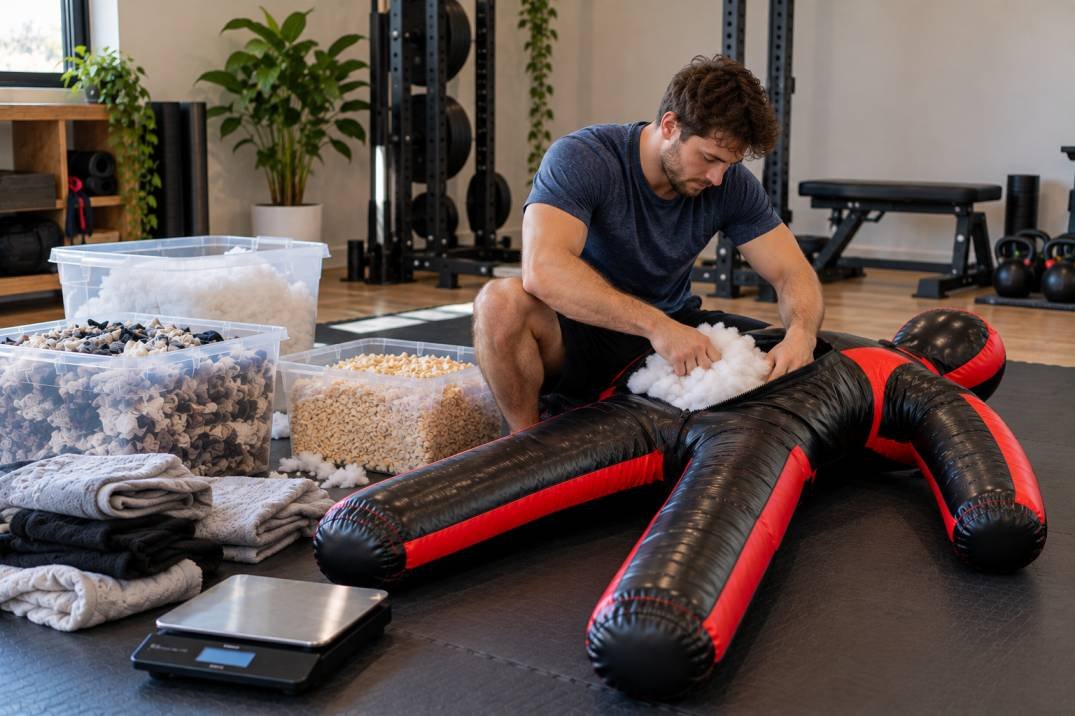
There is no universal amount of filling for a grappling dummy. The required quantity depends on the dummy's size, internal volume, construction, filler density, compressibility, desired firmness, and target weight. Always follow the manufacturer's filling instructions for your specific model rather than using a generic pound or kilogram figure.
Manufacturer instructions take priority over any general guidance here. Only use materials confirmed compatible with your specific dummy, and never force in enough material to stress seams or closures beyond their design.
How Much Filling Does a Grappling Dummy Need?
There's no universal fill quantity that applies to every grappling dummy. Larger dummies generally have more internal volume and need more material to fill fully; denser fillers can produce the same weight with less volume, while more compressible fillers may need more material to hold the same shape. Desired firmness and desired final weight both change the target amount too — and none of this is fixed until you factor in the manufacturer's specific instructions for your model.
Important distinction: fill amount is not the same as final weight. The same volume of two different materials can produce very different weights, because materials have different densities.
What Determines How Much Filling a Grappling Dummy Needs?
1. Dummy Size
A larger dummy generally has more internal volume, and more internal volume generally requires more filler to fill completely.
2. Dummy Construction
Different designs — different shapes, limb structures and internal compartments — have different internal capacities even at a similar overall size.
3. Filler Density
A denser material can produce more weight with less volume than a lighter, fluffier material occupying the same space.
4. Filler Compressibility
Highly compressible materials may need more material by volume to achieve and hold the same shape as a less compressible one.
5. Desired Firmness
A softer feel and a firmer feel may call for different fill levels, depending on the material and the dummy's construction.
6. Desired Weight
More material doesn't automatically translate into a proportionally heavier dummy, since different materials have different densities per unit of volume.
7. Manufacturer Instructions
This should be your first reference point for any specific dummy — general guidance here is a framework, not a substitute for product-specific guidance.
Is There a Standard Amount of Grappling Dummy Filler?
No. Different manufacturers and dummy models have different shell dimensions, limb structures, fill openings, intended uses, and recommended filling materials. A claim like "every grappling dummy needs a fixed amount of filler" doesn't hold up across that much product variation — the honest answer is that it depends on the specific model.
How Full Should a Grappling Dummy Be?
A properly filled dummy should maintain its intended shape, have firmness appropriate to its design, avoid large empty or hollow sections, and avoid obvious excessive bulging — all consistent with the manufacturer's guidance for that model. "Full" does not necessarily mean "maximally packed." Some dummies are designed to feel firm when completely full; others are designed with some give built into the intended fill level. Check your specific model's guidance rather than assuming maximum packing is always the goal.
How Filling Amount Affects Grappling Dummy Firmness
Generally, less filling tends to produce a softer feel, less shape retention, and more compressibility, while more filling tends to produce a firmer feel, greater shape retention, and higher overall weight. The exact result still depends on the specific filler material and the dummy's construction — we're not promising a particular feel at a particular fill level without product-specific evidence, since the same fill level can feel different across two different materials or two different dummy designs.
How Filling Amount Affects Grappling Dummy Weight
Final dummy weight is a function of the shell, the filler material, and the filler quantity together: shell weight plus filler mass equals finished weight. Because different materials have different densities, the same volume of filler does not produce the same weight across different materials — a large amount of a lightweight material can weigh less than a smaller amount of a denser one. For guidance on what overall weight is appropriate for your training goals, see what weight grappling dummy should I get; this page only covers how fill amount feeds into that final number.
Does Dummy Size Change How Much Filler You Need?
Generally, yes — larger dummies have more internal volume, and smaller dummies have less, so the raw quantity of filler needed to fill each completely will typically differ between a smaller, medium and larger model. We're not providing exact fill quantities for each size category here, since that depends on the specific model's actual internal volume, which the manufacturer is best positioned to specify. For help choosing dummy size itself, see what size grappling dummy should I buy.
Does the Type of Filler Change the Amount You Need?
Yes. Dense materials, lightweight materials, compressible materials, resilient materials and mixed-material combinations can all produce different results for the same target weight or firmness — a denser material generally requires less volume to reach a given weight, while a lighter or more compressible one generally requires more. For a full comparison of specific filler materials and their trade-offs, see grappling dummy filler: best materials and options — this section only covers how filler type affects the quantity question, not which material to choose.
How Do You Know When a Grappling Dummy Has Enough Filling?
These signs are a general guide, not a checklist that applies identically to every model — some dummies are designed with different shape and firmness expectations than others.
Can You Overfill a Grappling Dummy?
Depending on the construction, yes. Potential problems include excessive firmness beyond what the design intends, a distorted or misshapen appearance, added stress on seams and closures, an altered training feel, and difficulty maintaining the dummy's intended shape over time. This doesn't mean overfilling will definitely damage every dummy — some are built with more tolerance than others — but it's a real risk worth taking seriously, and manufacturer fill guidance (where available) is the best defense against it.
Can You Underfill a Grappling Dummy?
Yes, depending on the design. Potential issues include poor shape retention, an overly soft feel that doesn't match the intended training purpose, hollow or collapsed areas, unstable limbs, and reduced usefulness for certain training applications that expect a firmer target. As with overfilling, exactly how much underfilling matters depends on the specific dummy's design and intended use.
What Happens When Grappling Dummy Filling Settles?
Over time, filler material can compress and settle, leading to redistribution, changes in firmness, and changes in overall shape. Some materials settle more than others, and how much settling happens depends on the filler itself, how frequently the dummy is used, its construction, storage conditions, and general compression from repeated training. A dummy may need periodic adjustment — topping up or redistributing filler — as a result. For the detailed procedure, see how to fill a grappling dummy, which also covers refilling.
How Much Filling Does a BJJ Dummy Need?
BJJ dummies don't have one universal filling requirement — the appropriate amount depends on the specific model, its size, the filler being used, your intended training use, and the manufacturer's guidance. For more on BJJ-specific training dummies generally, see Brazilian Jiu Jitsu training dummy or browse BJJ training dummies.
How Much Filling Does a Wrestling Dummy Need?
Wrestling dummies also vary by model, size, construction, intended use and filling material, so the same "it depends on the specific product" answer applies here too. For wrestling-specific drilling guidance rather than filling quantity, see wrestling takedown drills.
DIY Filling vs Pre-Filled Grappling Dummy
| Factor | Unfilled Dummy | Pre-Filled Dummy |
|---|---|---|
| Convenience | Lower — requires filling before use | Higher — ready out of the box |
| Customization | Higher — you control material and amount | Lower — set by the manufacturer |
| Fill control | Higher — adjustable to your preference | Usually predetermined |
| Setup time | Required | Minimal |
| Weight adjustment | Potentially easier, depending on design | Depends on whether the design allows access |
| Consistency | Depends on your filling technique | Manufacturer-controlled |
For the full purchasing decision between filled and unfilled models, see filled vs unfilled grappling dummy. This page only covers the quantity question once you've made that choice.
How to Estimate the Amount of Filler You Need
There's no single universal formula for this — the practical approach is a process of checking, starting conservatively, and adjusting.
- Check manufacturer instructionsStart with any fill guidance the manufacturer provides for your specific model.
- Identify the intended fill typeConfirm whether your dummy is designed for textile, foam, or another specific filler type.
- Check for quantity or weight guidanceSome manufacturers specify an amount or a target weight; use that as your reference point if available.
- Start with a manageable amountBegin filling gradually rather than committing all your material at once.
- Assess shape and firmnessCheck the result against the fullness signs described above.
- Adjust according to manufacturer guidanceAdd or redistribute material as needed, staying within any stated limits.
Should You Fill the Dummy Based on Weight or Volume?
Weight and volume measure different things, and neither should automatically replace the other.
Filler Volume
How much physical space the material occupies — useful when the question is "how much material physically fits?"
Filler Mass
How much the material weighs — useful when the question is "how heavy will the finished dummy be?"
Final Dummy Weight
Shell weight plus filler mass together — the number that actually matters for training feel and handling.
Because filler density varies so much between materials, a volume-based approach and a weight-based approach can lead to different outcomes with the same material. The manufacturer's instructions determine which measurement is most useful for your specific model — use whichever one they reference.
What Affects Fill Amount: Summary Table
| Variable | Effect on Fill Amount |
|---|---|
| Dummy size | Larger internal volume may require more filler |
| Filler density | Denser material may require less volume for the same weight |
| Filler compressibility | More compressible material may require more material to hold shape |
| Desired firmness | Firmer feel may require more filling, depending on material and design |
| Desired weight | Higher final weight generally requires more mass, not necessarily more volume |
| Dummy construction | Internal design determines how much volume is actually available to fill |
Common Grappling Dummy Filling Mistakes
- Assuming one amount fits all dummies — internal volume varies significantly between models.
- Filling based only on weight — ignoring how that weight actually feels distributed through the shape.
- Filling based only on volume — ignoring that different materials at the same volume weigh differently.
- Ignoring filler density — leads to over- or under-estimating how much material is actually needed.
- Ignoring compression — packing without accounting for how the material will settle later.
- Overfilling — stresses seams and can distort intended shape.
- Underfilling — leaves the dummy hollow, unstable or overly soft.
- Creating uneven distribution — dense clumps in some areas and gaps in others.
- Ignoring manufacturer instructions — the single most avoidable mistake on this list.
- Assuming maximum firmness is always best — not every dummy or training style calls for maximum firmness.
- Confusing filler amount with dummy weight — the two are related but not the same measurement.
Quick Grappling Dummy Filling Checklist
Comparing filled and unfilled options?
Browse BJJ grappling dummies and check each listing's fill specifications before buying.
Frequently Asked Questions
Direct answers to the questions people ask about fill quantity.
How much filling does a grappling dummy need?
There's no universal amount. It depends on the dummy's size, internal volume, construction, filler density, compressibility, and desired firmness or weight — always check manufacturer instructions for your specific model.
How much stuffing does a grappling dummy need?
The same answer applies regardless of terminology — the required amount varies by model and depends on size, construction and the filler used, not a fixed universal figure.
How full should a grappling dummy be?
Full enough to maintain its intended shape and firmness without being excessively packed. Maximum fullness isn't necessarily the goal — check what your specific model is designed for.
Can you overfill a grappling dummy?
Depending on the construction, yes — this can cause excessive firmness, distorted shape, and stress on seams and closures. Follow manufacturer fill guidance to avoid this.
Can you underfill a grappling dummy?
Yes — this can lead to poor shape retention, a hollow feel, and unstable limbs, depending on the dummy's design and intended use.
Does more filling make a grappling dummy heavier?
Usually, yes, but the amount of weight added depends on the filler's density — two materials occupying the same volume can weigh very differently.
Does more filling make a grappling dummy harder?
Generally, yes, more filling tends to increase firmness, but the exact result depends on the specific filler material and the dummy's construction.
Does grappling dummy filling settle?
Many fillers compress or settle with use, and how much depends on the material, amount, construction, storage and training frequency.
Do bigger grappling dummies need more filling?
Generally, yes — larger dummies typically have more internal volume, which generally requires more filler to fill completely.
Does filler density affect how much material I need?
Yes — denser materials can reach a target weight with less volume, while lighter or more compressible materials may require more material for the same result.
How much filling does a BJJ dummy need?
There's no universal amount for BJJ dummies specifically — it depends on the model, size, filler and manufacturer guidance, same as any other grappling dummy.
Should I measure grappling dummy filler by weight or volume?
Whichever measurement the manufacturer references for your specific model — neither weight nor volume should automatically substitute for the other, since filler density varies.
How do I know when my grappling dummy is full?
When it holds its intended shape, has appropriate firmness, lacks large hollow areas, and isn't visibly overstuffed — consistent with the manufacturer's guidance for that model.
Can I adjust the filling later?
On many designs, yes, if the dummy allows access to the filling and the manufacturer doesn't restrict it — see how to fill a grappling dummy for the detailed process.
Is there a standard amount of grappling dummy filler?
No — shell dimensions, limb structures, fill openings and recommended materials all vary by manufacturer and model, so no single figure applies universally.
Shop BJJ & Grappling Training Equipment
Check each listing's fill specifications and construction details before deciding on filled or unfilled.
This guide provides general information to help judge how much filling a grappling dummy needs and is not a substitute for a specific manufacturer's product documentation. There is no universal fill amount — always check the current product listing and manufacturer instructions before filling, refilling or adjusting any grappling dummy. Explore more at Home Gym Goals.