
Wrestling Dummy for BJJ: Does It Work?
Short version: yes, potentially — but how useful a wrestling dummy is for Brazilian Jiu-Jitsu depends entirely on its design and the kind of BJJ you train. Here's where it helps, where it falls short, and how to choose.
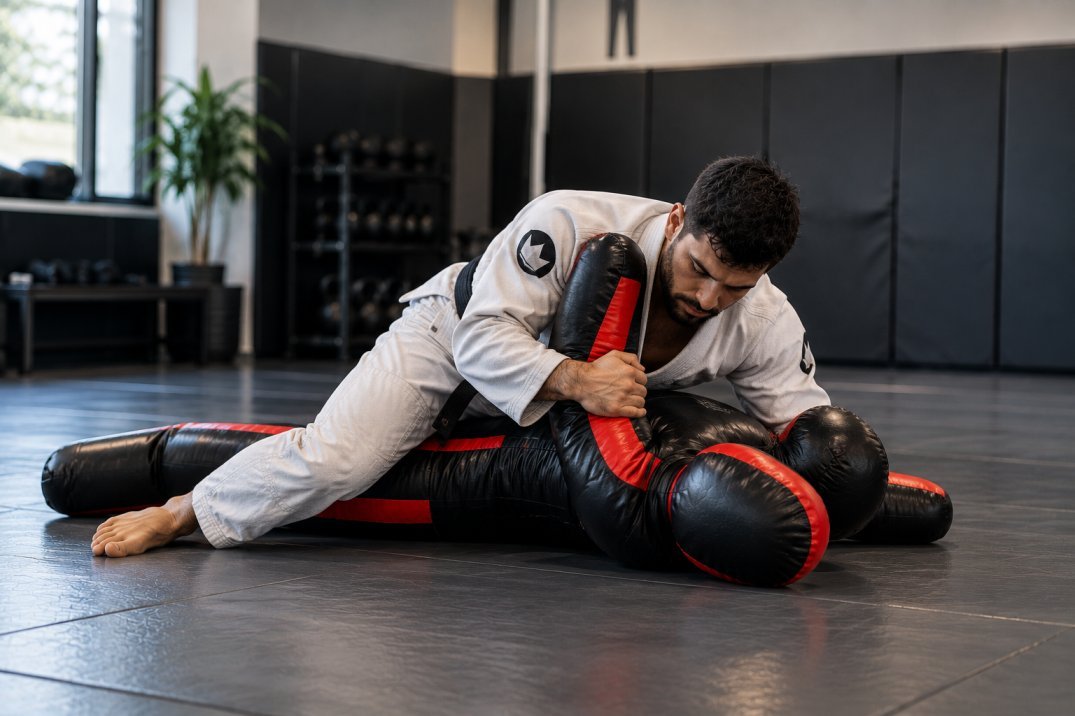
Yes, a wrestling dummy can be useful for BJJ, but how useful depends on its shape and intended design. It can support solo practice of positioning, movement, takedown-related work and some grappling transitions. A wrestling dummy may be less suitable for ground-focused BJJ if its design is primarily intended for standing wrestling. And like any dummy, it can't reproduce the resistance, reactions, timing, balance or unpredictability of a live training partner.
Can you use a wrestling dummy for BJJ?
Yes — with the important caveat that "wrestling dummy" is a broad category, not a single fixed product. It can be a valuable solo-training tool for BJJ, but the right question isn't "are wrestling dummies good for BJJ?" It's "is this wrestling dummy's design suitable for the BJJ movements I want to practise?"
Broadly, there are three overlapping types to keep in mind:
- Standing wrestling dummy — built to be worked with upright; strongest for entries, clinch and takedown-related practice.
- Ground-oriented wrestling dummy — shaped to lie on the mat; better for positional and ground work.
- General grappling dummy — often humanoid and mat-oriented, marketed across BJJ, wrestling and MMA.
For a full category-level breakdown beyond the BJJ angle, see our grappling dummy vs wrestling dummy comparison.
What can a wrestling dummy help you practise for BJJ?
At a high level, a suitably designed wrestling dummy can support these areas of solo BJJ practice:
- Body positioning — organising yourself around a body shape.
- Movement patterns — repeating the motions of your game.
- Takedown entries — level changes, penetration steps, grip and control.
- Transitions — flowing between positions where the shape allows.
- Positional awareness — feeling where you are relative to a body.
- Controlled technical repetition — grooving a movement cleanly.
- Basic movement sequences — linking steps into a flow.
This page stays high-level on the drills themselves — for structured routines, see our BJJ dummy drills and, for the wrestling side, our wrestling dummy drills.
Which parts of BJJ is a wrestling dummy good for?
General tendencies — not universal product ratings. Every row is design-dependent, so treat this as a guide and check the specific dummy.
| BJJ training area | Suitability | Why |
|---|---|---|
| Standing entries | Generally useful | Upright designs suit clinch and entry work |
| Takedown practice | Generally useful | Strong, if rated for the movement |
| Top-position movement | Design-dependent | Depends on shape and whether it lies flat |
| Ground transitions | Design-dependent | Needs a mat-friendly, humanoid shape |
| Guard practice | More limited | Depends heavily on limb configuration |
| Guard retention | Limited | Needs a reacting partner to be realistic |
| Live rolling | Not possible | No dummy can roll |
| Live resistance | Not a substitute | A dummy can't resist or react |
Where does a wrestling dummy fall short for BJJ?
This is the part that matters most, because BJJ is a reactive, ground-heavy sport. A dummy — wrestling or otherwise — cannot reproduce:
- Live resistance and reactions — nothing pushes back or counters.
- Timing — there's no moving target to read.
- Balance and frames — no dynamic weight to manage.
- Grip fighting — no hands contesting yours.
- Movement and unpredictable responses — it stays where you put it.
- Fatigue and decision-making — the human element that defines rolling.
This matters more in BJJ than in some other sports because so much of the skill is reactive — reading and responding to a live opponent. A dummy builds the mechanical, repeatable half; the reactive half only comes from partners and coaching.
Standing wrestling dummy vs BJJ grappling dummy
Focused specifically on which is better for BJJ training — for the full category comparison, see the grappling dummy vs wrestling dummy guide.
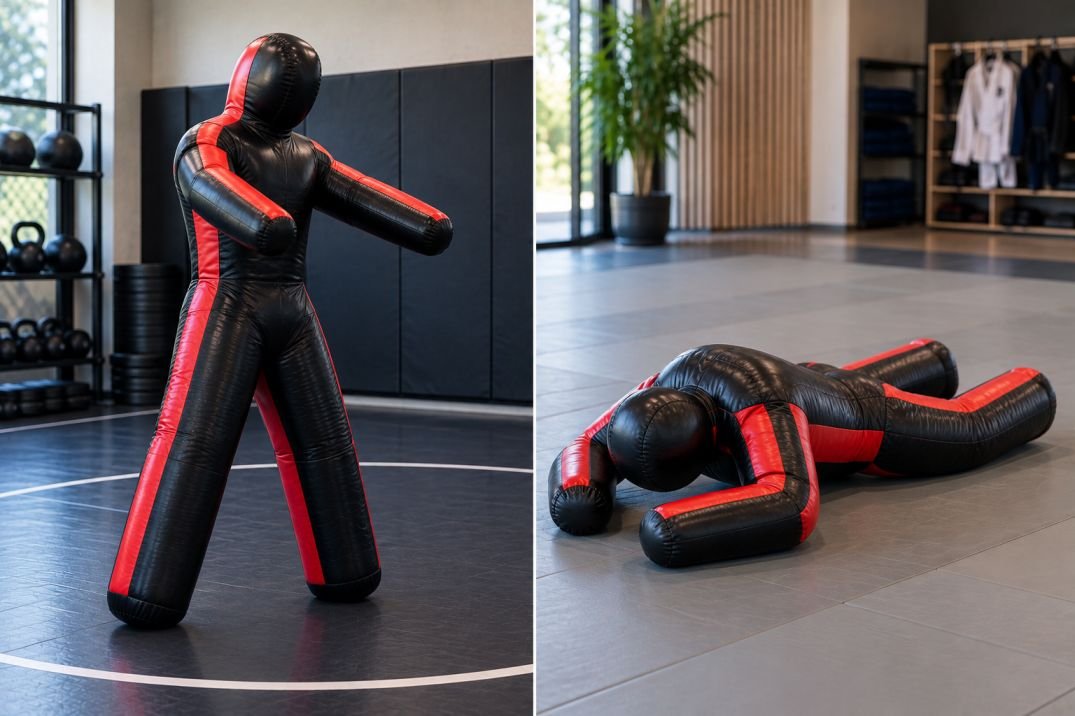
| Feature | Standing wrestling dummy | BJJ / grappling dummy |
|---|---|---|
| Primary orientation | Upright / standing | Often ground / mat |
| Standing practice | Strong | Varies by design |
| Ground practice | More limited | Often stronger |
| Takedown work | Strong, if rated | Design-dependent |
| Positional work | Design-dependent | Often stronger |
| Transitions | Design-dependent | Often stronger |
| Solo repetition | Yes | Yes |
| Storage | Varies | Varies |
| Space | Needs upright room | Needs mat space |
| Best suited for | Standing & takedowns | Ground & positional BJJ |
Is a standing wrestling dummy good for BJJ?
A standing wrestling dummy can be useful for the standing portion of BJJ — entries, takedown concepts, clinch positioning, and standing-to-ground transition concepts. If your BJJ goals include improving your takedowns and clinch, an upright dummy is a sensible fit.
It may be less suitable for prolonged ground-position practice, guard-focused work, ground-only movement and certain positional repetitions — simply because an upright-oriented design isn't built to be worked with flat on the mat for long. As always, the answer depends on the specific dummy: some standing dummies are explicitly marketed for ground and submission positioning too. (A dedicated standing-wrestling-dummy guide is planned as a separate resource.)
Is a filled wrestling dummy better for BJJ?
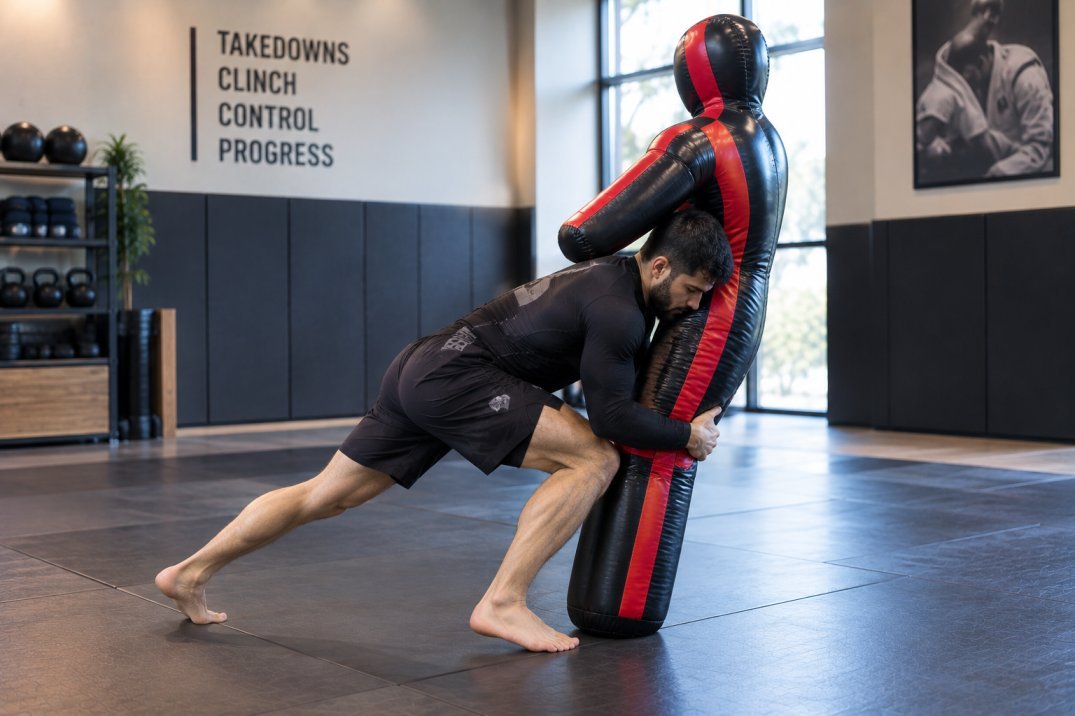
"Filled" describes the dummy's internal configuration — that it's stuffed to hold a shape and weight — and it's a common term in wrestling equipment. But "filled" does not automatically mean better, more realistic, more durable or more suitable for BJJ.
Suitability still comes down to the same design factors: shape, dimensions, posture, limb configuration, intended use, weight, filling type and training orientation. A filled dummy with a ground-friendly humanoid shape may suit BJJ well; a filled dummy built purely for upright throwing practice may not. Judge the design, not the label. (A dedicated filled-wrestling-dummy guide is planned separately.)
Can beginners use a wrestling dummy for BJJ?
Yes — as a supplementary training tool. For a beginner, a suitable dummy helps with movement repetition, learning basic positional concepts, developing familiarity with positions, home practice, and reviewing techniques picked up in class.
The important limit: a beginner should not try to teach themselves complete BJJ from a dummy alone. Qualified instruction and live practice remain essential — the dummy reinforces what you learn on the mat, it doesn't replace the mat. See our guide to BJJ training at home for how to balance the two.
Can a wrestling dummy replace a BJJ training partner?
No. A dummy is a tool for repetition, not a complete training partner. The gap is fundamental:
| Attribute | Dummy | Live partner |
|---|---|---|
| Resistance | No | Yes |
| Reaction | No | Yes |
| Balance | Static | Dynamic |
| Timing | No | Yes |
| Grip interaction | No | Yes |
| Feedback | None | Constant |
| Unpredictability | None | High |
| Safety communication | None | Yes (tapping) |
| Technique adaptation | None | Yes |
Wrestling dummy for BJJ takedown training
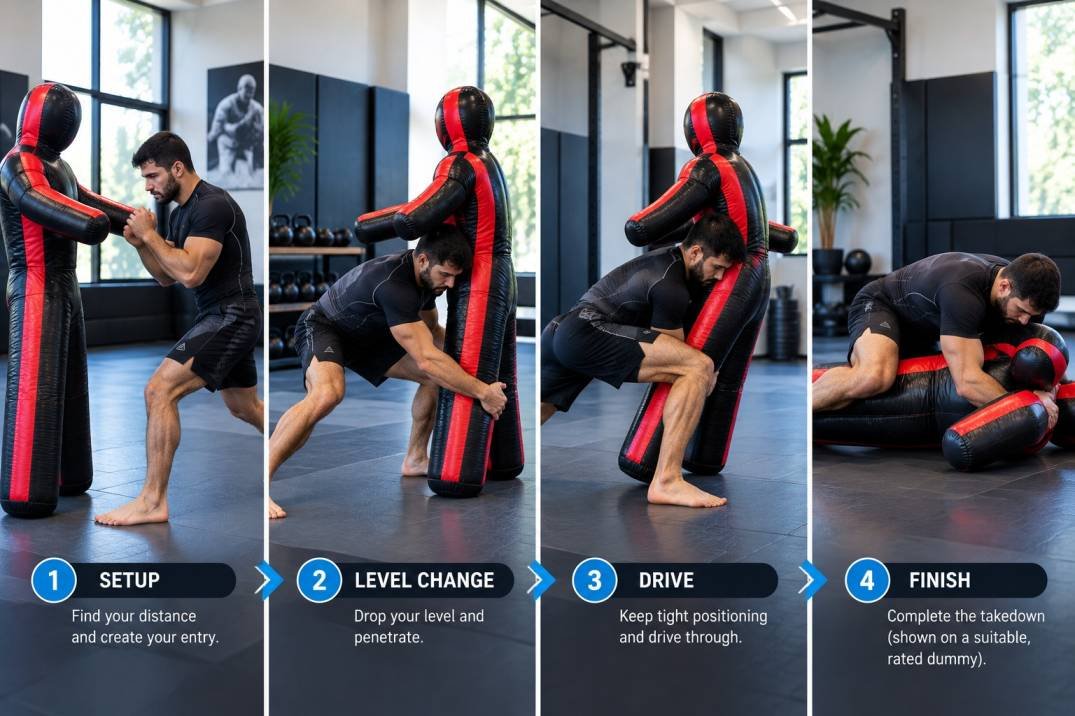
This is where wrestling-oriented dummies are often at their most useful for BJJ. A suitable upright dummy can support standing entries, body positioning, takedown movement patterns and controlled repetition — grooving the motion of a level change or penetration step on your own time.
Keep the scope realistic: entry motions drill well on many dummies, while full finishes (driving through, lifting) are design-dependent and should only be done on a dummy rated for them. For structured takedown work, a dedicated takedown-training beginner's guide and BJJ/wrestling takedown-drill pages are planned as separate resources; in the meantime our takedown dummy drills cover the motion-versus-finish distinction.
Wrestling dummy for BJJ ground training
Here, suitability depends heavily on the dummy's shape. A humanoid, mat-friendly dummy can support ground positioning, transitions, top-position movement and basic positional repetition. But some wrestling dummies are designed primarily around upright practice and are simply less practical to work with flat on the ground for extended ground-focused BJJ.
If most of your training is on the mat, prioritise a shape and flexibility built for ground work — which is exactly what most BJJ/grappling dummies are designed around. For choosing on shape and size specifically, see how to choose a grappling dummy.
Can you practise BJJ submissions on a wrestling dummy?
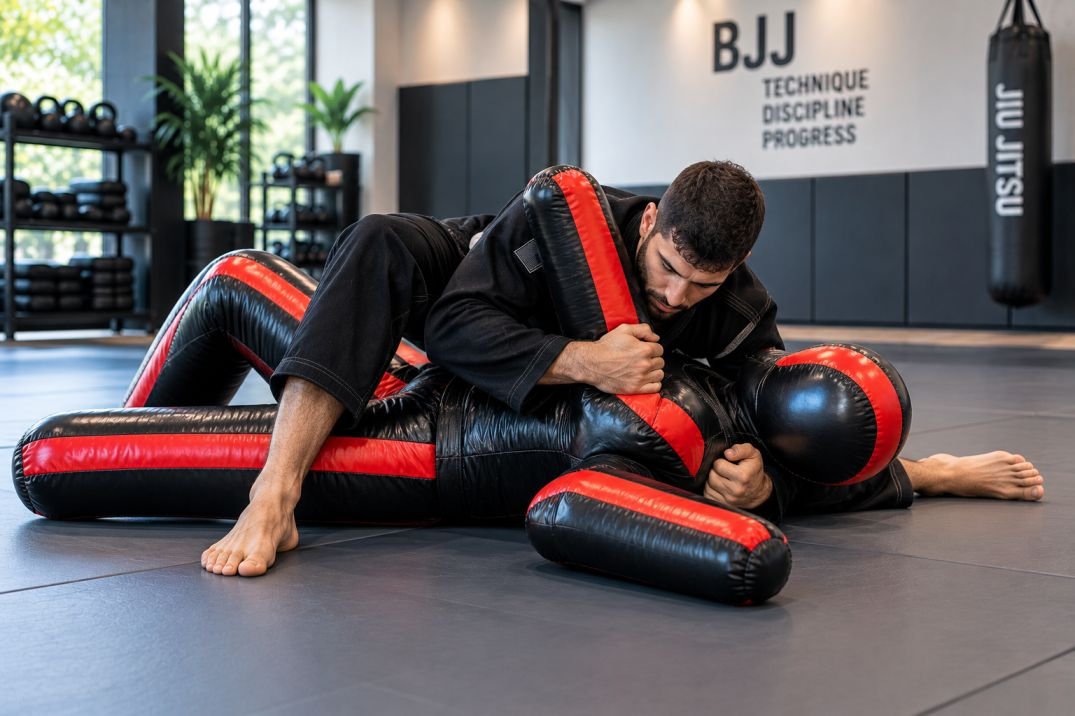
Depending on its construction, a suitable grappling dummy can be used for controlled technical repetition of certain submission positions and movement patterns — rehearsing the positioning and mechanics rather than forcing a finish. A dummy can't tap, resist or defend, so this is always practice of the shape, never a real submission.
Not every wrestling dummy is designed for every submission drill — limb flexibility and configuration vary — so follow the manufacturer's intended use. For a full solo submission library, see our submission grappling drills.
What type of dummy is best for BJJ?
There's no universal winner — it's a decision based on your training. A simple framework:
- Mainly standing + takedowns → a wrestling / standing dummy may be useful.
- Mainly ground positions + transitions → a grappling / BJJ-oriented dummy may be more suitable.
- Mixed standing + ground → choose on the dummy's shape and intended use, not the label.
- Limited home space → factor in dimensions and storage before anything else.

For the numbers side of this decision, our guides on what size grappling dummy to buy and what weight grappling dummy to get go deeper.
What should you check before using a wrestling dummy for BJJ?
Pre-use checklist
- Intended for grappling practice
- Suitable shape
- Suitable limb configuration
- Appropriate size
- Appropriate weight
- Suits standing or ground use as needed
- Durable construction
- Suitable training surface
- Manufacturer-approved intended use
- Fits your available space
- Safe for the planned movements
Wrestling dummy vs BJJ dummy: which should you choose?
General guidelines, not universal rules — the specific design always overrides the category.
| Scenario | Better starting choice |
|---|---|
| Mainly wrestling | Wrestling dummy |
| Mainly BJJ ground work | BJJ / grappling dummy |
| BJJ + wrestling takedowns | Either, depending on design |
| Mostly standing practice | Standing wrestling / grappling dummy |
| Mostly ground practice | Ground-oriented grappling dummy |
Using a wrestling dummy as part of BJJ home training
The balanced approach puts the dummy in its proper place — reinforcing live training, not replacing it.
- 1. Learn from qualified instruction.
- 2. Practise concepts under supervision.
- 3. Use the dummy for repetition at home.
- 4. Return to live practice to test skills against resistance.
- 5. Use the dummy to reinforce — not replace — live training.
For the full picture of what solo and home work can and can't build, see our guide to BJJ training at home.
Is a wrestling dummy worth it for BJJ?
It's worth considering when you want solo repetition, when you also train wrestling or takedowns, when the dummy's shape fits your BJJ goals, when you understand its limitations, and when you have suitable home-training space.
It's less suitable when you want a complete replacement for live BJJ, when the dummy's design is primarily incompatible with your training goals (for example, an upright-only dummy for a guard-heavy game), or when you expect realistic resistance. Set those expectations correctly and a well-matched dummy is a genuinely useful addition to a home setup.
Home Gym Goals BJJ grappling dummy options
If your primary goal is BJJ-focused solo training, it's usually worth starting from a dummy designed with grappling in mind rather than adapting a standing wrestling dummy. You can explore the full range on the Home Gym Goals BJJ grappling dummy hub and match a design to the drills you actually run.
Standing BJJ Grappling Dummy
$149.00 – $199.00 · In stock
For readers who want a standing option that still covers grappling, the Standing BJJ Grappling Dummy (model WG-D1023) is a standing, human-shaped dummy the listing describes as suitable for BJJ, MMA, boxing, wrestling and kickboxing. Per the product page, its confirmed details are:
- Design: standing, human-shaped, lace-up closure
- Sizes: 4 FT, 5 FT and 6 FT
- Material: synthetic leather, with nylon, fabric and cotton
- Filling: cotton and mixed materials
- Weight: approximately 2 kg (relatively easy to reposition)
- Listed applications: BJJ, MMA, boxing, wrestling, kickboxing — including takedown entries, clinch work and submission positioning
Because it's a standing design, it leans toward the standing and takedown side of the framework above; the listing also notes grappling and submission-positioning use, so check its shape against your ground-training needs.
Details above reflect the current product listing only. Confirm size, colour, price and availability on the product page before ordering, as listings can change.
Quick decision tree
A fast way to narrow it down.
Match the dummy to your BJJ
If your training is mostly on the ground, start from a grappling-oriented design. Compare the options and check each one's shape and intended use.
Frequently asked questions
Short, direct answers to the questions BJJ buyers ask most.
Can you use a wrestling dummy for BJJ?
Yes, as a supplementary solo-training tool, though how useful it is depends on its design. It can help with positioning, movement, takedowns and some transitions, but can't reproduce a live partner's resistance or reactions.
Is a wrestling dummy good for jiu jitsu?
It can be, especially for standing and takedown-related practice. For ground-heavy jiu-jitsu, a grappling/BJJ-oriented dummy is often more suitable. Judge the specific dummy's shape and intended use rather than the category.
Is a standing wrestling dummy useful for BJJ?
Yes for the standing side — entries, clinch and takedown concepts. It's generally less practical for prolonged ground and guard work, since upright designs aren't built to be worked with flat on the mat.
Can you practise BJJ takedowns with a wrestling dummy?
Yes — entry motions, level changes and body positioning drill well on a suitable upright dummy. Full finishes such as lifting or driving through depend on the dummy being rated for them.
Can you practise ground BJJ with a wrestling dummy?
It depends on the shape. A humanoid, mat-friendly dummy supports ground positioning and transitions; an upright-only design is less practical for extended ground-focused work.
Is a wrestling dummy better than a BJJ dummy?
Neither is universally better — it depends on your training. Wrestling dummies lean toward standing and takedowns; BJJ/grappling dummies lean toward ground and positional work. Match the design to your goals.
Can a wrestling dummy replace a BJJ training partner?
No. A dummy can't provide resistance, reactions, timing, grip fighting, feedback or unpredictability. It's a repetition tool that supplements live training and coaching, never a replacement.
Can beginners use a wrestling dummy for BJJ?
Yes, as a supplement for movement repetition and reviewing what you learn in class. Beginners shouldn't try to learn complete BJJ from a dummy alone — qualified instruction and live practice remain essential.
What should I look for in a wrestling dummy for BJJ?
A shape and limb configuration suited to the movements you train, an appropriate size and weight, whether it's meant for standing or ground use, durable construction, and the manufacturer's stated intended use.
Are filled wrestling dummies good for BJJ?
"Filled" describes the internal build, not BJJ suitability. A filled dummy with a ground-friendly humanoid shape can work well; one built purely for upright practice may not. Judge the design, not the label.
Is a grappling dummy better than a wrestling dummy for BJJ?
For ground-focused BJJ, usually yes — grappling dummies are designed around mat work. For a takedown-heavy game, a wrestling-oriented dummy may serve you just as well. It comes down to your training focus.
Are wrestling dummies worth it for BJJ?
They can be, if you want solo repetition, the shape fits your goals, and you understand the limits. They're not worth it if you expect realistic resistance or a full replacement for live rolling.
Continue your research
Related guides and equipment to help you choose.
This guide provides general information to help decide whether a wrestling dummy suits your BJJ training; it is not product-specific advice for any dummy other than where clearly attributed to a verified product listing. "Wrestling dummy" and "grappling dummy" are broad categories, not technical standards — actual capabilities, dimensions, weight, materials and intended use vary by product and should be confirmed against the manufacturer's documentation and the live product listing. A dummy is a fixed training tool and cannot provide live resistance, reactions or coaching, and it cannot replace qualified instruction or live training. No equipment is injury-proof, and no training tool guarantees self-defense ability. Explore more at Home Gym Goals.