
Rear Naked Choke Training and Drills
The rear naked choke (RNC) is one of the most recognized submissions in Brazilian Jiu-Jitsu, submission grappling and MMA — but it's built on back control, not just the finish itself. This guide covers the positional fundamentals, a practical drill library, and safe ways to train entries, retention, transitions and defensive awareness, whether solo, with a grappling dummy, or with a partner.
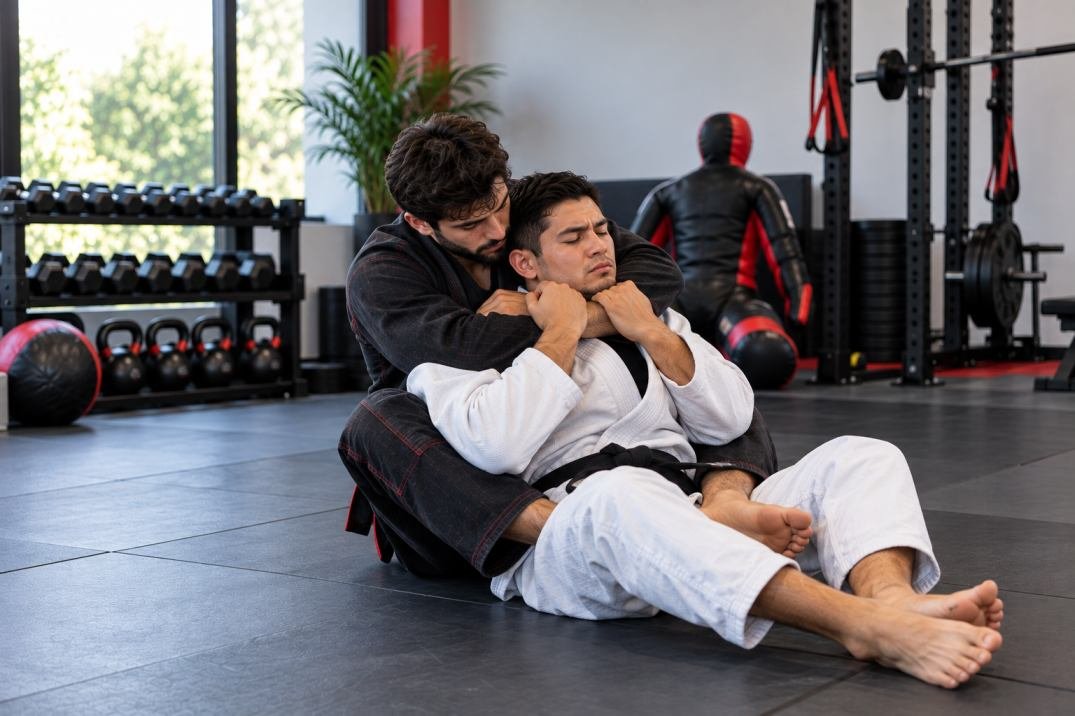
- Learn back-control fundamentals before anything else.
- Learn RNC positioning and hand/grip control concepts.
- Drill slowly with a cooperative partner, focusing on technical accuracy.
- Practice entries into position and retaining back control.
- Add controlled resistance gradually, with clear communication and tap awareness.
- Integrate RNC concepts into live grappling under qualified supervision.
This is an educational guide, not a substitute for qualified BJJ or grappling coaching. Chokes carry real risk and should only be practiced with a trained, communicative partner, at controlled speed and pressure, under qualified supervision where possible. Tap early, release immediately after any tap, and never apply a choke at full force during drilling or to an untrained person. No technique is guaranteed to work in every situation or as self-defense.
What Is a Rear Naked Choke?
A rear naked choke is a submission technique applied from behind an opponent, using the arms to control the neck and upper body without relying on clothing (the "naked" in the name). It's commonly abbreviated RNC.
Conceptually, the rear naked choke depends on positional control before anything else. It's applied from back control — a position where the practitioner is behind the opponent with hooks or body triangle, seatbelt grip, and control over the opponent's posture and movement. Establishing and maintaining that control is what creates a viable opportunity for the choke; without it, an RNC attempt is far less likely to succeed and can expose the attacker to a worse position.
Because of this reliance on positional control, the rear naked choke appears across BJJ, submission grappling and MMA as a technique that rewards patience and control over speed. It's widely taught because the underlying back-control and body-mechanics principles carry over across grappling styles and rule sets.
Why Train the Rear Naked Choke?
Training the RNC develops skills that extend beyond the finish itself:
- Back-control awareness — recognizing and maintaining one of grappling's most dominant positions.
- Positional control — prioritizing control before attempting a finish.
- Submission awareness — recognizing when a finishing opportunity is actually available.
- Timing — understanding when to transition from control to finishing attempt.
- Grip awareness — developing the hand and arm positioning the technique depends on.
- Transition awareness — moving fluidly between control, entries and finishing attempts.
- Maintaining dominant position — a skill that supports far more than just this one submission.
- Submission-chain development — connecting the RNC to other attacks and reactions.
- Defensive understanding — recognizing the position from the other side builds better all-around awareness.
None of this guarantees success in any specific live situation — outcomes depend on positional control, timing, an opponent's reactions and skill, and the ruleset being trained under.
Rear Naked Choke Fundamentals for Beginners
These principles apply broadly across RNC training. Focus on understanding them as concepts rather than rushing toward finishing attempts.
Position Before Submission
Establishing and confirming control comes before any finishing attempt — a rushed attempt from poor position is more likely to fail or cost position.
Back-Control Fundamentals
Hooks or body triangle, chest-to-back connection and hip control form the base the RNC is built from.
Arm and Hand Positioning
Deliberate, controlled arm placement around the neck and upper body, developed slowly through repetition.
Maintaining Control
Continuously managing the opponent's posture and movement rather than treating control as a one-time setup.
Body Position
Keeping your own hips, chest and base connected to the opponent throughout the sequence.
Posture and Balance
Staying balanced and controlled rather than overcommitting weight or reaching in a way that risks the position.
Timing
Recognizing the moments — such as a defensive reaction opening space — when a finishing attempt becomes more viable.
Recognizing Defensive Reactions
Reading how the opponent is defending so you can adjust rather than force a fixed sequence.
Transition Awareness
Understanding how to move between control, entry attempts and alternative positions as the exchange develops.
Safe Training and Tapping
Clear communication, controlled pressure, and immediate release the moment a partner taps.
Rear Naked Choke Training Progression
Learn back-control fundamentals
Back control is the foundation everything else in this guide builds on.
Understand RNC positioning
Learn where the arms, hands and body need to be before attempting movement.
Learn control concepts
Understand how to manage an opponent's posture and movement from the back.
Practice movement slowly
Rehearse the technical movement at low speed before adding resistance.
Drill entries
Practice getting into position from common training contexts.
Drill retention
Practice keeping back control against a partner's attempts to escape.
Practice transitions
Move between control, entries and alternative positions fluidly.
Add controlled resistance
Introduce light, honest resistance and increase it gradually.
Develop defensive awareness
Understand the position from the bottom side as well as the top.
Integrate into live grappling
Apply RNC concepts within live rolling, under qualified supervision.
Best Rear Naked Choke Drills for Beginners
General, controlled drills used to build RNC fundamentals. Keep intensity conservative, communicate clearly, and follow your coach's guidance on pacing and technical detail.
RNC Position Familiarization Drill
Back control established on a cooperative partner or dummy.
Build comfort and recognition of correct RNC body positioning.
Confirm hook/triangle, chest connection and hand positioning before any movement.
Hold the position and check each control point in sequence.
3–5 rounds of 30–60 seconds.
Talk through each control point out loud with a coach or partner.
Rushing to the choke before position is confirmed.
No choking pressure applied during this drill.
Back-Control Maintenance Drill
Back control, partner shifting posture slowly.
Practice maintaining control as the opponent moves.
Keep hooks/triangle and chest connection through movement.
Adjust hip and hook position in response to the partner's slow, cooperative movement.
3–4 rounds of 60 seconds.
Partner moves at a slow, predictable pace.
Losing chest connection while chasing hand position.
Cooperative pace only; no escape resistance yet.
RNC Grip and Hand-Position Awareness Drill
Back control, partner or dummy stationary.
Build familiarity with correct arm and hand placement.
Locate and confirm hand positioning slowly and deliberately.
Establish and release grip positioning repeatedly at slow speed, without applying choking pressure.
8–10 slow repetitions per side.
Practice on a dummy first before moving to a partner.
Gripping with unnecessary tension before position is confirmed.
No finishing pressure — positioning only.
RNC Entry Drill
A common back-take context, such as turtle or a transitional scramble position.
Practice moving into back control from a realistic starting point.
Smooth, connected entries rather than isolated position-holding.
Move from the starting position into back control with hooks or triangle established.
5–8 repetitions per side.
Partner allows the entry at a slow, cooperative pace.
Rushing the entry and losing chest connection in the process.
Cooperative pace, controlled movement throughout.
RNC Transition Drill
Back control with an established grip attempt.
Practice moving between control, grip attempts and repositioning.
Fluid movement between phases rather than a single fixed sequence.
Cycle between control, grip attempt and reset at a controlled pace.
4–6 rounds of 60–90 seconds.
Pre-plan the sequence with your partner before adding unpredictability.
Abandoning position entirely between phases.
No sustained choking pressure during transition practice.
Back-Retention Drill
Back control, partner attempting a slow, cooperative escape.
Practice keeping back control against escape attempts.
Recognize and respond to escape attempts early.
Adjust hooks, hips and chest connection as the partner tries to create space.
3–5 rounds of 60–90 seconds.
Partner telegraphs escape attempts clearly at first.
Reacting only with the arms instead of adjusting hips and hooks.
Cooperative pace; increase resistance only gradually.
RNC Reaction Drill
Back control, partner offering a specific, pre-agreed defensive reaction.
Practice adjusting to common defensive reactions.
Recognize the reaction and adjust control or grip approach accordingly.
Partner performs the agreed reaction; you respond with the appropriate positional adjustment.
5–8 repetitions per reaction type.
Start with one reaction type before adding variety.
Forcing the original plan instead of adjusting to the reaction.
Pre-agreed, cooperative reactions only at this stage.
RNC Positional-Control Drill
Back control with a grip established.
Reinforce that positional control takes priority over rushing to finish.
Practice consciously prioritizing control when a finishing attempt looks uncertain.
Hold and confirm control, deliberately choosing not to attempt a finish, then reset.
3–4 rounds of 60 seconds.
Coach calls out "control" or "attempt" to guide the decision.
Treating every control moment as a finishing opportunity.
No finishing pressure required for this drill.
Submission-Chain Drill
Back control, partner offering a cooperative defensive reaction.
Practice connecting an RNC attempt to an alternative option when defended.
Recognize a defended attempt and transition to another control option rather than forcing it.
Attempt control, meet the cooperative defense, then transition to an alternative control point.
4–6 repetitions.
Pre-plan the alternative with your partner before adding unpredictability.
Continuing to force the original attempt instead of transitioning.
Keep this conceptual — link to dedicated pages for other submissions rather than drilling them in depth here.
Defensive-Awareness Drill
Bottom side of back control, partner establishing control slowly.
Build recognition of back control developing from the defensive side.
Recognize danger early and understand basic protective positioning.
Notice hook and grip establishment, and practice maintaining defensive posture and hand positioning.
3–5 rounds of 60 seconds.
Partner narrates each step of establishing control while you observe and react.
Ignoring the position developing until it's already fully established.
Cooperative pace; this drill teaches recognition, not force defense against pressure.
Partner RNC Drilling
Back control established cooperatively.
Combine the full sequence — control, entry, grip, and light resistance — with a live partner.
Test technical sequencing under light, communicative resistance.
Run the full technical sequence slowly, checking in with your partner throughout.
3–5 rounds of 90 seconds, with rest between rounds.
Keep resistance minimal and increase only gradually across sessions.
Escalating intensity before technique is consistent.
Tap early, release immediately after any tap, and reset calmly.
Grappling-Dummy RNC Drill
Back control on a suitable grappling dummy.
Repeat positioning and technical movement without needing a partner present.
Build technical familiarity and repetition volume.
Establish back control, rehearse hand positioning and grip mechanics, then reset.
8–12 repetitions.
Slow the pace and pause at each control point to self-check position.
Assuming the dummy behaves like a live opponent's reactions and resistance.
Follow the specific dummy's manufacturer guidance on intended use.
Back Control for RNC Training
Back control is the foundation the rear naked choke is trained from. It matters because it lets the top player maintain a dominant position, control the opponent's movement, and stay balanced while looking for a genuine finishing opportunity — rather than attempting a choke from an unstable or contested position. Good back control also helps prevent unnecessary positional loss if a finishing attempt doesn't immediately succeed.
The relationship generally runs like this:
This page covers back control only as it supports RNC training. For a complete treatment of back-control positioning and escapes, see BJJ back control training and BJJ back escape drills.
Rear Naked Choke Entry Drills
An RNC opportunity generally starts with entering back control from a recognizable training context. The right response depends on the specific situation, the opponent's base and the ruleset.
| Context | Positional Context | Training Objective | Recognition Cue | Common Beginner Mistake |
|---|---|---|---|---|
| Back control | Already established position | Maintain and look for grip opportunities | Stable hooks/triangle, chest connection | Rushing the grip before position is stable |
| Transition to the back | Mid-scramble or positional shift | Secure hooks and chest connection quickly but controlled | Opponent's back briefly exposed | Grabbing for the choke before hooks are in |
| Turtle-related transition | Opponent turtled defensively | Work toward hooks and back exposure | Opponent's hips and back accessible from behind | Flattening out without securing control first |
| Scramble-related exposure | Fast-moving exchange | Prioritize stable control over a rushed attempt | Brief back exposure during a scramble | Chasing the choke instead of the position |
No entry guarantees a finish — success depends on control quality, timing and the opponent's reactions.
RNC From Back Control
Back control is the primary training context for the rear naked choke because it offers the most stable platform to work from. Training here generally emphasizes maintaining position, controlling the opponent's movement, recognizing genuine openings rather than forcing one, and understanding when positional priorities should come before a finishing attempt.
Transition awareness matters as well — if a finishing attempt doesn't develop cleanly, a well-trained practitioner returns to solid control rather than abandoning position. Safe partner practice here follows the same principles covered in the partner RNC drills section below: cooperative repetition first, gradual resistance, and clear communication throughout.
RNC From Turtle
Turtle is a defensive position where back-taking opportunities frequently develop, since the opponent's back becomes more accessible while they're defending. Training in this context generally focuses on positional recognition (identifying when a back-take opportunity is genuinely available), managing back exposure carefully, developing control before attempting to finish, and staying aware of transition options if the position shifts. As with other entries, the specific technical detail of taking the back from turtle is context-dependent and best learned from a qualified instructor.
RNC From Other Positions
Mount-related and guard-related transitions, along with general scrambles, can occasionally create back-take opportunities, though these are typically less central training contexts than back control or turtle. Rather than manufacturing sections for the sake of keyword coverage, it's more accurate to say that these transitional positions are worth being aware of, but the core of RNC training remains rooted in back control and turtle-related situations. If a specific transitional context isn't a major or practical training focus at your gym, that's consistent with how most instructors approach RNC development.
RNC Transition Drills
RNC training involves moving between several connected phases rather than a single fixed sequence.
When these transitions lead toward other submissions, technical detail is covered on the relevant specialist pages, such as BJJ armbar training and drills and BJJ triangle training and drills.
RNC Chains and Combinations
Submission-chain thinking treats a single attempt as one link in a broader sequence rather than an isolated event. These are training concepts to be aware of, not guaranteed sequences:
Rear Naked Choke Defense Awareness
Understanding the RNC from the defensive side is a responsible and useful part of training. Key awareness points include:
- Recognizing when an opponent is establishing back control — noticing hooks, triangle setup or grip attempts early.
- Understanding the danger of losing positional control — back control being established is the moment that matters most, not just the choke attempt itself.
- Protecting the neck appropriately — general defensive hand and chin positioning, learned and refined with a qualified instructor.
- Maintaining posture and positioning — staying structurally sound rather than collapsing under pressure.
- Learning defensive movement under qualified instruction — specific escape mechanics are best learned in person, not from written material alone.
- Tapping early when appropriate — there's no benefit to delaying a tap in training.
Responsible training — This section is deliberately kept at a conceptual level. Defensive movement under real pressure carries genuine risk and should be learned and practiced under qualified supervision, not attempted for the first time without guidance.
Partner RNC Drills
Safe partner drilling generally follows a clear progression:
A practical beginner partner routine: position familiarization → grip and hand-position awareness → slow cooperative repetitions → light, communicative resistance. Avoid uncontrolled pressure at every stage, and train under qualified supervision where possible.
Solo Rear Naked Choke Drills
Alone, you can reasonably practice movement patterns, position visualization, back-control movement concepts, grip visualization, transition visualization, shadow drilling, technical rehearsal and hip movement relevant to back control. This builds real technical familiarity without needing a partner present.
Solo training has clear limits. It cannot reproduce live resistance, an opponent's reactions, grip fighting, real timing, genuine pressure, defensive movement, or the unpredictable positioning that comes from a live person actually trying to escape or defend. Solo practice is a supplement to live BJJ training, not a replacement for it.
RNC Drills With a Grappling Dummy
A grappling dummy can support several parts of solo RNC training: repeating back-control positioning, rehearsing movement patterns, practicing hand-position awareness, repeating transitions, building technical familiarity, and position-retention practice.
Important — A grappling dummy cannot reproduce live resistance, neck movement, defensive reactions, grip fighting, timing, coaching or live rolling.
Always follow the specific dummy's manufacturer-intended use. To explore suitable options for back-control and RNC repetition, see BJJ grappling dummies. For dummy drilling that goes beyond RNC specifically, see BJJ dummy drills.
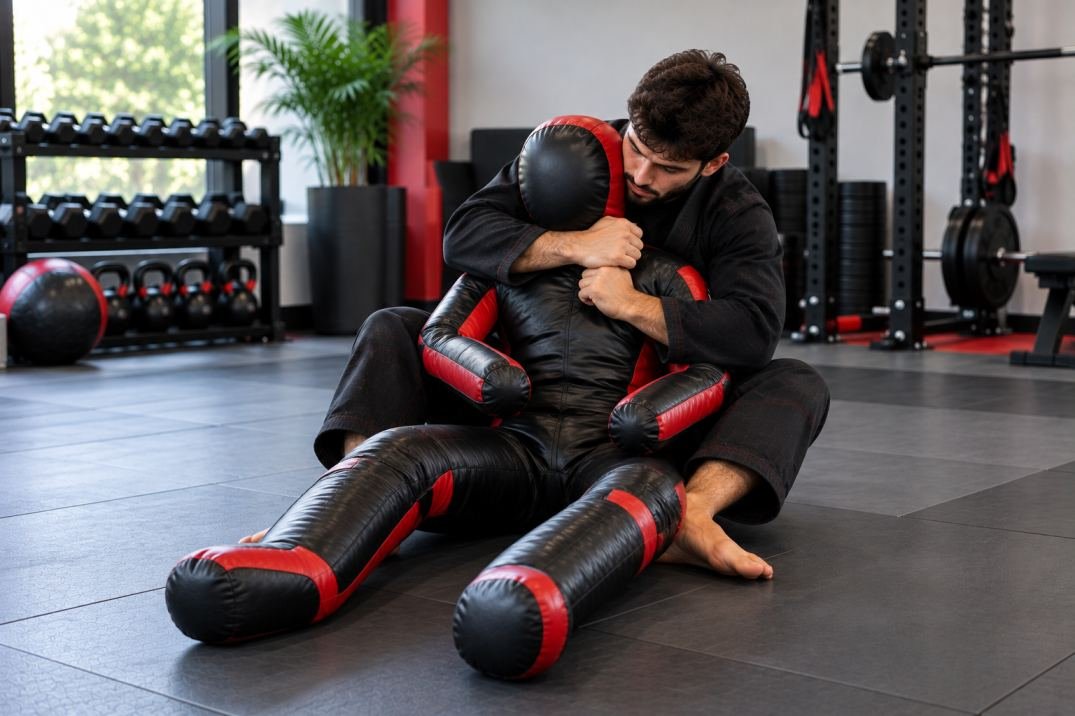
Building out your solo repetition practice?
Explore Home Gym Goals' grappling dummies for back-control positioning and technical RNC repetition at home.
RNC Training at Home
Home practice should complement qualified instruction and live training, not replace it. For a fuller look at building a complete home training approach, see BJJ training at home.
- Suitable mats — appropriate cushioning and a training surface designed for grappling.
- Space requirements — enough room to move freely without obstacles nearby.
- Grappling dummy — supports positioning and movement repetition when a partner isn't available.
- Warm-up — general mobility before technical drilling.
- Technical drilling — solo movement or dummy-assisted repetition of position and grip mechanics.
- Partner practice if available — cooperative drilling with a trained, communicative partner.
- Solo visualization — mentally rehearsing sequences and decision points.
- Cool-down — light stretching and movement to close the session.
- Safety — appropriate space, controlled intensity, and no substitute for qualified instruction.
30-Minute RNC Training Session
A general educational example, not personalized coaching — adapt it to your own gym, coach and level.
Common RNC Training Mistakes
- Focusing only on finishing — neglecting the positional control that makes a finish viable in the first place. Better approach: prioritize back-control quality first.
- Ignoring back control — attempting entries or grips without stable position underneath them. Better approach: confirm hooks and chest connection before anything else.
- Losing positional stability — overcommitting to a grip attempt at the cost of position. Better approach: treat control as the priority, not the attempt.
- Drilling too quickly — rushing technique before it's grooved. Better approach: slow down and prioritize technical accuracy.
- Using excessive force — relying on strength instead of positioning and mechanics. Better approach: refine technique before adding intensity.
- Poor control — inconsistent hook or chest connection during drilling. Better approach: isolate control drilling before adding complexity.
- Ignoring defensive reactions — forcing a fixed sequence regardless of how the partner responds. Better approach: practice reading and adjusting to reactions.
- Not practicing transitions — treating control and finishing as disconnected skills. Better approach: drill the connections between phases.
- Not practicing retention — only training the finish, never the ability to keep the position. Better approach: dedicate specific drilling time to retention.
- Treating a grappling dummy like a live partner — expecting resistance or reactions it can't provide. Better approach: use the dummy for repetition, not live testing.
- Skipping warm-up — going straight into technical drilling cold. Better approach: always warm up mobility first.
- Training on unsuitable surfaces — practicing contact drilling on hard or uneven flooring. Better approach: use appropriate mats.
- Ignoring coaching feedback — self-teaching technical detail without correction. Better approach: seek qualified instruction regularly.
- Practicing chokes without appropriate supervision — especially as a beginner. Better approach: train under a qualified instructor, particularly early on.
How Often Should You Train the RNC?
There's no single universal training frequency. For beginners, shorter, more frequent technical sessions focused on position and control generally build a stronger foundation than infrequent, high-intensity sessions. Intermediate practitioners typically add more live drilling and controlled resistance as consistency improves. Advanced practitioners often integrate RNC concepts continuously into live rolling rather than treating it as an isolated drilling block. Across all levels, consistency, technical quality, adequate recovery, and a balance between positional drilling and live training tend to matter more than any specific number of sessions per week.
RNC Training by Skill Level
| Skill Level | Training Focus | Recommended Drills | Main Goal |
|---|---|---|---|
| Beginner | Back control, positioning, basic RNC concepts | Position familiarization, back-control maintenance, grip awareness | Build a stable positional foundation |
| Intermediate | Entries, retention, transitions, controlled resistance | Entry drills, back-retention drills, RNC transition drills | Connect control to genuine finishing opportunities |
| Advanced | Chains, reactions, positional integration | Reaction drills, submission-chain drills, positional sparring | Apply RNC concepts fluidly within live grappling |
RNC Training Equipment
RNC training doesn't require expensive equipment. The essentials are a BJJ gi or appropriate no-gi clothing depending on your training context, suitable grappling mats, and adequate training space. A grappling dummy can support solo repetition between partner sessions. For general training equipment, see home gym equipment, and for BJJ and grappling-specific gear, browse BJJ and grappling training equipment.
RNC vs Other Submissions
A conceptual comparison — for full technical coverage, see the dedicated specialist pages linked below.
| Comparison | General Control Concept | Common Positional Context | Beginner Consideration |
|---|---|---|---|
| RNC vs Kimura | Neck/upper-body control vs shoulder-joint control | Back control vs guard, side control or mount | RNC depends heavily on back control; Kimura can be trained from more positions — see BJJ Kimura training and drills |
| RNC vs Americana | Neck/upper-body control vs shoulder-joint control | Back control vs mount or side control | Different body mechanics and risk profile — see BJJ Americana training and drills |
| RNC vs Armbar | Neck/upper-body control vs elbow-joint control | Back control vs guard, mount or side control | Armbar can be trained from more positions than RNC — see BJJ armbar training and drills |
| RNC vs Triangle | Neck/upper-body control vs leg-based neck and arm control | Back control vs guard | Triangle relies on leg positioning rather than back control — see BJJ triangle training and drills |
Gi vs No-Gi RNC Training
Gi and no-gi RNC training share the same underlying principles — back control, positional priority, timing and grip mechanics — but aren't mechanically identical. Grips differ because gi fabric offers additional friction and control points that no-gi training doesn't have. Clothing considerations affect how control is established and maintained, and some practitioners find positioning adjustments necessary when switching between the two. Training in both contexts, where possible, tends to build a more complete understanding of the underlying control principles.
BJJ vs MMA RNC Training
The underlying RNC mechanics are similar across BJJ, submission grappling and MMA, but training context differs. In MMA, positioning and control must also account for striking considerations, including ground-and-pound, which affects how a practitioner enters and maintains back control. Rules also differ between contexts, which can affect what positional options are available or emphasized. This is why training methods can differ somewhat between BJJ-focused and MMA-focused practitioners, even though the core technique is shared. This page focuses on BJJ and submission-grappling training methods rather than serving as a general MMA training guide.
How to Improve Your RNC
Beginner RNC Training Checklist
Optional 30-Day RNC Progression
This is an example framework, not a universal training prescription — adjust it to your own schedule, gym and coaching.
Back control + RNC positioning
Focus on stable back control and correct RNC body positioning through repetition.
Entries + retention
Add entry drilling from common contexts and back-retention drilling against light resistance.
Transitions + controlled resistance
Practice moving between control, grip attempts and resets, with gradually increasing resistance.
Chains + positional sparring + review
Introduce submission-chain thinking, light positional sparring, and review technical detail with a coach.
RNC Training Methods Compared
| Training Method | Main Focus | Beginner Friendly? | Equipment | Main Limitation |
|---|---|---|---|---|
| Partner RNC drilling | Full technical sequence with feedback | Yes, with cooperative pacing | Mats, partner | Requires a trained, available partner |
| Solo RNC drilling | Movement patterns and visualization | Yes | Mats | No resistance or reactions |
| Grappling dummy RNC drilling | Positioning and technical repetition | Yes | Mats, dummy | No resistance, reactions or timing |
| Back-control positional drilling | Foundational control skill | Yes | Mats, partner or dummy | Doesn't test finishing mechanics alone |
| Positional sparring | Applying skills under limited live resistance | Intermediate and up | Mats, partner, supervision recommended | Requires appropriate experience and control |
| Live rolling | Full integration under realistic conditions | Intermediate and up | Mats, partner, supervision recommended | Higher skill and safety requirements |
Each method develops a different aspect of RNC skill — the most complete development generally combines several of them under qualified coaching.
Frequently Asked Questions
Direct answers to the questions people ask about rear naked choke training.
What is a rear naked choke in BJJ?
A submission applied from behind an opponent using the arms to control the neck and upper body, generally trained from back control. It's commonly abbreviated RNC.
How do you train a rear naked choke?
By learning back-control fundamentals first, then RNC positioning and grip concepts, drilling slowly with a cooperative partner, practicing entries and retention, and gradually adding controlled resistance under qualified supervision.
What are the best rear naked choke drills for beginners?
Position familiarization, back-control maintenance, grip and hand-position awareness, and cooperative entry drills are strong starting points before adding resistance.
What are the best RNC drills?
The most useful drills depend on skill level, but generally include back-control retention, entry drills, transition drills and, eventually, controlled positional sparring.
Can you practice a rear naked choke with a grappling dummy?
Yes, for position repetition, hand-position awareness and technical sequencing. A dummy cannot reproduce live resistance, reactions, timing or a changing base.
Can you train the RNC alone?
You can practice movement patterns, positioning and visualization alone. Solo training can't replicate live resistance, grip fighting or an opponent's reactions, so it supplements partner training rather than replacing it.
Why is back control important for the RNC?
Back control provides the stable, dominant position the RNC is trained from. Without it, a finishing attempt is far less likely to succeed and can expose the attacker to a worse position.
Is the rear naked choke used in no-gi?
Yes. The RNC is trained in both gi and no-gi contexts, sharing the same underlying principles, though grip and control details differ slightly between the two.
Is the RNC used in MMA?
Yes, the RNC is used in MMA as well as BJJ and submission grappling, though MMA training also accounts for striking considerations like ground-and-pound.
How often should you drill the RNC?
There's no single universal frequency — beginners generally benefit from shorter, more frequent technical sessions, while more experienced practitioners often integrate it continuously into live training.
Is RNC training suitable for beginners?
Yes, when introduced through controlled, cooperative drilling with proper supervision, gradually adding resistance as technical understanding and safety awareness develop.
How do you safely practice a rear naked choke?
Use appropriate mats, communicate clearly with your partner, keep pressure controlled, increase resistance gradually, tap early when needed, and release immediately after any tap.
What is the difference between an RNC and other BJJ submissions?
The RNC controls the neck and upper body from back control, while submissions like the armbar, Kimura, Americana and triangle target joints or use different positional contexts and control mechanics.
Rear Naked Choke Training: Quick Answers
What is a rear naked choke?
A submission applied from behind an opponent, using the arms to control the neck and upper body, generally trained from back control.
What is RNC training?
The practice of developing back control, positioning, grip mechanics, entries, retention and transitions that support the rear naked choke.
What is an RNC drill?
A structured, controlled repetition — such as position familiarization, entries or retention practice — used to build RNC skill safely.
What is an RNC entry?
The movement used to establish back control from a recognizable context, such as turtle or a transitional scramble.
What is back control?
A dominant grappling position behind the opponent, typically with hooks or a body triangle and chest connection, that the RNC is trained from.
What is back retention?
The ability to maintain back control against an opponent's attempts to escape or create space.
What is an RNC transition?
Movement between control, grip attempts and repositioning as an RNC exchange develops.
What is RNC defense?
Recognizing back control developing, protecting posture and the neck, and learning defensive movement under qualified instruction.
Why should BJJ practitioners train the RNC?
It develops back-control awareness, positional priority, timing, grip mechanics and defensive understanding that carry over broadly across grappling.
Can a grappling dummy help with RNC training?
Yes, for position repetition and technical familiarity. It cannot reproduce live resistance, reactions or timing.
Shop BJJ & Grappling Training Equipment
Once your fundamentals are solid, a suitable dummy can support the solo side of your RNC and back-control training between partner sessions.
This guide provides general educational information about rear naked choke training and drills and is not a substitute for qualified instruction. Chokes carry real risk and should be practiced with a trained, communicative partner under qualified supervision, with gradual resistance and immediate release after any tap. No technique is guaranteed to work in every situation or as self-defense. A suitable training dummy can support some repetitions but cannot reproduce a live training partner. Explore more at Home Gym Goals.