
Martial Arts Dummy vs Grappling Dummy: What's the Difference?
The two terms overlap, which is why they're so easily confused. In short: "martial arts dummy" is a broad label, while "grappling dummy" usually points to a design built for grappling. Here's what that means in practice — and how to choose.
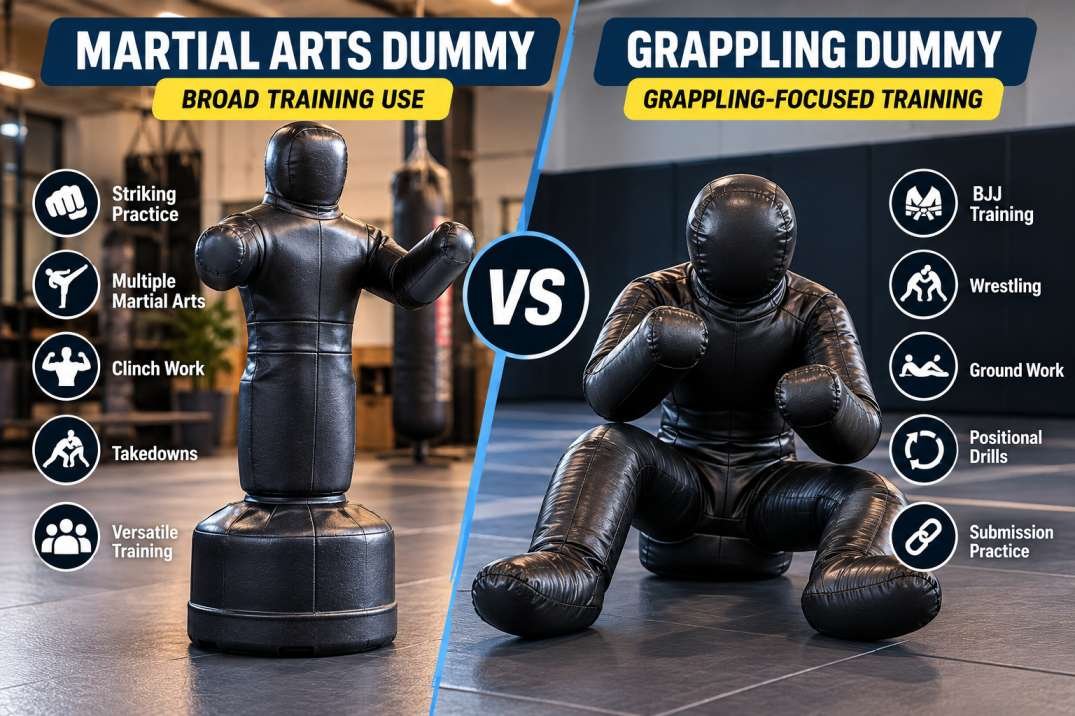
"Martial arts dummy" is a broad term for any training dummy used in martial arts, which — depending on design — may support striking, grappling or both. "Grappling dummy" is generally more specialized, built primarily for grappling practice such as BJJ, wrestling and MMA ground work. The right choice depends on your intended training, and the product's actual design matters more than the name alone.
Martial arts dummy vs grappling dummy: at a glance
General tendencies by term — not universal product specifications. Every cell is design-dependent, so confirm against the actual product.
| Feature | Martial arts dummy | Grappling dummy |
|---|---|---|
| Main purpose | Broad martial arts training | Grappling-focused training |
| BJJ | Depends on design | Usually highly relevant |
| Wrestling | Depends on design | Often relevant |
| MMA | Depends on design | Strong for the grappling component |
| Ground work | Product-dependent | Usually a core use |
| Takedowns | Product-dependent | Often supported |
| Striking | Product-dependent | Not necessarily designed for it |
| Best suited for | Multi-purpose, depending on design | BJJ, wrestling & grappling |
What is a martial arts dummy?
A martial arts dummy is a broad product or category term for a training dummy used in martial arts practice. What it can actually do depends entirely on how that particular dummy is built.
Depending on design, a martial arts dummy may support striking practice, grappling practice, throws, takedowns, clinch work, positional practice or movement drills — but you should never assume a given martial arts dummy supports all of these. Some are striking-oriented and shaped like an upright target; others are humanoid grappling tools; others are hybrids. The label tells you the intended field (martial arts) but not the specific job.
That's the crucial point: because "martial arts dummy" is used loosely across manufacturers, the term alone can't tell you whether a product suits your training. The construction does.
What is a grappling dummy?
A grappling dummy is generally designed primarily for grappling practice. That typically covers BJJ, Brazilian Jiu-Jitsu, wrestling, MMA grappling, submission grappling, takedown practice, positional drills, ground-control practice and solo grappling training.
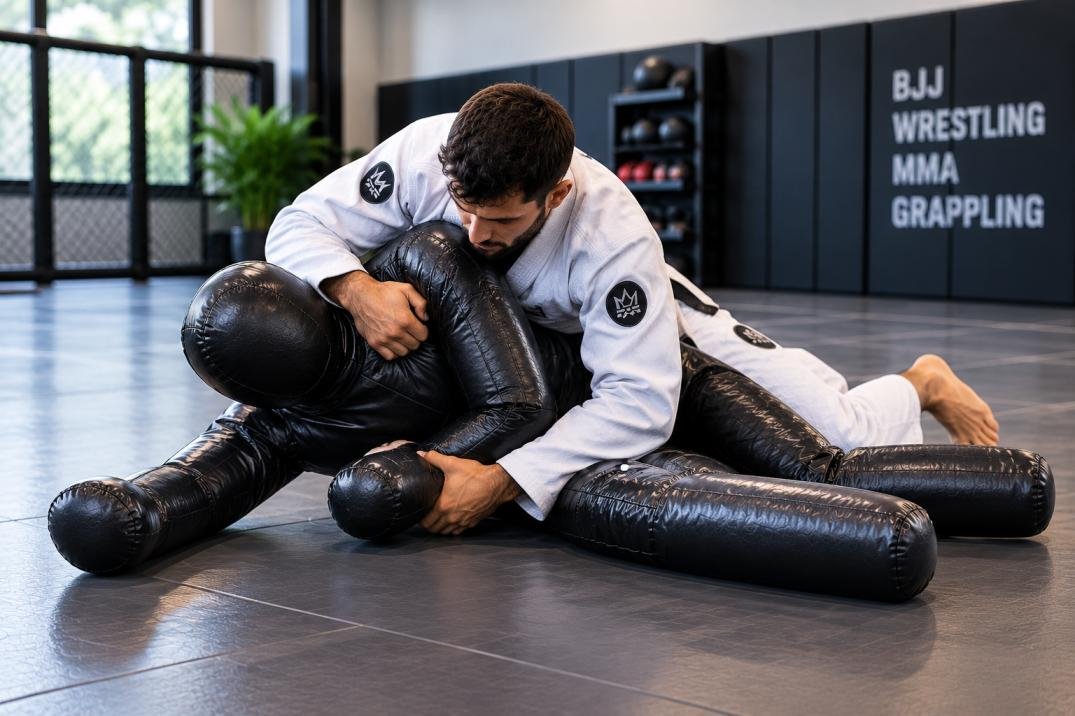
Grappling dummies are usually humanoid with positionable or semi-positionable limbs, and they're built to be worked with on the mat as well as (in some designs) upright. As with the broader term, though, designs vary between manufacturers — a grappling dummy built for standing takedown work and one built for ground positioning can feel quite different. The name signals grappling intent; the specific design still decides the details.
If you're weighing a grappling dummy specifically against a wrestling-oriented one, our grappling dummy vs wrestling dummy guide goes deeper on that particular comparison.
Martial arts dummy vs grappling dummy: key differences
The practical differences come down to breadth of purpose and how the dummy is designed to be used — not a rigid technical divide.
| Feature | Martial arts dummy | Grappling dummy |
|---|---|---|
| Primary purpose | Broad martial arts practice | Grappling practice |
| Typical training styles | Striking, grappling or mixed | Ground, positional, takedowns |
| Striking suitability | Sometimes, by design | Often not designed for it |
| Grappling suitability | Depends on design | Usually a core strength |
| Takedown practice | Product-dependent | Often supported, if rated |
| Ground-position practice | Product-dependent | Usually a core use |
| BJJ suitability | Depends on design | Typically high |
| Wrestling suitability | Depends on design | Often relevant |
| MMA suitability | Depends on design | Strong for grappling |
| Limb positioning | Varies widely | Often positionable |
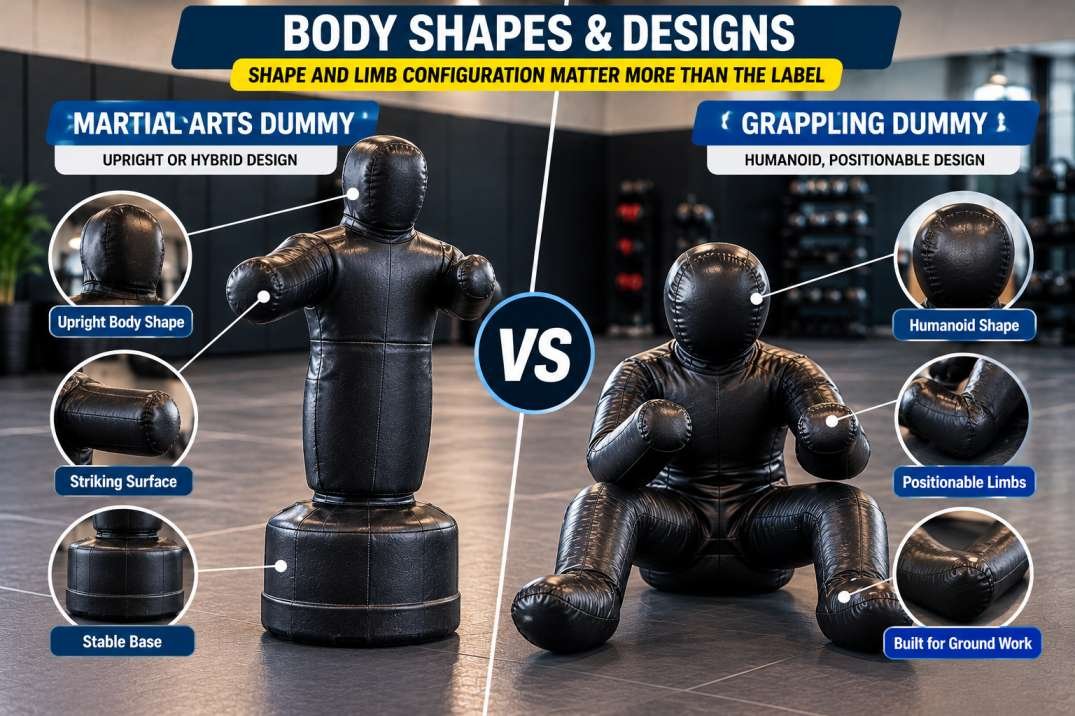
| Body shape | Upright or humanoid | Usually humanoid |
| Training environment | Standing or ground | Mat, sometimes standing |
| Best suited user | Multi-discipline, by design | Grapplers & BJJ athletes |
Are martial arts dummies and grappling dummies the same thing?
Not exactly. The terms overlap — a grappling dummy is a martial arts dummy — but they aren't interchangeable. Think of it as a category and a type within it: every grappling dummy is a martial arts dummy, but not every martial arts dummy is a grappling dummy. A striking-oriented martial arts dummy, for example, isn't a grappling dummy.
The key takeaway: product names are not standardized. Two products with the same label can be built very differently, and manufacturers use these terms loosely. Judge the construction, shape, limb positioning, intended position and stated intended use rather than the name on the box.
Martial arts dummy vs grappling dummy for BJJ
For BJJ, the characteristics that matter are the ones that support ground and positional work: a humanoid shape, positionable limbs, mat-friendly design and suitable weight. Those let you rehearse takedowns, positional drilling, guard-related movement, mount, side control and back control, submission-positioning movement and solo drilling.
A grappling or BJJ dummy is usually built around exactly these needs, whereas a general martial arts dummy only suits BJJ if its design happens to include them. This is an equipment-suitability question, not a technique one — for the actual drilling, see our BJJ dummy drills.

Martial arts dummy vs grappling dummy for wrestling
For wrestling, the relevant qualities are those that support takedowns, body positioning, sprawls, controlled movement drills and ground wrestling. A grappling dummy with a suitable shape and weight often serves these well; a general martial arts dummy depends on whether it's built for upright, takedown-style handling.
Full takedown or throwing movements are always design-dependent — only perform them on a dummy rated for that use. For wrestling-specific work, see our wrestling dummy drills, and for the BJJ crossover, wrestling dummy for BJJ.

Martial arts dummy vs grappling dummy for MMA
MMA blends striking and grappling, so the answer depends on which side you're training. For the grappling component — takedowns, ground positioning and transition practice — a grappling dummy is generally the more directly relevant tool. For striking, a grappling dummy isn't automatically a substitute for a heavy bag or dedicated striking equipment.
In other words, a grappling dummy covers the wrestling-and-BJJ half of MMA well, but you'd typically pair it with separate striking equipment rather than expecting one dummy to do everything. Our MMA grappling drills cover the grappling side.
Which is better for BJJ?
For primarily BJJ or grappling-focused training, a properly designed grappling or BJJ dummy is generally the more directly relevant choice — it's built around the ground and positional work that defines the sport. That said, evaluate the actual product rather than the marketing name: a well-designed martial arts dummy with the right humanoid, mat-friendly build can also work, and a poorly matched "grappling dummy" might not suit your specific game. Match the design to your drills. To weigh up a specific product, our how to choose a grappling dummy guide walks through the factors.
Which is better for MMA?
There's no universal winner for MMA — it depends on your primary goal. If you're focused on striking, a striking-capable martial arts dummy or dedicated striking equipment matters more. If you're focused on grappling, takedowns or ground work, a grappling dummy is the stronger fit. Most MMA athletes end up with a grappling dummy for the wrestling-and-BJJ side and separate equipment for striking, rather than trying to make one dummy cover both.
Which is better for wrestling?
For wrestling, the better dummy is the one whose design supports the movements you drill — typically an upright or humanoid dummy with a suitable weight and shape for takedown entries, body control and movement, rated for the handling you intend. Both a grappling dummy and a wrestling-oriented martial arts dummy can fit that description; the deciding factor is the specific build and its stated intended use, not the category label.
What should you look for when comparing them?
When you're specifically choosing between a martial arts dummy and a grappling dummy, these are the factors that resolve the decision:
- Intended use — striking, grappling or mixed, per the manufacturer.
- Construction and stitching/seams — how it holds up to your training.
- Shape and limb configuration — humanoid and positionable for grappling.
- Material and fillability — cover material and whether you can adjust the fill.
- Size and weight — relative to your body and drills.
- Standing vs ground-oriented design — the single biggest practical split.
- Durability, storage and available space — the practical realities of home use.
This is the comparison-specific short version; for a full buyer's walk-through, see how to choose a grappling dummy.
Can you use a grappling dummy for martial arts training?
Yes — for the grappling side of martial arts. A grappling dummy works well for BJJ, wrestling and MMA ground practice: positions, transitions, takedown motions and submission positioning. Where it's less appropriate is striking-oriented training — for that, a heavy bag or a striking-specific target is usually the better tool. So a grappling dummy covers a large slice of martial arts practice, just not the striking slice.
Can you use a martial arts dummy for BJJ?
It depends heavily on the dummy's construction and intended use. A martial arts dummy with a humanoid, mat-friendly, positionable design can work well for BJJ; one built primarily as an upright striking target generally won't suit ground-focused BJJ. Because "martial arts dummy" is such a broad label, you have to check the specific product's shape and stated intended use rather than assuming — the name alone doesn't guarantee BJJ suitability.
Martial arts dummy vs grappling dummy: pros and cons
General tendencies by term — always verify against the specific product.
- Broad term — can cover striking, grappling or both
- Some designs are genuinely multi-purpose
- May suit mixed-discipline training in one tool
- The label tells you little about the actual build
- Grappling suitability is design-dependent
- Some are striking-only and unsuited to ground work
- Generally built around grappling and ground work
- Usually humanoid with positionable limbs
- Strong, direct fit for BJJ and submission grappling
- Not necessarily designed for striking
- Standing/takedown use is still design-dependent
- No live resistance or reactions (like any dummy)
Which dummy should you buy?
A simple, practical framework.
- Choose a grappling dummy if your primary training is BJJ, submission grappling is the focus, ground-position drilling matters, or solo grappling practice is your priority.
- Consider another martial arts dummy design if your training needs a different body configuration, striking-oriented practice is important, or a specific product explicitly supports the training you intend to do.
Either way, the decision comes down to matching the design to your actual goals — and confirming the manufacturer's stated intended use before you buy.

Can a grappling dummy replace a training partner?
No. Whichever type you choose, a dummy is a supplemental solo-training tool, not a substitute for a partner. It can't provide:
- Live reactions and resistance adaptation
- Timing against a moving person
- Realistic grip fighting and unpredictable movement
- Coaching feedback and rolling
A dummy builds the repeatable, mechanical side of your game on your own time. The reactive side — the heart of grappling — still comes from live partners and qualified coaching.
Choose the right dummy for your training
If your main goal is BJJ, grappling or solo ground training, explore the grappling-oriented range and match a design to your drills.
Frequently asked questions
Short, direct answers to the questions buyers ask most.
Is a grappling dummy the same as a martial arts dummy?
Not exactly. A grappling dummy is a type of martial arts dummy — every grappling dummy is a martial arts dummy, but not every martial arts dummy is a grappling dummy. "Martial arts dummy" is the broad term; "grappling dummy" points to a grappling-focused design.
What is the best dummy for BJJ?
For BJJ, a grappling or BJJ dummy designed for ground and positional work is usually the most directly relevant choice — humanoid, mat-friendly and with positionable limbs. Match the specific design to the positions and movements you want to drill.
Can you use a martial arts dummy for BJJ?
It depends on the construction. A martial arts dummy with a humanoid, mat-friendly, positionable design can work for BJJ; an upright striking-oriented one generally won't suit ground work. Check the product's shape and intended use rather than the label.
Can you use a grappling dummy for MMA?
Yes, for the grappling side — takedowns, ground positioning and transitions. It isn't a substitute for a heavy bag or striking equipment, so most MMA athletes pair a grappling dummy with separate striking tools.
Can a grappling dummy be used for wrestling?
Often yes, for takedown entries, body positioning and movement drills, if its shape and weight suit upright handling. Full takedowns or throws should only be done on a dummy rated for that use.
Are martial arts dummies good for beginners?
They can be, as a supplement for movement and repetition. Beginners should still learn technique from a qualified instructor and train with partners — a dummy reinforces what you learn, it doesn't teach the reactive skills.
What is the difference between a BJJ dummy and a martial arts dummy?
A BJJ dummy is a grappling dummy designed around Brazilian Jiu-Jitsu, so it's a specific type of martial arts dummy. "Martial arts dummy" is the broad umbrella that also covers striking-oriented and other designs.
Is a grappling dummy worth buying for home training?
For solo grappling repetition and positional practice, many people find one worthwhile — provided they understand it can't replace live partners. Factor in size, weight and storage before buying.
Can you practise submissions with a grappling dummy?
You can rehearse the positioning and movement of submissions on a suitably designed dummy, as controlled technical practice. A dummy can't tap or resist, so it's practice of the shape, never a real finish.
What should I look for when comparing training dummies?
Intended use, construction, shape and limb configuration, material and fillability, size and weight, standing-versus-ground design, durability, storage and available space — plus the manufacturer's stated intended use, which matters more than the label.
Continue your research
Related comparisons and guides to help you decide.
This guide provides general, category-level information to help compare the terms "martial arts dummy" and "grappling dummy"; it is not product-specific advice. These labels are broad and not standardized between manufacturers — actual capabilities, dimensions, weight, materials, construction and intended use vary by product and should be confirmed against the manufacturer's documentation and the live product listing. A dummy is a supplemental solo-training tool: it cannot provide live resistance, reactions or coaching, and it does not replace qualified instruction or live partner training. Train on appropriate mats with sufficient space, follow the manufacturer's instructions, and learn techniques from a qualified instructor. No equipment is injury-proof, and no training tool guarantees self-defense ability. Explore more at Home Gym Goals.