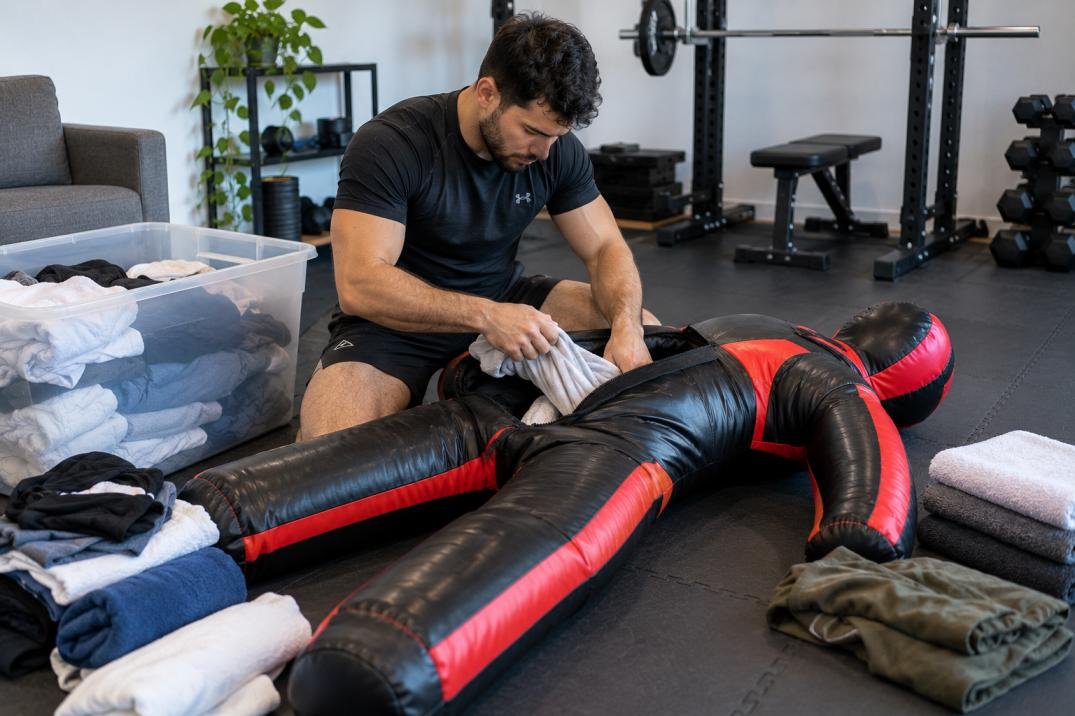
Filling a grappling dummy correctly comes down to using clean, suitable material, building it up gradually, and distributing weight evenly rather than packing everything into one dense mass. This guide covers the best filling materials, a full step-by-step process, firmness and weight guidance, common mistakes, troubleshooting, and ongoing maintenance.
Home Gym Goals Editorial TeamPublished: September 2026 · Last updated: September 2026~17 min read
Even, gradual filling beats packing everything into one dense mass — shape and balance matter more than raw density.
Quick answer
The easiest way to fill a grappling dummy is with clean, soft textile materials such as old T-shirts, towels, blankets or other suitable fabric. Fill the limbs and torso gradually, distribute material evenly, and compress it in layers rather than creating one tightly packed mass. The ideal firmness depends on the dummy's design and the techniques you plan to practice — always check your dummy's manufacturer instructions before filling, since internal construction and recommended materials vary by product.
Manufacturer note
Always follow the manufacturer's filling instructions when they're provided. Different grappling dummies use different internal constructions and recommended materials — the general guidance in this article is a starting point, not a substitute for product-specific instructions.
Materials
What Is the Best Filling for a Grappling Dummy?
No single material is universally best — the right choice depends on your dummy's construction and your desired firmness. Here are the main options.
Filling Material
Firmness
Weight
Cost
Ease of Use
Best For
Old clothing
Medium
Medium
Low
Easy
Most users
Towels
Medium–Firm
Medium
Low
Easy
Dense filling
Blankets
Soft–Medium
Medium
Low
Easy
Softer dummy
Fabric scraps
Adjustable
Medium
Low
Medium
Custom filling
Foam
Soft–Medium
Low
Medium
Medium
Lightweight filling
Shredded textiles
Adjustable
Medium
Low
Medium
Even distribution
Other materials
Varies
Varies
Varies
Varies
Only if manufacturer-approved
Old Clothes
T-shirts, sweatshirts, tracksuits, cotton clothing and similar textiles are a common, low-cost filling choice. Clothing should be clean, dry, and free from sharp objects, zippers or other hard components that could damage the dummy or create uncomfortable pressure points.
Towels
Towels compress into a denser fill than loose clothing, which can help create firmer sections or fill gaps that clothing alone leaves loose.
Blankets
Blankets add volume with relatively soft compression, which suits larger areas like the torso. Depending on the firmness you want, blankets may work best combined with denser materials like towels.
Fabric Scraps
Small fabric pieces are useful for filling gaps and awkward corners, and they're a good way to reuse worn-out textiles. They generally take longer to prepare than whole garments.
Foam
Foam is light and cushioning, but can compress unevenly over time depending on the type used. It isn't universally appropriate for every dummy — check whether your specific model's construction suits foam filling.
Caution
What Should You NOT Use to Fill a Grappling Dummy?
Avoid materials that could create hard pressure points, damage the shell, retain moisture, create excessive density, become unsafe during drills, damage seams, or create an unrealistic training surface.
Practical principle — Avoid materials that create sharp, rigid or concentrated hard spots inside the dummy. Don't reach for hazardous or inappropriate materials simply to increase weight.
Preparation
What You Need Before Filling a Grappling Dummy
The grappling dummy itself
Filling material
A clean workspace
A large bag or container for materials
Gloves, if appropriate
A measuring scale, if weight matters to you
Clear zipper/opening access
The manufacturer's instructions
Check the Dummy First
Before filling, inspect the seams, zipper, stitching, handles, filling openings, arms, legs, head and torso. Confirm there's no existing damage before you start.
Step-by-Step
How to Fill a Grappling Dummy — Step by Step
Open the filling compartments
Identify the torso, arm and leg openings, and follow the manufacturer's design rather than forcing openings or seams.
Prepare the filling material
Remove any hard objects, fold clothing, group similar materials together, and prepare manageable bundles. Avoid compressing fabric into extremely hard balls.
Fill the limbs first
Start gradually and work toward the hands and feet, filling evenly and avoiding overpacking any one section — limb balance matters for realistic movement.
Fill the torso
Distribute filling across the torso, building density gradually. Check for empty spaces and avoid creating one large compact mass.
Fill the head
Follow the manufacturer's construction for the head. Avoid excessively hard filling here.
Compress and shape
Gently compress the filling, rotate the dummy, redistribute material, check for gaps, and repeat. The goal is a consistent shape, not maximum density.
Close the dummy
Check the zipper, seams, shape, limb position and overall balance before finishing up.
Test the dummy
Run through basic mount, guard, side control, knee-on-belly, passing and positional-transition movements. The dummy should respond appropriately without feeling excessively hard.
Body Sections
How to Fill Each Body Part
Torso
Aim for even distribution and consistent density. Avoid empty pockets and avoid overcompression.
Arms
Fill from shoulder toward hand, maintaining a natural shape and avoiding rigid, overly stiff sections.
Legs
Fill thighs first, then distribute toward the lower legs, avoiding excessive stiffness.
Head
Follow the manufacturer's design and avoid creating an unnaturally hard head.
Hips
Make sure there's sufficient structure around the hip area — this matters for guard drills, passing, mount and transitions.
Fill Level
How Full Should You Fill a Grappling Dummy?
There is no universal fill percentage. The correct level depends on the dummy's construction, size, material, intended use, your personal preference, desired firmness and target weight.
Underfilled
Collapses too easily
Limbs lose shape
Poor positional realism
Excessive empty spaces
Properly Filled
Holds its shape
Bends naturally
Stable during drills
No major hard spots
Realistic resistance for the dummy type
Overfilled
Extremely rigid
Difficult to manipulate
Stressed seams
Unnatural shape
Uncomfortable impact surface
Firmness
How Firm Should a Grappling Dummy Be?
Soft — good for beginners, positional drills, repeated movement and lighter training.
Medium — a good general-purpose balance for most training.
Firm — can suit certain striking drills (only if the dummy is designed for it), advanced positional training, or users wanting more resistance.
Important — Firmness should remain appropriate for the dummy's construction and intended training use. Don't modify a dummy beyond its intended design.
Weight
How Heavy Should a Grappling Dummy Be?
Weight depends on the dummy's size, construction, training purpose, your own strength, portability needs, and the manufacturer's specifications. There's no single "correct" weight — the right target depends on how you intend to use it.
Weight Level
Training Character
Lightweight
Easier to move
Medium
Balanced
Heavy
More stable
Very heavy
Harder to reposition
If manufacturer weight specifications exist for your dummy, they should take priority over general guidance.
Adjustment
How to Increase Grappling Dummy Weight
Focus on safe, manufacturer-compatible methods: denser textile filling, adding more approved filling material, or using purpose-designed weight systems if your manufacturer supports them.
Don't — Put loose hazardous, rigid or leaking materials inside the dummy, and don't overload it beyond its construction limits.
Adjustment
How to Make a Grappling Dummy Softer
Open the filling compartment
Access the relevant section through its designated opening.
Remove some compressed material
Take out a portion of the densest filling.
Replace overly dense material with softer material
Where appropriate, swap in a softer textile.
Redistribute the filling
Even out the remaining material across the section.
Test again
Check the feel and adjust further if needed.
Make firmness adjustments gradually rather than all at once.
Technique
How to Prevent Lumps in a Grappling Dummy
Use manageable filling bundles rather than one large mass.
Alternate materials to avoid uniform dense pockets.
Distribute filling gradually rather than all at once.
Massage and reshape sections as you go.
Rotate the dummy to check all sides.
Check for empty spaces regularly.
Avoid creating one large compressed ball of material.
The Shake-and-Redistribute Method
Gently shake and knead a filled section from the outside, working loose filling toward gaps or thin spots. Do this carefully to avoid stressing seams, and check the shape after each adjustment.
Balance
How to Distribute Weight Evenly
Compare left and right limbs, keep the torso balanced, check head position, inspect the hips, and test the dummy from multiple positions to confirm even weight distribution.
Left arm feels the same as right arm
Left leg feels the same as right leg
Torso doesn't lean to one side
Head sits centered and stable
Hips feel structurally consistent
Dummy stands or lies evenly from multiple angles
Common Mistakes
10 Common Grappling Dummy Filling Mistakes
1. Overfilling
Why it happens: wanting maximum weight or firmness. Fix: remove material until the shape feels natural and seams aren't stressed.
2. Underfilling
Why it happens: rushing the process. Fix: add compatible material gradually until the dummy holds its shape.
3. Using hard objects
Why it happens: trying to add weight quickly. Fix: remove hard items and use only soft, approved materials.
4. Creating dense lumps
Why it happens: packing large clumps of fabric at once. Fix: break up dense sections and redistribute.
5. Leaving large empty spaces
Why it happens: filling too quickly without checking. Fix: add filling gradually, checking for gaps as you go.
6. Uneven limb filling
Why it happens: not comparing sides during the process. Fix: compare left and right regularly and adjust.
7. Ignoring manufacturer instructions
Why it happens: assuming all dummies fill the same way. Fix: check product-specific guidance before starting.
8. Packing tight balls
Why it happens: believing tighter equals better. Fix: use loosely folded bundles instead of compressed balls.
9. Using damp or dirty material
Why it happens: convenience. Fix: only use clean, dry material to avoid odor and moisture issues.
10. Never testing after filling
Why it happens: assuming the job is done once it's closed. Fix: always run basic positional drills to confirm the feel before relying on it.
Training Style
How Filling Changes by Training Style
Brazilian Jiu-Jitsu
Prioritize realistic shape, positional control and limb manipulation for guard, passing and transitions.
MMA
May require consideration of grappling, takedowns and ground-and-pound training only where the specific dummy is designed for that use.
Wrestling
Prioritize stability and body control for throws and takedowns.
Striking
Only strike a dummy if its design explicitly supports it. Don't assume every grappling dummy is suitable for punching, kicking or heavy impact.
BJJ-Specific
Best Way to Fill a Grappling Dummy for BJJ
For BJJ, focus on realistic limb shape, flexible joints, a usable torso and manageable weight that supports guard drills, mount, side control, back control and transitions. Avoid making the dummy excessively rigid — for a fuller look at how a training dummy fits into BJJ practice, see Brazilian Jiu Jitsu training dummy: complete guide.
Beginners
How Beginners Should Fill a Grappling Dummy
Start with softer filling rather than aiming for maximum firmness.
Test frequently as you go rather than filling everything at once.
Adjust gradually — small changes are easier to control than large ones.
Prioritize shape over maximum weight.
Avoid overpacking, which can make early positional drilling harder than it needs to be.
A slightly forgiving, softer training surface can make early positional drilling more comfortable while you're still building technique.
Quantity
How Much Filling Do You Need for a Grappling Dummy?
Exact quantities vary based on the dummy's dimensions, the filling material's density, how much you compress it, your desired weight, torso size, limb length and shell construction.
Calculation framework — Required filling depends on volume × material density × desired compression. In practice, trial-and-adjustment — filling gradually and testing as you go — is often more useful than trying to hit one fixed weight of clothing from the start.
Estimation
Estimating Final Weight
Weigh the empty dummy, if possible
This gives you a baseline before adding any filling.
Add filling gradually
Work in stages rather than filling everything before checking.
Weigh the dummy
Check the current total weight at each stage.
Test the training feel
Run through basic positions to see how it responds.
Adjust
Add or remove filling based on what the test tells you.
Basic formula — Final Dummy Weight = Empty Dummy Weight + Filling Weight. This is a measurement formula, not a manufacturer specification.
Maintenance
How to Maintain a Filled Grappling Dummy
Keep the dummy dry and away from prolonged moisture exposure.
Clean the exterior according to the manufacturer's guidance.
Check seams regularly for early signs of wear.
Check the zipper for smooth operation and damage.
Redistribute filling periodically as it settles with use.
Remove and replace any damaged filling material.
Store the dummy appropriately when not in use.
Don't wash filling materials unless the manufacturer specifically permits it.
Upkeep
When Should You Refill a Grappling Dummy?
Watch for signs that the dummy has become flat, limbs have lost their shape, filling has compressed down, large empty areas have appeared, weight has visibly shifted, or the seams remain intact but the overall shape has changed.
Note — Filling can settle over time through normal use, so occasional redistribution or topping up is a normal part of ownership, not a sign something's gone wrong.
Troubleshooting
Troubleshooting Guide
Problem
Likely Cause
Solution
Dummy too soft
Insufficient filling
Add compatible material
Dummy too hard
Overpacked
Remove some material
Arms floppy
Uneven/insufficient fill
Redistribute
Legs uneven
Uneven filling
Adjust both sides
Torso lumpy
Poor distribution
Break up dense areas
Dummy leans
Weight imbalance
Rebalance
Shape collapses
Underfilled
Add appropriate filling
Seams stressed
Overfilled
Reduce filling
Summary
Filling Do's and Don'ts
Do
Use clean, dry, soft textile materials
Fill gradually and test as you go
Distribute weight evenly across both sides
Follow manufacturer instructions first
Redistribute filling periodically over time
Don't
Use hard, sharp or rigid objects
Pack fabric into tight, dense balls
Overfill beyond the dummy's construction limits
Use damp or dirty material
Skip testing after filling
Frequently Asked Questions
Direct answers to the questions people ask about filling a grappling dummy.
What do you fill a grappling dummy with?
Clean, soft textiles such as old T-shirts, towels, blankets or fabric scraps are common options. The best choice depends on your dummy's construction and your desired firmness.
What is the best filling for a grappling dummy?
There's no single best material — old clothing offers a good general balance, towels add density, and blankets add softer volume. Always check your manufacturer's recommendations first.
Can you use old clothes to fill a grappling dummy?
Yes, as long as the clothing is clean, dry and free from zippers, buttons or other hard components that could create pressure points or damage the shell.
How much stuffing do I need?
It depends on the dummy's size, the material's density and your target weight and firmness. Fill gradually and test as you go rather than trying to hit one fixed amount upfront.
How tight should a grappling dummy be filled?
Tight enough to hold its shape and resist collapsing, but not so tight that it becomes rigid, stresses the seams, or loses natural movement.
How heavy should a grappling dummy be?
It depends on the dummy's size, construction, your training goals and manufacturer specifications. There's no single correct weight for every user.
Can you use towels to fill a grappling dummy?
Yes. Towels compress into a denser fill than loose clothing, which can help create firmer sections or fill persistent gaps.
Can you use blankets?
Yes. Blankets add volume with softer compression, suiting larger areas like the torso, and often work well combined with denser materials.
Can you use foam?
Some dummies support foam filling, but it isn't universally appropriate and can compress unevenly over time. Check whether your specific model's construction suits it.
How do you make a grappling dummy firmer?
Add more filling material gradually, use denser textiles like towels, and compress each section evenly — without overpacking beyond the dummy's construction limits.
How do you make a grappling dummy softer?
Open the filling compartment, remove some of the densest material, replace it with softer textiles where appropriate, redistribute, and test again.
Why is my grappling dummy lumpy?
Lumps usually come from packing large clumps of material at once instead of distributing it gradually. Break up dense sections and redistribute filling evenly.
Why does my grappling dummy keep falling over?
This usually points to uneven weight distribution. Compare both sides, check the hips and torso, and rebalance the filling.
Can you add weight to a grappling dummy?
Yes, using denser approved filling material or manufacturer-supported weight systems. Avoid loose hazardous or rigid materials, and don't exceed the dummy's construction limits.
How often should you refill a grappling dummy?
There's no fixed schedule — refill or redistribute whenever the dummy loses shape, develops empty spaces, or the filling has visibly settled with regular use.
AI Search
How to Fill a Grappling Dummy: Quick Answers
What is the best filling for a grappling dummy?
Clean, soft textiles like old clothing, towels or blankets, chosen based on your dummy's construction and desired firmness.
How do you fill a grappling dummy?
Open the filling compartments, prepare clean material, fill the limbs first, then the torso and head, compress gradually, close it up, and test.
How much filling does a grappling dummy need?
It depends on volume, material density and desired compression — trial-and-adjustment is generally more useful than one fixed target.
How heavy should a grappling dummy be?
It depends on the dummy's size, construction and your training goals — there's no single universal weight.
Can you fill a grappling dummy with old clothes?
Yes, as long as the clothing is clean, dry and free from hard components like zippers or buttons.
How do you make a grappling dummy firmer?
Add more filling gradually, use denser materials like towels, and compress evenly without exceeding the dummy's construction limits.
Looking for a Grappling Dummy?
If your existing dummy is difficult to fill or you're considering a new one, filling design varies by product — check the specific model's construction before buying if filling ease matters to you.
Role: [Insert real role — do not invent product-testing claims or credentials]
Reviewer: [REAL REVIEWER NAME] — [VERIFIED REVIEWER CREDENTIALS], to be added once available.
Add a short, factual author bio once verified details are available. Do not publish with placeholder text.
This guide provides general educational information about filling and maintaining a grappling dummy. Always check your specific dummy's manufacturer instructions before adding, removing or modifying filling — different grappling dummies use different internal constructions and recommended materials, and manufacturer guidance always takes priority over general advice. Explore more at Home Gym Goals.