
Brazilian Jiu Jitsu Training Dummy: Complete Guide
A Brazilian Jiu Jitsu training dummy is a human-shaped training aid built to help practitioners rehearse grappling movement, positioning and transitions without needing a live partner present. It supports real solo practice, but it can't reproduce the resistance, reactions and timing of a real person. This guide covers what a BJJ dummy is, what it's genuinely useful for, who it suits, and how to choose and use one responsibly.
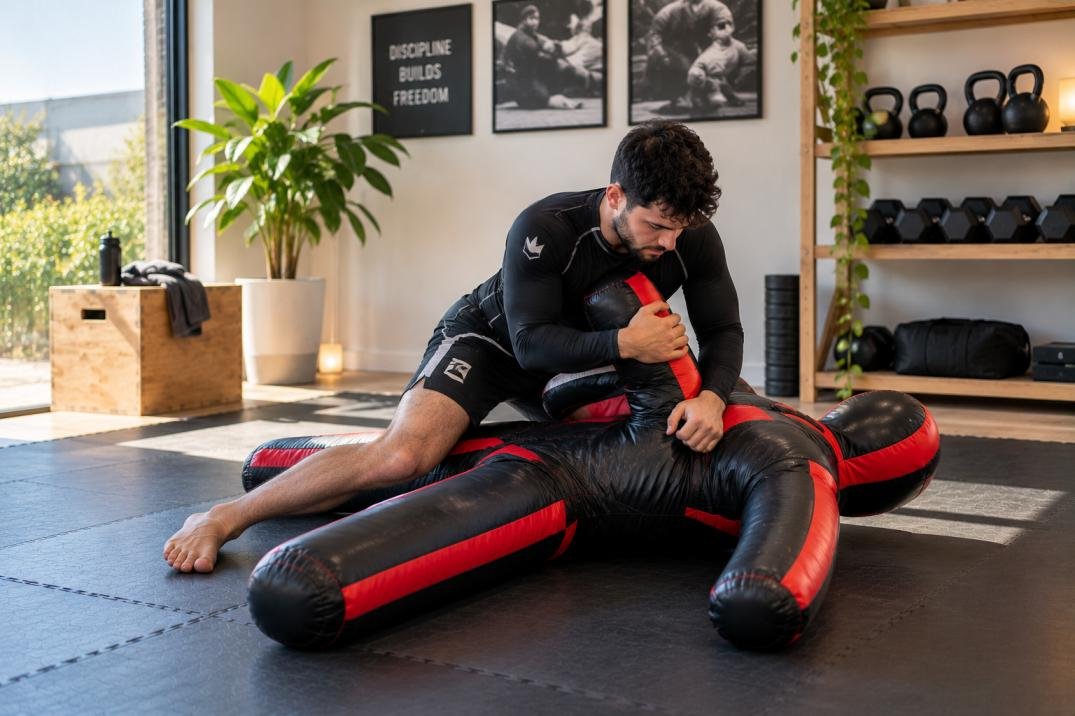
A Brazilian Jiu Jitsu training dummy is a human-shaped training aid designed to help practitioners rehearse grappling movements, positions, transitions and selected techniques without requiring a live partner. It supports solo practice but cannot reproduce the resistance, reactions, timing or unpredictability of a real training partner.
This is an educational guide, not a substitute for qualified BJJ instruction. Use appropriate mats and adequate space, follow the manufacturer's instructions for your specific dummy, inspect equipment regularly, and never treat solo dummy practice as a substitute for learning technique safely from a qualified instructor or applying it to a consenting, trained partner.
What Is a Brazilian Jiu Jitsu Training Dummy?
A Brazilian Jiu Jitsu training dummy is a human-shaped training aid — typically with a defined torso, head, arms and legs — designed to let a practitioner rehearse grappling positions and movement without a live partner.
Construction varies by manufacturer and model. Some BJJ dummies emphasize flexible, poseable limbs suited to ground positioning; others are firmer and more focused on general body positioning than joint articulation. Terms like BJJ dummy, jiu jitsu dummy, BJJ grappling dummy and Brazilian Jiu Jitsu grappling dummy are generally used interchangeably across the market, though exact design details differ from product to product.
The core distinction to understand up front: a training dummy is a fixed, non-reactive object. It holds a position you place it in. A live partner moves, resists, reacts and adjusts. That difference shapes everything else in this guide.
What Is a BJJ Dummy Used For?
Broadly, a BJJ training dummy supports:
- Movement repetition — repeating a physical motion enough times to build familiarity.
- Positional practice — rehearsing where your body should be relative to the dummy's.
- Transitions — practicing the movement between one position and another.
- Body positioning — checking hip, hand and weight placement without needing a partner to hold still.
- Drilling sequences — running through a technical sequence you've already learned.
- Solo practice — training when no partner is available.
- Technique rehearsal — reinforcing movement patterns taught in class.
- Home training — supplementing gym sessions between classes.
For a full library of specific drills by position and technique, see BJJ dummy drills.
Why Use a Brazilian Jiu Jitsu Training Dummy?
The main appeal is repeatable, on-demand practice: no partner scheduling, available whenever you have time and space, and useful for reviewing what you learned in your last class while it's still fresh. Repetition supports comfort with movement patterns, and having a physical target to work against is generally more useful than shadow movement alone for many positional and transition drills.
That said, a dummy does not automatically improve your BJJ. Progress still depends on quality instruction, feedback from a coach or training partners, and time spent training against real resistance. A dummy is a tool that supports the process — it doesn't replace the parts of the process that require another person.
What Can You Practice With a BJJ Training Dummy?
Categories of practice a dummy can reasonably support — for detailed drill instructions on any of these, see the linked specialist pages.
Positional Movement
Rehearsing hip and body positioning relative to the dummy in a given position.
Transitions
Practicing the movement between positions, such as BJJ guard training concepts moving toward mount or side control.
Guard-Related Movement
Hip movement, frame positioning and guard shape changes worked against a stationary target.
Passing Movement
Rehearsing the footwork and body positioning involved in moving around a guard.
Mount Positioning
Practicing balance and positioning from mount — see BJJ mount training.
Side-Control Positioning
Practicing pressure and positioning concepts from side control.
Back-Control Positioning
Hook and chest-connection positioning from behind the dummy — see BJJ back control training.
Takedown Movement
Entry footwork and setup movement — see BJJ takedown drills.
Submission-Position Rehearsal
Safe technical rehearsal of hand and body positioning for a submission — not force or finishing pressure. See rear naked choke training and drills.
Escapes and Movement Patterns
Rehearsing the movement mechanics involved in a positional escape.
What a BJJ Dummy Cannot Teach You
This is the single most important section of this guide. A training dummy — no matter how well made — cannot reproduce:
- Live resistance — a real opponent pushes back; a dummy does not.
- Reactions — a partner responds to what you do; a dummy stays exactly as placed.
- Timing against a moving person — timing only develops against something that's actually moving unpredictably.
- Grip fighting — a dynamic, contested skill that requires another set of hands actively working against yours.
- Unpredictable movement — a dummy's "movement" is only what you do to it.
- Scrambling — fast, reactive exchanges that only happen between two moving people.
- Pressure changes — a partner's weight and pressure shift dynamically; a dummy's does not.
- Defensive reactions — genuine defense requires someone actually trying to prevent what you're doing.
- Coaching feedback — real-time correction from a qualified instructor.
- Live rolling — the open-ended, reactive practice that ties everything else together.
The core distinction — Dummy training is supplemental practice. Live training against a real partner remains essential for developing skills against real resistance. A dummy alone cannot teach BJJ.
Who Should Use a Brazilian Jiu Jitsu Training Dummy?
A BJJ training dummy can suit a range of practitioners, though the value looks different at each level:
- Beginners — best used to reinforce movement patterns already taught by a qualified instructor, not to learn technique from scratch.
- Intermediate practitioners — useful for repetition and reviewing sequences between classes.
- Advanced practitioners — can use it for technical rehearsal and reviewing detail on specific sequences.
- Competitors — sometimes used for reviewing specific sequences ahead of competition.
- People training at home — a way to supplement infrequent gym access.
- People reviewing techniques — reinforcing what was covered in a recent class while it's fresh.
- Coaches and instructors — sometimes used for demonstration purposes.
- People with limited partner availability — a way to keep training momentum between live sessions.
For beginners specifically: learn techniques from qualified instruction first, and use the dummy to reinforce appropriate movement patterns — not as your primary way of learning something new.
Brazilian Jiu Jitsu Training Dummy vs Regular Grappling Dummy
Terminology in this space overlaps significantly — many products are marketed under multiple names, including "grappling dummy," "BJJ dummy" and "submission grappling dummy," even when the underlying design is very similar. Where meaningful differences exist, they tend to relate to:
| Factor | BJJ-Oriented Design | General Grappling Dummy |
|---|---|---|
| Intended training use | Ground positioning, guard, mount, back control | Broader — may include standing and takedown use |
| Limb flexibility | Often built for ground-oriented poseability | Varies widely by product |
| Standing use | Sometimes secondary | Often a primary design consideration |
No universal rule applies across every product — check the specific manufacturer's intended use before assuming a given model suits your training goals.
BJJ Training Dummy vs Wrestling Dummy
BJJ training generally emphasizes ground positioning, guard, transitions and submissions, while wrestling training emphasizes standing exchanges and takedowns. A dummy built with wrestling-style takedown drilling in mind may prioritize a build and weight distribution suited to being lifted and taken down, whereas a BJJ-oriented dummy may prioritize ground poseability. For a full comparison of construction, intended use and which suits which training goal, see grappling dummy vs wrestling dummy.
Types of BJJ Training Dummies
Broad categories only — exact features vary by manufacturer and model.
Ground-Focused Grappling Dummies
Built with ground positioning and poseability as the priority, generally suited to guard, mount, side control and back-control practice.
Standing Dummies
Built to support standing drilling, including takedown entries and setups.
Hybrid Dummies
Designed to support both ground and standing use to varying degrees.
Flexible vs Firmer Designs
Flexible designs generally support a wider range of ground positioning; firmer designs may prioritize durability and general positioning over joint articulation.
Filled vs Unfilled Models
Sold pre-filled or as an empty shell the buyer fills themselves — covered in more detail below.
What Makes a Good BJJ Training Dummy?
A high-level evaluation framework — for a complete buying walkthrough, see how to choose a grappling dummy.
- Construction quality — stitching, seams and overall build durability.
- Shape and limb positioning — realistic enough proportions to support the positions you intend to train.
- Flexibility — appropriate joint movement for your intended training positions.
- Size — proportionate to your own body and the positions you'll train — see the dedicated section below.
- Weight — appropriate for your training goals and space — see the dedicated section below.
- Filling — affects firmness, weight and realism — see the dedicated section below.
- Material — durability and feel under repeated use — see best material for a grappling dummy.
- Storage and available space — how easily it fits your home training area when not in use.
- Intended use — matching the product's stated purpose to your actual training goals.
Filled vs Unfilled BJJ Training Dummies
Pre-filled dummies are ready to use out of the box, which is more convenient but limits customization of firmness and exact weight. Unfilled (empty-shell) dummies ship smaller, and let the buyer choose the filling material — which affects firmness and final weight — but require assembly effort before first use. Neither option is universally better; the right choice depends on how much you want to customize firmness and weight versus how much convenience you want on delivery. For a full breakdown, see filled vs unfilled grappling dummy and how to fill a grappling dummy.
How Heavy Should a BJJ Training Dummy Be?
Useful weight depends on your own size, your training goals, whether you plan to do lifting or transition-heavy work, the space you're training in, and the specific dummy's construction. There's no single correct weight for every practitioner — heavier isn't automatically better if it makes certain drills impractical in your available space. For a full weight-selection guide, see what weight grappling dummy should I get?
How Big Should a BJJ Training Dummy Be?
Size affects realism, how the dummy fits your own body during positional drilling, which positions feel natural to train, and how easily the dummy stores in your available space. A dummy that's too large or too small relative to your own build can make certain positions feel unrealistic. For a full sizing guide, see what size grappling dummy should I buy?
How to Use a BJJ Training Dummy Safely
- Train on an appropriate surface — suitable BJJ or grappling mats, not hard or uneven flooring.
- Ensure sufficient space around the training area before starting.
- Inspect the dummy regularly for damaged seams, stitching or filling issues.
- Follow the specific manufacturer's instructions for your model.
- Avoid uncontrolled throws or drops in a space that isn't set up for them.
- Use controlled movements rather than maximum-speed or maximum-force repetitions.
- Avoid striking the dummy unless the specific model is intended for that use.
- Avoid excessive force on joints or limbs in ways the design isn't built to handle.
- Stop using damaged equipment until it's repaired or replaced.
Submission practice — Practice controlled mechanics only. A dummy is never a substitute for learning safe submission application from a qualified instructor, and safe application on a live partner requires their informed consent and appropriate training. Never apply choking or joint-lock force to another person without proper instruction and consent.
How to Train With a BJJ Dummy at Home
A dummy can fit naturally into a few parts of a home session: light warm-up movement, technical repetition of a position or sequence, transition practice, and review immediately after a class while the material is still fresh. Keep sessions realistic in length and scope — a dummy supports focused technical work, not a replacement for the broader training structure. For a complete approach to structuring home BJJ practice, see BJJ training at home and solo BJJ training.
Example BJJ Dummy Training Session
A simple, beginner-friendly structure. The specific drills should come from techniques you've already learned properly from a qualified instructor.
How a BJJ Dummy Fits Into Your Overall Training
A training dummy is one part of a broader training system, not a stand-alone method:
Its role is supplementary — reinforcing what qualified instruction and live training already provide, not replacing either.
Are Brazilian Jiu Jitsu Training Dummies Worth It?
For home practitioners, people who want repetition between classes, people with limited partner access, and practitioners who want supplemental drilling or competitors reviewing specific sequences, a BJJ dummy can be a worthwhile addition to a training setup. It's less useful for someone expecting the dummy to replace live training entirely, someone without adequate space to use it properly, someone primarily looking for striking practice, or someone without a clear training purpose for it. For a fuller discussion of value across grappling dummies generally, see are grappling dummies worth it?
BJJ Training Dummy for Beginners
Common Mistakes When Buying or Using a BJJ Dummy
- Buying only by price — the cheapest option isn't necessarily suited to your training goals.
- Ignoring intended use — buying a standing-oriented dummy for ground-focused BJJ training, or vice versa.
- Ignoring available space — buying a size or weight that doesn't fit your actual training area.
- Choosing inappropriate size — a dummy that doesn't proportion well to your own body.
- Assuming heavier is always better — excess weight can make certain drills impractical.
- Expecting realistic resistance — a dummy will never push back like a person.
- Using it as a replacement for partners — rather than a supplement to partner and live training.
- Practicing techniques never properly learned — reinforcing incorrect mechanics without coaching correction.
- Ignoring manufacturer instructions — using the dummy outside its intended purpose or construction limits.
- Neglecting equipment inspection — continuing to use a dummy with damaged seams or filling.
Training Method Comparison
| Training Method | Partner Required | Resistance | Solo Friendly | Main Benefit |
|---|---|---|---|---|
| BJJ Training Dummy | No | Limited/none | Yes | Repetition |
| Live Partner | Yes | Real | No | Real reactions |
| Solo Movement | No | None | Yes | Movement |
| Positional Sparring | Yes | Real | No | Timing + reactions |
Frequently Asked Questions
Direct answers to the questions people ask about Brazilian Jiu Jitsu training dummies.
What is a Brazilian Jiu Jitsu training dummy?
A human-shaped training aid designed to help practitioners rehearse grappling movements, positions, transitions and selected techniques without a live partner. It supports solo practice but cannot reproduce real resistance or reactions.
Is a BJJ dummy the same as a grappling dummy?
The terms overlap heavily and are often used interchangeably. Some products are specifically designed with BJJ-style ground positioning in mind, while others are marketed more broadly across grappling disciplines.
Can you practice BJJ with a dummy?
Yes, for positional movement, transitions and technical repetition of techniques you've already learned. It cannot replace live resistance, reactions or coaching feedback.
Can beginners use a BJJ dummy?
Yes, when used to reinforce movement patterns already taught by a qualified instructor rather than to learn new technique from scratch.
Can you learn BJJ at home with a dummy?
A dummy can support supplemental practice at home, but learning BJJ fully requires qualified instruction and live training against real resistance that a dummy cannot replicate.
What can you practice on a BJJ dummy?
Positional movement, transitions, guard-related movement, passing movement, mount and side-control positioning, back-control positioning, takedown entries and safe technical rehearsal of submission positioning.
Is a BJJ dummy worth buying?
For home practitioners, those with limited partner access, or anyone wanting supplemental repetition, a BJJ dummy can be a worthwhile addition. It's less valuable if you expect it to replace live training entirely.
Should a BJJ dummy be filled?
Filled dummies are ready to use immediately; unfilled models let you customize firmness and weight but require assembly. Neither is universally better — it depends on your priorities.
How heavy should a BJJ dummy be?
It depends on your size, training goals and available space. There's no single correct weight — heavier isn't automatically better if it limits which drills are practical for you.
Can a BJJ dummy replace a training partner?
No. A dummy cannot reproduce live resistance, reactions, timing, grip fighting or coaching feedback — all things that require a real training partner and qualified instruction.
Is a wrestling dummy good for BJJ?
It depends on the specific product. Wrestling-oriented dummies often prioritize standing and takedown use, while BJJ-oriented designs prioritize ground poseability — check the manufacturer's intended use before buying.
What should I look for in a BJJ training dummy?
Construction quality, appropriate shape and flexibility for your intended positions, suitable size and weight for your body and space, filling type, durable material, and a clear match between the product's intended use and your training goals.
Brazilian Jiu Jitsu Training Dummy: Quick Answers
What is a BJJ dummy?
A human-shaped training aid used to rehearse grappling positions and movement without a live partner.
What can you practice with a BJJ dummy?
Positional movement, transitions, guard, mount, side-control and back-control positioning, takedown entries, and safe technical rehearsal of submission positioning.
Can you learn BJJ at home?
Partially — solo and dummy practice support supplemental learning, but qualified instruction and live training against real resistance remain essential.
Is a BJJ dummy worth it?
For home practitioners and those wanting supplemental repetition, generally yes. It's not a substitute for live training.
Can a BJJ dummy replace a partner?
No — it cannot reproduce live resistance, reactions, timing or coaching feedback.
What is the difference between a BJJ dummy and a wrestling dummy?
BJJ-oriented dummies generally prioritize ground poseability; wrestling-oriented dummies often prioritize standing and takedown use. Many products overlap in terminology.
Should a BJJ dummy be filled or unfilled?
Filled models are ready immediately; unfilled models let you customize firmness and weight but require assembly.
How heavy should a BJJ training dummy be?
It depends on your size, training goals and available space — there's no single correct weight for everyone.
Shop BJJ & Grappling Training Equipment
If you've decided a BJJ training dummy fits your training goals, explore Home Gym Goals' BJJ grappling dummies for solo drilling and positional repetition.
This guide provides general educational information about Brazilian Jiu Jitsu training dummies and is not a substitute for qualified instruction. A training dummy supports solo repetition and positional practice, but it cannot reproduce the resistance, reactions, timing or unpredictability of a live training partner, and it is never a substitute for learning technique — especially submissions — safely from a qualified instructor. Explore more at Home Gym Goals.