
BJJ Triangle Training and Drills
A focused, beginner-friendly guide to training the BJJ triangle — positioning, control, entries, drills and defense awareness — built around safe, controlled practice rather than shortcuts to a finish.
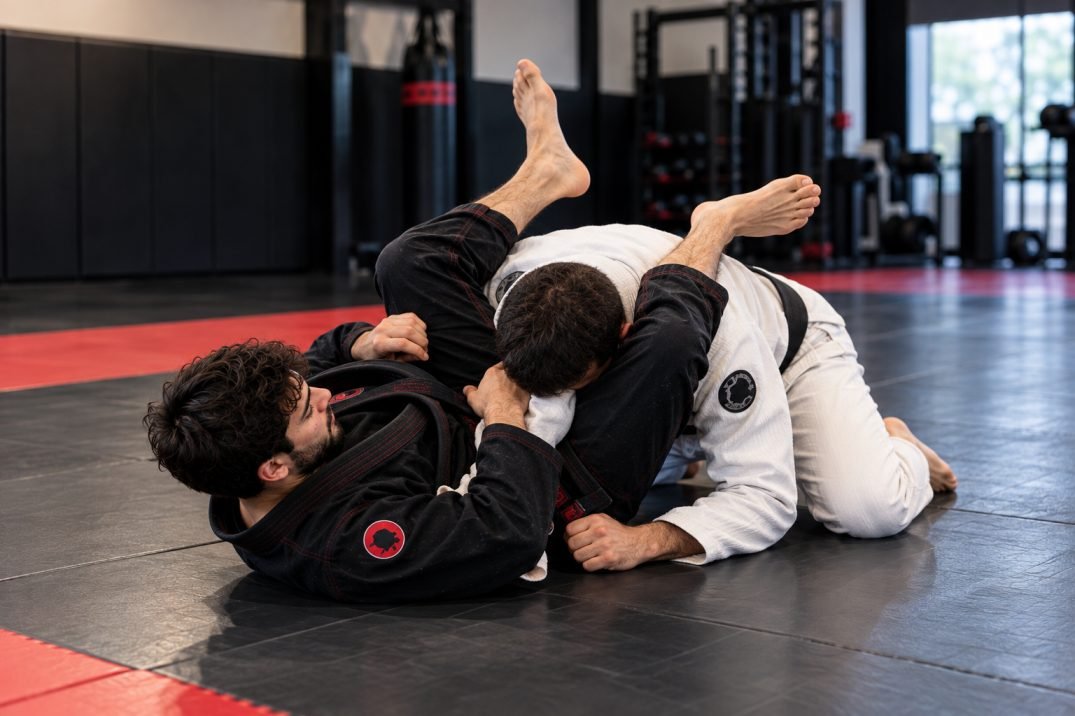
A BJJ triangle is a guard-based submission where the legs form a triangular figure-four around an opponent's head and one arm, using hip and leg positioning for control. Triangle training focuses on positioning, angle, timing and controlled repetition — drilled slowly with a partner or dummy before ever applying resistance or speed.
This article covers training concepts and drilling methodology, not instructions for applying maximum pressure. Learn technique details from a qualified instructor. Train slowly and under control, communicate with your partner, tap early, and release immediately the moment your partner taps. Use appropriate mats and space, and never practice submissions on someone who hasn't consented and isn't trained to tap and communicate.
What Is a BJJ Triangle?
The triangle is a guard-based submission concept in Brazilian Jiu-Jitsu built around trapping an opponent's head and one arm between your legs, which are locked into a figure-four shape. It's fundamentally a position before it's a finish — the legs create a frame that restricts space and controls posture, and the submission only becomes available once that positional control is established.
Because it's built from guard, the triangle is closely tied to guard retention, hip movement and angle creation. Timing matters as much as the shape itself: attempting the position before control is established generally leads to a stalled or escaped attempt rather than a finished one.
Why Is Triangle Training Important in BJJ?
Triangle training builds skills that carry well beyond the triangle itself: submission awareness, guard development, positional control, leverage, timing, transition recognition and defensive awareness. Working through triangle entries and control sharpens hip movement and angle-creation skills that show up across many other guard-based positions and submissions — without it being the only important submission to learn.
BJJ Triangle Fundamentals for Beginners
These concepts apply regardless of which entry or position you're training from.
- Position — establishing the leg frame before anything else
- Control — restricting your partner's posture and movement
- Angle — positioning your hips off-center rather than straight on
- Arm-and-head relationship — understanding which arm is trapped and which is free
- Hip positioning — where your hips sit relative to your partner's shoulder line
- Balance — maintaining your own base throughout the movement
- Posture awareness — recognizing how your partner's posture changes the position
- Timing — recognizing when the position is actually available
- Transition awareness — knowing where to go if the triangle isn't there
- Defensive awareness — understanding how the position is countered
- Tapping and safety — communicating and stopping immediately when needed
Keep early training conceptual and slow. Understanding these ideas thoroughly matters more at the beginner stage than speed or finishing rate.
Triangle Training From Guard
Guard is the primary context for triangle training. Solid guard positioning, hip mobility and the ability to create an angle relative to your partner all directly enable triangle opportunities. Part of triangle training is simply spending time recognizing when an opening appears from guard and understanding how your positional control and your partner's posture interact — recognizing the opportunity is a skill in itself, separate from executing the finish.
This isn't a substitute for dedicated guard training as its own topic — think of guard work and triangle training as connected but distinct skill sets that reinforce each other.
BJJ Triangle Entries
An entry is how you move from a starting position into the triangle setup. Good entries depend on recognizing genuine openings rather than forcing the position, controlling your partner throughout the movement, creating the right angle before committing, and maintaining your own balance as you move. Rushed entries without control tend to be easier to defend and put your own position at risk.
Practice entries slowly at first, focused on the mechanics of the movement rather than the finish — speed and resistance come later, once the movement itself is sound.
BJJ Triangle Drills for Beginners
Each drill below is a training format, not a finishing technique — start every one slowly, under control, with a cooperative partner where noted.
1. Position Recognition Drill
Purpose: build familiarity with what the triangle shape looks and feels like.
- Starting position: guard, partner posture upright
- Movement: move slowly into the leg-frame shape without applying finishing pressure
- Training objective: recognize the shape and required leg placement
- Difficulty: Beginner
- Suggested reps/time: 5–8 slow repetitions per side
- Partner requirement: cooperative partner
- Safety note: no pressure applied — positioning only
2. Guard-to-Triangle Movement Drill
Purpose: connect guard movement to the triangle setup as one continuous motion.
- Starting position: closed or open guard
- Movement: flow from guard positioning directly into the triangle shape
- Training objective: smooth transition without losing control
- Difficulty: Beginner
- Suggested reps/time: 6–10 repetitions per side
- Partner requirement: cooperative partner
- Safety note: stop if base or balance is lost — reset and repeat
3. Angle-Awareness Drill
Purpose: develop a feel for hip angle relative to your partner's shoulder line.
- Starting position: guard
- Movement: practice shifting hip angle before and during the triangle setup
- Training objective: recognize correct vs incorrect angle
- Difficulty: Beginner
- Suggested reps/time: 5 minutes per side
- Partner requirement: cooperative partner or dummy
- Safety note: movement-focused, no submission pressure
4. Arm-and-Head Positioning Drill
Purpose: build clarity on which arm is trapped and which is free.
- Starting position: guard, partner posture broken forward
- Movement: practice identifying and controlling arm position before locking the leg frame
- Training objective: recognize correct arm positioning before committing
- Difficulty: Beginner–Intermediate
- Suggested reps/time: 6–8 repetitions per side
- Partner requirement: cooperative partner
- Safety note: slow pace, communicate throughout
5. Triangle Entry Recognition Drill
Purpose: practice spotting genuine entry opportunities rather than forcing them.
- Starting position: light positional guard work
- Movement: partner moves through postures; you identify moments an entry would be appropriate without completing it
- Training objective: timing and recognition, not execution
- Difficulty: Intermediate
- Suggested reps/time: 3–5 minutes
- Partner requirement: cooperative, moderately active partner
- Safety note: no submissions applied during this drill
6. Control-and-Reset Drill
Purpose: practice establishing the position, then releasing and resetting.
- Starting position: guard
- Movement: enter the triangle shape, hold light control briefly, release, and reset to guard
- Training objective: control without rushing to finish
- Difficulty: Beginner
- Suggested reps/time: 5–8 repetitions
- Partner requirement: cooperative partner
- Safety note: release fully between reps
7. Triangle Transition Drill
Purpose: practice moving from a stalled or defended triangle into an alternative position.
- Starting position: triangle setup, light resistance
- Movement: when the position stalls, transition to an alternate guard or control position
- Training objective: avoid getting "stuck" chasing one finish
- Difficulty: Intermediate
- Suggested reps/time: 5–6 repetitions
- Partner requirement: cooperative partner with light resistance
- Safety note: keep resistance light and controlled
8. Submission-Awareness Drill
Purpose: build awareness of when the position is genuinely finished vs still developing.
- Starting position: established triangle control
- Movement: partner taps at a pre-agreed cue; practice recognizing and immediately releasing
- Training objective: tap recognition and immediate release habit
- Difficulty: Beginner
- Suggested reps/time: 4–6 repetitions
- Partner requirement: cooperative partner
- Safety note: this drill is specifically about tap response, not finishing pressure
9. Defensive Recognition Drill
Purpose: learn to recognize the position developing from the defender's side.
- Starting position: partner beginning a triangle entry against you
- Movement: practice recognizing early signs and creating posture/space in response
- Training objective: early recognition, not full escape mechanics
- Difficulty: Intermediate
- Suggested reps/time: 5 minutes
- Partner requirement: cooperative partner
- Safety note: stop and reset at the first sign of discomfort
BJJ Triangle Drills With a Partner
Partner drilling should progress in stages: cooperative repetition first, then slow technical drilling, then controlled resistance, then progressive resistance, and eventually positional sparring. Move to the next stage only once the previous one feels genuinely comfortable and controlled.
- Communicate clearly before and during drilling
- Tap early, and release immediately the moment your partner taps
- Never continue applying pressure after a tap
- Keep pace controlled, especially in early sessions
- Reset positions calmly between reps
- Use appropriate mats with adequate space
- Learn technique specifics from qualified instruction
Solo BJJ Triangle Drills
Realistically, solo training covers movement patterns, hip movement, guard movement, positional visualization, shadow grappling, transition movement, mobility and technical repetition of the shapes involved. It's a genuinely useful way to build movement familiarity between classes — for more on what solo work can realistically achieve, see solo BJJ training.
What it can't do is provide live resistance, opponent reactions, realistic timing, partner feedback or live defensive movement. Solo drilling supplements live training; it doesn't replace it.
BJJ Triangle Drills With a Grappling Dummy
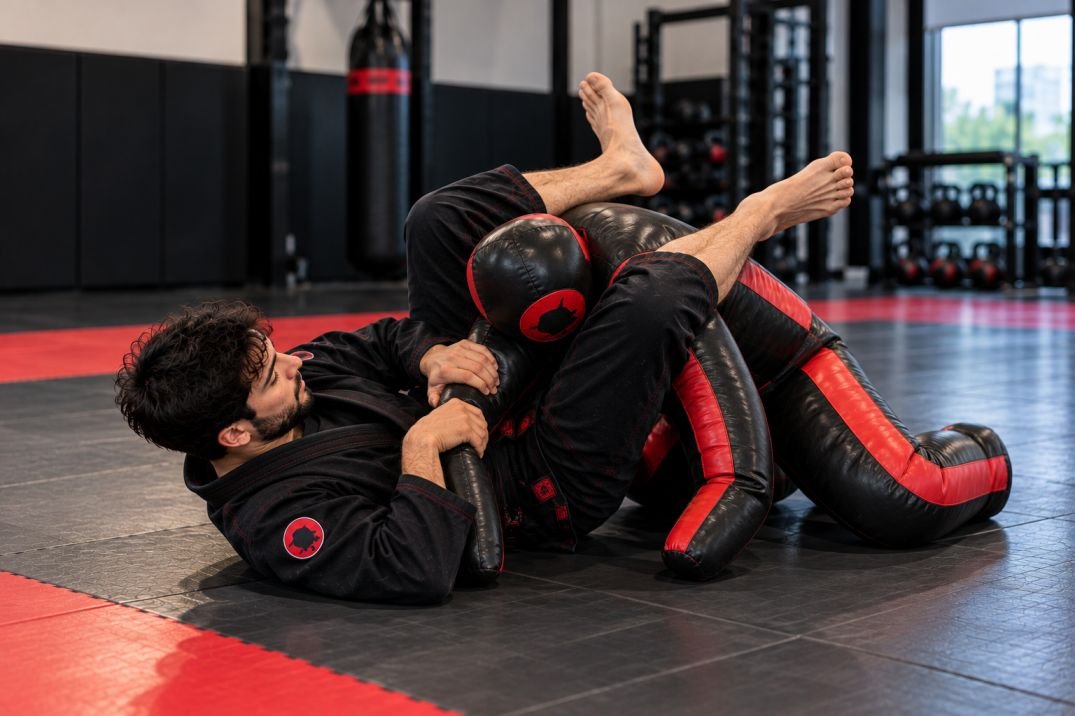
A suitable grappling dummy may support positional familiarization, body positioning, movement patterns, transitions and controlled repetition for solo practice. Not every grappling dummy is designed or shaped for triangle-specific work — check the manufacturer's intended use before assuming a given product supports it.
As with solo movement drilling, dummy practice has real limits: no live resistance, no active defense, no realistic reactions, no live timing, no grip fighting and no partner feedback. It supplements qualified coaching, live training partners, positional sparring and live rolling — it doesn't replace any of them.
Triangle Training From Different Positions
While guard is the primary context, triangle opportunities can also arise from mount, side control and various transitional scrambles, depending on how a position develops. Training triangle recognition across these different starting points is a natural extension once guard-based entries feel comfortable — each context has its own positional considerations that go beyond the scope of this triangle-focused guide.
Triangle Transitions and Combinations
Triangle training connects with broader grappling movement at a conceptual level: a triangle entry can lead to positional control, a triangle threat can prompt a transition to another position, a stalled attempt can lead to an alternative attack, and triangle defense can lead to a positional recovery. Guard movement itself is often what creates the triangle opportunity in the first place.
Triangle training also connects conceptually with armbar training, since both are commonly available from similar guard positions — though armbar-specific technique and drilling is its own dedicated topic.
BJJ Triangle Defense and Escape Awareness
Learning the triangle should include understanding how it's defended — this isn't optional context, it's part of understanding the position fully. It's worth distinguishing three related ideas:
- Prevention — recognizing the position developing early and acting before it's established
- Defense — maintaining posture, arm positioning and creating space once an entry is underway
- Escape — recovering position after the triangle has already developed further
At a beginner level, focus on awareness: recognizing when the position is developing, maintaining good posture habits, and knowing to tap when a submission is genuinely applied rather than trying to fight through it.
No-Gi Triangle Training
No-Gi training changes grip availability, movement, control, positioning and pace compared to training in a gi — there's no fabric to grip for control, which generally changes how entries and control points are established. Neither format is universally easier or harder; they simply train the position under different conditions, and many practitioners benefit from experience in both.
BJJ Triangle Training at Home
At home, realistic practice includes solo movement, technical visualization, positional movement, controlled dummy practice, transition movement, mobility and general conditioning. It doesn't include live resistance, realistic opponent reactions, partner feedback, live timing or live rolling.
Home training requires appropriate mats, adequate space, safe equipment and a controlled approach — and, as with any submission training, qualified instruction for learning technique details. Never practice submissions on people who haven't trained and consented to it.

Common BJJ Triangle Training Mistakes
| Mistake | Why It Matters | Better Approach |
|---|---|---|
| Focusing only on the finish | Skips the positional control that makes the finish possible | Drill position and control before chasing the tap |
| Ignoring position | Leads to rushed, easily defended attempts | Confirm control before committing to the entry |
| Poor angle awareness | Wrong hip angle makes the position weak or unavailable | Drill angle specifically, separate from the full entry |
| Losing balance | Compromises your own base and control | Practice slowly until balance holds throughout |
| Rushing the entry | Increases chance of a stalled or escaped attempt | Wait for a genuine opening rather than forcing it |
| Ignoring control | A locked shape without control is easy to escape | Prioritize control throughout, not just at the finish |
| Training only one entry | Limits recognition of other real opportunities | Rotate between different entry scenarios |
| Ignoring transitions | Leaves you stuck when the triangle stalls | Practice moving to an alternate position when it stalls |
| Ignoring defense | Incomplete understanding of the position overall | Study defense and prevention alongside offense |
| Using too much resistance too early | Increases injury risk and reinforces bad habits | Progress resistance gradually, only once mechanics are sound |
| Training too aggressively | Raises risk for both partners | Keep pace controlled, especially early on |
| Continuing after a tap | A serious safety violation | Release immediately, every time, without exception |
| Treating a dummy as a live opponent | Builds unrealistic expectations of resistance and timing | Use dummy work for positioning, not simulated live rolling |
| Practicing without suitable mats | Increases injury risk | Train on appropriate grappling mats with adequate space |
| Skipping qualified instruction | Technique learned incorrectly is hard to unlearn | Learn technique details from a qualified instructor |
How to Progress Your BJJ Triangle Training
- Learn terminology and safety.Understand the basic vocabulary and safety expectations before anything else.
- Learn guard positioning.Triangle training builds directly on solid guard fundamentals.
- Understand triangle concepts.Position, control, angle and timing, before attempting live entries.
- Practice controlled movement.Slow, cooperative repetition of the shape and setup.
- Practice entries.Move from recognizing openings to entering the position smoothly.
- Drill with a partner.Cooperative, then slow technical drilling.
- Add light resistance.Gradually, once mechanics are sound.
- Use positional sparring.Live but constrained practice focused on the position.
- Apply appropriately during live rolling.Under your instructor's guidance, once ready.
Progression speed varies by instructor, gym, experience, age, training goals and physical ability — there's no fixed timeline to mastery, and that's normal.
30-Minute BJJ Triangle Training Session
A supplementary practice session — this does not replace coached BJJ training.
| Activity | Time | Purpose | Solo / Partner / Dummy |
|---|---|---|---|
| Warm-up | 5 min | General mobility and readiness | Solo |
| Movement | 5 min | Hip and guard movement patterns | Solo |
| Guard positioning | 5 min | Reinforce base guard mechanics | Partner or Dummy |
| Triangle drills | 10 min | Position, entry and control drilling | Partner or Dummy |
| Defense awareness | 3 min | Recognition and posture practice | Partner |
| Review / cooldown | 2 min | Reflect on what felt controlled vs rushed | Solo |
BJJ Triangle Training by Skill Level
Complete Beginner
- Safety and terminology
- Guard fundamentals
- Basic movement
- Basic triangle awareness
Beginner
- Controlled drills
- Entries
- Transitions
- Defense awareness
Intermediate
- Timing
- Chaining with other positions
- Reading reactions
- Positional sparring
Advanced
- Decision-making under pressure
- Combinations
- Live resistance
- Refined timing
BJJ Triangle vs BJJ Armbar
A brief comparison to show the topical relationship — this isn't a substitute for a dedicated armbar training resource.
| Aspect | Triangle | Armbar |
|---|---|---|
| Primary concept | Leg-based head-and-arm control | Arm isolation and hyperextension control |
| Typical position | Guard-based | Guard, mount or side-control based |
| Control emphasis | Hip angle and leg-frame control | Arm isolation and hip control |
| Training focus | Angle, timing, leg positioning | Arm control, hip movement, isolation |
| Common transitions | Often connects to armbar attempts | Often connects to triangle attempts |
| Beginner considerations | Requires guard comfort first | Requires arm-control comfort first |
Equipment for BJJ Triangle Training
Essential
- Suitable BJJ or grappling mats
- Appropriate training clothing
- A training partner for live drilling
- Qualified coaching for technique details
Useful
- A suitable grappling dummy for solo repetition
- A basic timer for drill and session structure
Optional
- General mobility equipment
- Recovery and conditioning tools
Equipment supports training — it doesn't replace instruction. Explore home gym equipment or BJJ training dummies to round out a home setup.
Frequently Asked Questions
Direct, self-contained answers — including how this topic relates to nearby BJJ subjects.
What is a BJJ triangle?
A guard-based submission where the legs form a triangular figure-four around an opponent's head and one arm, relying on hip and leg positioning for control rather than the arms.
What is BJJ triangle training?
Training focused specifically on triangle positioning, control, entries, transitions and defense — through solo movement, partner drilling and, where appropriate, grappling dummy practice.
What are the best triangle drills for beginners?
Position-recognition, guard-to-triangle movement, angle-awareness and control-and-reset drills are good starting points, all practiced slowly and cooperatively.
How do beginners practice the triangle?
Starting with terminology, guard fundamentals and slow, cooperative positional drilling before adding resistance or speed, ideally under qualified instruction.
Can you practice triangle drills at home?
Yes, for solo movement, positional visualization and dummy-assisted drilling. Live resistance and opponent reactions still require training with a partner.
Can a grappling dummy help with triangle training?
A suitable dummy may support positional familiarization and movement practice, but not every dummy is designed for it — check the manufacturer's intended use, and treat it as a supplement, not a live opponent.
What positions can you train the triangle from?
Primarily guard, though opportunities can also arise from mount, side control and various transitional situations depending on how the position develops.
How often should I practice triangle drills?
There's no fixed frequency that suits everyone — consistency alongside regular live training matters more than any specific number of sessions per week.
Is triangle training suitable for beginners?
Yes, when introduced conceptually and drilled slowly under qualified instruction, with an emphasis on position and safety before speed or resistance.
What is the difference between a triangle and an armbar?
A triangle uses the legs to control the head and one arm; an armbar isolates and controls a single arm directly. Both often connect to each other from similar guard positions.
How is triangle training different from general submission training?
Submission training covers submissions broadly across BJJ; this guide focuses specifically on the triangle — its positioning, entries, drills and defense.
How is this different from submission grappling drills generally?
General submission grappling drills cover a wide drill library across many techniques; this page is scoped specifically to triangle-focused drilling.
How does triangle training relate to BJJ guard training?
Guard training covers guard positioning and retention broadly; triangle training is one specific opportunity that emerges from strong guard fundamentals.
How does this differ from BJJ dummy drills generally?
General BJJ dummy drills cover a range of positions and techniques on a dummy; this guide covers triangle-specific dummy practice as one part of a broader triangle curriculum.
Can a grappling dummy replace live partner training for triangles?
No. It can support positioning and movement repetition, but it can't provide live resistance, reactions or realistic timing.
Is No-Gi triangle training different from Gi training?
Yes — grip availability, movement and control differ without a gi to grip, which changes how entries and control points are typically established.
What should I focus on first when learning the triangle?
Position and control fundamentals — angle, hip placement and recognizing genuine openings — before focusing on finishing at all.
What's the difference between triangle prevention, defense and escape?
Prevention stops the position from developing early; defense maintains posture and space once an entry is underway; escape recovers position after the triangle has already developed further.
Do I need a partner to start learning triangle concepts?
Not for the conceptual and movement side, but live entries, resistance and timing genuinely require training with a partner under instruction.
Is triangle training safe?
When practiced slowly, with clear communication, immediate release on a tap, and appropriate mats and space, yes — safety depends heavily on how the training is conducted, not the technique itself.
Related Training Equipment
Equipment supports triangle training as a supplement to coached instruction and live partner drilling.
Building a home BJJ training setup?
A suitable grappling dummy can support solo positional practice as part of a wider training routine.
This guide provides general training and drilling information about BJJ triangle concepts and is not a substitute for qualified in-person instruction. Techniques described here are conceptual and positional — always learn technique specifics from a qualified instructor, train under control, communicate with your partner, and stop immediately on a tap. A grappling dummy or solo drilling can support practice but cannot replace live training, coaching or sparring. No training method is injury-proof. Explore more at Home Gym Goals.