BJJ Guard Passing Drills
Guard passing is as much a decision-making skill as a technical one — reading distance, tracking legs and reacting to movement matter as much as any single pass. This guide is built around practical drills: posture and base, movement, closed and open guard passing, partner and reaction drilling, and how solo and dummy-assisted practice fit around live training, from beginner through advanced.
- Learn posture and base.
- Practice distance and leg control.
- Drill basic passing movements.
- Add partner movement.
- Introduce controlled resistance.
- Use positional sparring and live rolling.
This is an educational guide, not a substitute for qualified BJJ coaching. Train on suitable mats, communicate with training partners, warm up first, and add resistance gradually. Stop if pain or sharp discomfort occurs. A grappling dummy cannot replace a live training partner.
What Is Guard Passing in BJJ?
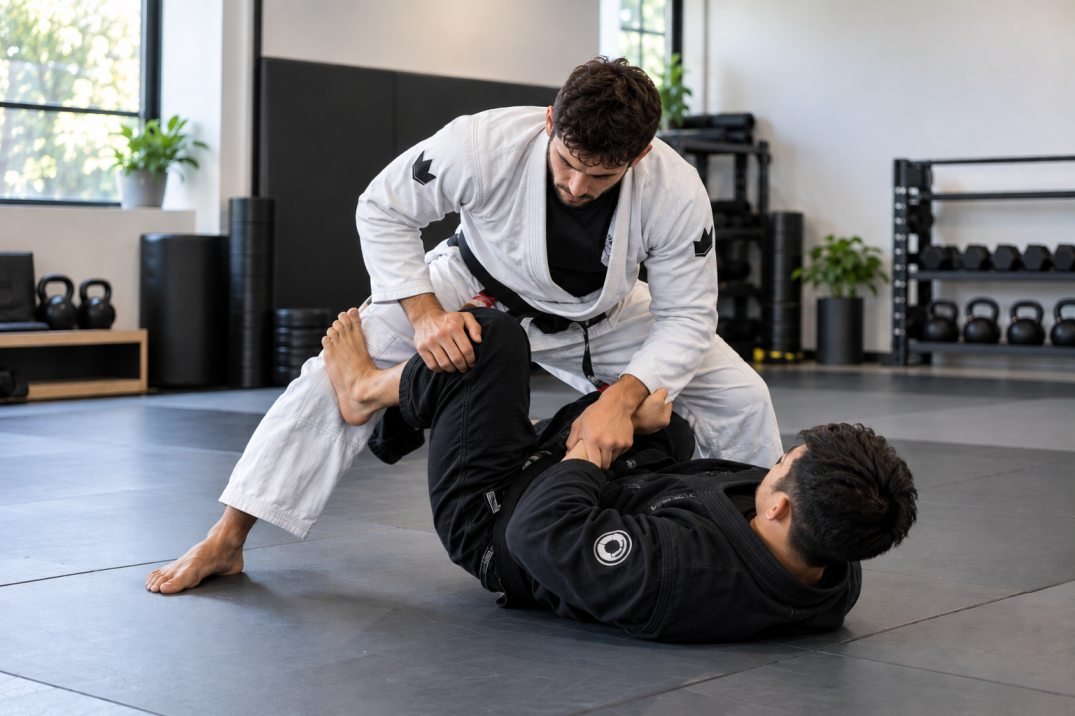
Guard passing in BJJ is the process of moving from being inside an opponent's guard — where their legs are positioned between you and their body — to a stable, dominant top position, such as side control or mount, past that leg-based defense.
Passing is a movement and decision-making skill, not a single technique. It depends on posture, distance management, grip awareness, balance and controlled pressure working together, and on reading how your opponent reacts as you move rather than following one fixed sequence. Being outside the guard — clear of the opponent's legs — is the position that allows a pass to be established and held.
Why Train Guard Passing?
Guard passing training builds positional awareness, movement quality, balance, distance management, grip awareness, pressure control and reaction speed — all of which extend beyond passing itself into overall grappling ability. It also builds transition skill and confidence in top position, and connects directly to side control, mount and other dominant positions once a pass succeeds. None of this guarantees you'll pass any given guard in live rolling — the goal is building the tools that make passing more consistent over time, against resistance that will vary.
Guard Passing Fundamentals for Beginners
Posture
An upright, structurally sound position that resists being broken down or pulled forward.
Base and Balance
A stable foundation that resists being off-balanced as your opponent moves or sweeps.
Distance Management
Controlling the space between you and your opponent's legs and hips throughout the pass.
Grip Awareness
Recognizing and managing grips — yours and your opponent's — that influence control and options.
Controlling the Legs
Managing your opponent's legs, which are the primary defensive tool the guard relies on.
Controlling the Hips
Limiting hip mobility reduces your opponent's ability to reguard or create angles.
Clearing the Guard
The moment of moving past the legs into a position where they no longer separate you from the body.
Passing to a Stable Position
Landing in a position you can actually hold, not just briefly clearing the legs.
Maintaining Pressure Responsibly
Applying enough pressure to limit movement without using excessive or reckless force.
Timing and Reaction
Recognizing openings and reacting to your opponent's movement rather than working on a fixed clock.
Staying Patient
Passing often takes several attempts and adjustments — rushing tends to cost position.
Guard Passing Training Progression
Each stage builds on the last — skipping ahead tends to create gaps that show up under resistance.
- Learn basic posture and baseThe structural foundation everything else depends on.
- Learn distance managementControlling space before adding movement or pressure.
- Practice controlling guard structuresManaging legs and hips against a cooperative partner.
- Drill basic passing movementsRepeating the movement pattern of a single pass type.
- Practice one positional pass repeatedlyBuilding depth in one pass before adding variety.
- Add partner movementIntroducing a partner who moves rather than stays still.
- Introduce controlled resistanceLight, then increasing resistance from your partner.
- Add different guard typesPracticing the same pass concepts against varied guards.
- Chain multiple passesLinking passes together when one attempt is defended.
- Practice positional sparringLive passing and guard-retention exchanges within the position.
- Integrate passing into live rollingApplying everything within full live grappling.
Best BJJ Guard Passing Drills for Beginners
Controlled, technique-focused drills. Adjust pace, repetitions and resistance to your and your partner's experience.
| Drill | Starting Position | Purpose | Basic Movement | Reps/Time | Beginner Modification | Common Mistake |
|---|---|---|---|---|---|---|
| Guard passing movement drill | Standing or kneeling in guard | Groove overall passing movement | Move around a stationary partner's legs without full commitment | Adjust to conditioning | Partner stays still | Standing too tall |
| Posture and base drill | Inside guard | Build structural posture | Hold upright posture while partner pulls or pushes gently | Adjust to conditioning | Light, predictable partner pressure | Rounding the back forward |
| Distance-management drill | Inside guard | Control the gap to the hips/legs | Adjust distance as partner extends or retracts legs | Adjust to conditioning | Slow, telegraphed leg movement | Staying too close or too far consistently |
| Leg-control drill | Inside open guard | Practice managing opponent's legs | Control and redirect legs as partner repositions them | Adjust to conditioning | Partner offers minimal resistance | Grabbing without a clear control point |
| Hip-control drill | Inside guard, near pass | Limit hip mobility | Apply and maintain hip control as partner attempts to shift | Adjust to conditioning | Reduced speed and pressure | Losing hip contact while adjusting |
| Angle-changing drill | Inside guard | Practice changing angle to find an opening | Shift angle side to side around partner's legs | Adjust to conditioning | Small, controlled steps | Changing angle without adjusting posture |
| Knee-cut movement drill | Half-passed position | Groove a common passing movement pattern | Practice the knee-slide movement without full weight commitment | Adjust to conditioning | Walk through slowly first | Rushing the slide and losing base |
| Outside passing movement drill | Outside opponent's legs | Practice passing around rather than through the legs | Circle around the legs to a stable side position | Adjust to conditioning | Partner keeps legs still initially | Circling too wide and losing connection |
| Body-lock passing movement drill | Inside guard, close range | Practice close-range control-based passing | Secure a body lock and walk around to a stable position | Adjust to conditioning | Partner stays passive initially | Standing up too early and losing the lock |
| Toreando-style movement drill | Inside open guard | Practice redirecting legs and passing around them | Control pant legs or shins and step around to the side | Adjust to conditioning | Slow, cooperative leg redirection | Letting go of leg control mid-pass |
| Guard recovery reaction drill | Mid-pass, partner recovering | Practice reacting to a defended pass | Adjust or reset as partner recovers guard | Adjust to conditioning | Partner recovers slowly and predictably | Continuing to force a pass that's already defended |
| Pass-to-side-control drill | Just past the legs | Practice settling into a stable position | Establish side control immediately after clearing the legs | Adjust to conditioning | Pause to check position before adding resistance | Rushing to the next pass instead of consolidating |
| Pass-and-reset drill | Inside guard | Build repetition through structured resets | Attempt a pass, reset to the start, repeat | Adjust to conditioning | Reset from a neutral, cooperative position | Rushing resets and skipping posture checks |
| Continuous passing drill | Inside guard | Build passing endurance and flow | Attempt passes continuously for a set period with brief resets | Adjust to conditioning | Shorter duration, lower intensity | Sacrificing technique for speed |
| Positional passing drill | Inside guard, live | Test passing under live conditions | Live passing exchange within the position, defined stopping point | Adjust to conditioning | Reduced intensity to start | Going too hard too soon |
Guard Passing Movement Drills
Movement quality is often what separates a pass that works from one that doesn't. Useful movement components include lateral movement around the legs, forward and backward adjustments to manage distance, angle changes to find openings, hip movement that supports pressure without overcommitting, footwork that keeps your base intact, level changes where the specific pass calls for them, and maintaining balance throughout rather than only at the start and end of a pass. Drilling these components in isolation — without necessarily attempting a full pass — helps them become automatic before you need them live.
Passing Different Guard Types
Each guard structure changes what a passer needs to prioritize. This section stays at the level of training focus and drill category rather than becoming a full instructional breakdown of each guard.
Closed Guard Passing Drills
Closed guard requires managing posture and base while your opponent's legs are locked around your body, then working to open the guard before passing. Useful drills include posture-under-pressure practice, base drills against hip movement, and passing drills that begin immediately after the guard is opened, so the transition from opening to passing becomes one smooth motion rather than two separate steps.
Open Guard Passing Drills
Open guard passing generally emphasizes distance management, leg control, angle changes and grip awareness, since the legs are free to move and create frames. Useful drills include distance-management repetitions, leg-redirection drills, and movement around the legs toward a stable side position, with an emphasis on resetting safely when a pass attempt is defended.
Half Guard Passing Drills
Half guard passing centers on hip control, managing the trapped leg, and transitioning to a fully passed, dominant position. Beginner-friendly drills include hip-control repetitions and slow-motion transition drilling from half guard to side control or mount, focusing on maintaining connection throughout.
Butterfly Guard Passing Drills
Butterfly guard uses hooks under the legs to off-balance and create space, so passing generally emphasizes base, distance and managing those hooks. Useful drills focus on maintaining base against hook-based movement and practicing controlled passes around or through the guard structure.
Seated Guard Passing Drills
Seated guard positions require distance management, hand positioning and controlled angle changes to enter a passing position without getting drawn into the opponent's preferred exchanges. Drills here focus on movement around a seated partner and controlling the legs before committing to a pass.
De La Riva
Challenging due to the hook behind your leg; training focus is managing that hook and the resulting angles.
Spider Guard
Uses sleeve or wrist grips with feet on the biceps; training focus is managing grips and distance.
Knee Shield (Half Guard)
Uses the shin/knee as a frame; training focus is clearing the frame while maintaining hip control.
Single-Leg X
Controls one leg with an entangled position; training focus is base and recognizing the entry before it's established.
Headquarters (Ashi Garami family)
Leg-entanglement position; training focus is early recognition and controlled disengagement.
Not every guard variation has equal search demand or equal relevance to every gym's curriculum — these are included at a summary level; check with your instructor for gym-specific terminology and depth.
Partner Guard Passing Drills
Partner drilling is where passing becomes real. A beginner-friendly partner routine generally progresses through cooperative drilling, where your partner offers predictable, slow movement, to light resistance, to variable resistance, to positional sparring. Communication, controlled pace and gradual difficulty matter throughout — avoid uncontrolled pressure, especially with newer or unfamiliar partners.
Reaction-Based Guard Passing Drills
Reaction drills build recognition and decision-making rather than memorized sequences. General concepts to drill: if your partner moves their legs left, adjust your angle; if they move right, adjust the other way; if the guard opens, transition toward passing; if legs recover to reguard, reset rather than force the original attempt; if a passing lane closes, change direction rather than pushing through it. No single rigid sequence works universally — the goal is training recognition speed, not a fixed script.
Positional Guard Passing Drills
Positional sparring restarts from a defined position — closed guard, open guard, half guard or seated guard — with clear goals for both partners: the top player works to pass and establish a stable dominant position, while the bottom player works to recover guard or prevent the pass. Restarting from the same position repeatedly (rather than playing out a full live round) concentrates repetitions on exactly the skill you're training, and it's one of the more direct ways to develop the timing and decision-making that separates drilling from live competence.
Solo Guard Passing Drills
Realistically, solo training can cover footwork, general movement patterns, level changes, angle changes, hip movement, passing visualization, shadow movement, and technical stand-up movement where relevant to your passing style. This builds real components of passing skill without needing a partner.
Solo training cannot reproduce live guard retention, grip fighting, an opponent's reactions, real weight distribution, timing, resistance, or dynamic guard recovery. It does not replace partner practice — treat it as a way to sharpen movement between partner sessions, not a substitute for them.
Guard Passing Drills With a Grappling Dummy
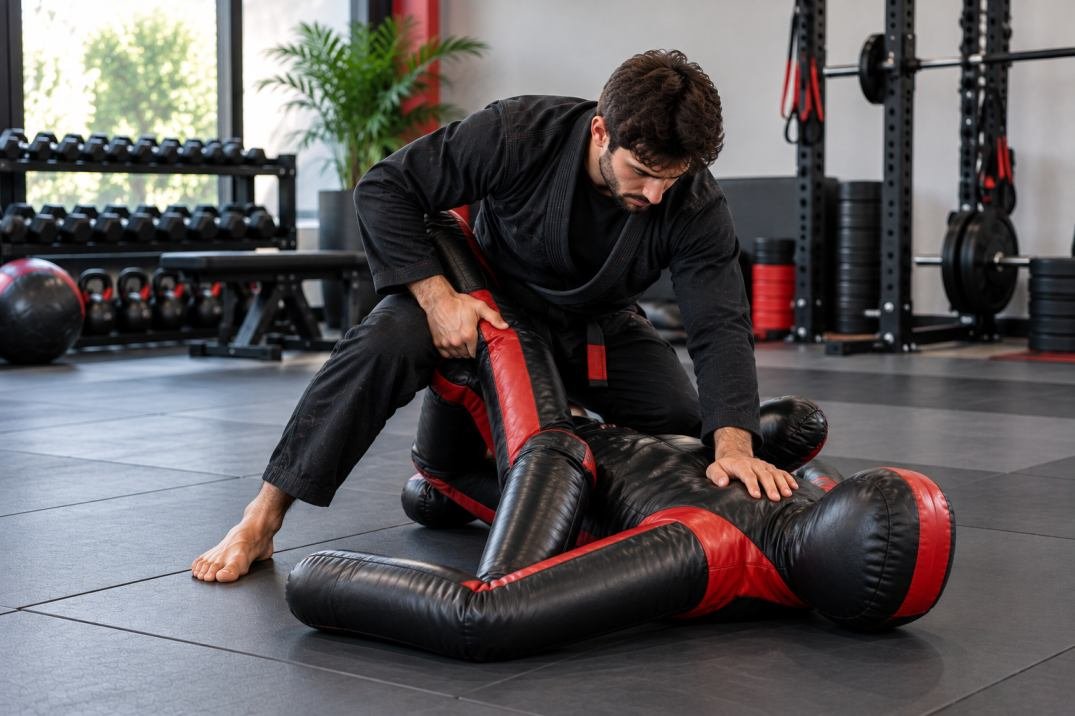
A grappling dummy can support realistic applications like movement rehearsal, position transitions, passing movement patterns, general body positioning, repetitive technical practice, and passing-to-control transitions — useful for home drilling between coached or partner sessions.
Important: a dummy cannot reproduce live legs, guard retention, grip fighting, dynamic reactions, timing, resistance, coaching feedback or live rolling. Follow the manufacturer's intended use for the specific product rather than assuming it supports every drill on this page.
If you're considering a BJJ grappling dummy for this kind of work, check the product's construction and intended use before relying on it heavily.
Guard Passing at Home
A safe home setup includes suitable mats, adequate space to move freely, and a routine that mixes solo movement work with dummy-assisted drilling where available, plus partner practice when a partner is on hand. A sensible structure: warm-up, solo or dummy technical drilling, review, and cooldown.
Home-only training has real limits — it can build movement, positional familiarity and repetition, but live BJJ with a resisting partner remains important for developing genuine reaction and resistance skills. For more on structuring a complete home BJJ setup, see BJJ training at home.
30-Minute Guard Passing Training Session
Guard Passing Drills by Skill Level
| Skill Level | Training Focus | Recommended Drills | Main Goal |
|---|---|---|---|
| Beginner | Posture, base, movement, simple passing patterns | Posture/base drills, distance drills, single-pass repetition | Build a technically sound foundation |
| Intermediate | Different guard types, reactions, combinations | Guard-specific passing drills, reaction drills, chained passes | Handle variety and adjust to resistance |
| Advanced | Chains, reactions, positional sparring, live integration | Positional sparring, full live rolling with a passing focus | Apply passing adaptively under full resistance |
Common Guard Passing Mistakes
- Standing too tall — raises your center of gravity and makes you easier to off-balance.
- Poor base — undermines every other part of the pass.
- Crossing feet unnecessarily — reduces stability and mobility at the wrong moments.
- Ignoring leg control — the legs are the guard's primary defensive tool.
- Chasing the pass — committing fully before position is actually secure.
- Moving without controlling distance — makes you easier to sweep or reguard against.
- Using excessive force — increases injury risk and rarely substitutes for technique.
- Passing without establishing control — clearing the legs isn't the same as holding the position.
- Losing balance — often the first sign a pass attempt has been compromised.
- Stopping after the first pass attempt — good passing usually requires adjusting and re-attacking.
- Failing to react to guard recovery — continuing to force a defended pass wastes energy and position.
- Memorizing one pass only — leaves you without options against different guard types.
- Drilling without resistance — cooperative-only practice never tests whether a pass actually works.
- Treating a dummy like a live opponent — it can't retain guard, grip fight or react.
- Skipping warm-up — increases injury risk for any contact drilling.
- Ignoring coaching feedback — self-assessment alone misses errors a coach would catch.
How to Improve Your Guard Passing
Guard Passing Combinations
Chaining passes means linking attempts based on how your opponent reacts, rather than relying on one option. For example: a pass attempt draws a defensive reaction, you adjust, and a second passing option opens up as a result — or one side pass gets recovered, you change angle, and an alternative pass becomes available. Good passing is adaptive; treating any single sequence as something that "always" works tends to fall apart against a partner who's actually paying attention.
Passing to Dominant Positions
A completed pass generally leads to side control, mount, knee-on-belly, or another stable top position, depending on how the pass was executed and how your opponent responds. The point of passing is ultimately positional control — clearing the legs is a means to that end, not the end itself. For dedicated breakdowns of what comes next, see BJJ side control training, BJJ mount training, and BJJ back control training.
Gi vs No-Gi Guard Passing Drills
| Factor | Gi | No-Gi |
|---|---|---|
| Grip options | Collar, sleeve and pant grips available | Grips limited mainly to wrists, ankles and the body itself |
| Distance | Fabric grips can be used to manage distance | Distance managed more through body positioning and underhooks |
| Control | Fabric-based control points common | More reliance on pressure and body control |
| Movement | Can be slowed by grip-based stalling | Often faster-paced due to fewer grip-based stalling options |
| Passing style | Grip-fighting-heavy passing common | Pressure- and speed-based passing common |
| Training adaptation | Practice grip fighting alongside movement | Practice underhooks and pressure control alongside movement |
Gi and no-gi guard passing are related but not identical — most of the fundamentals in this guide apply to both, but grip-specific details differ.
Guard Passing Training Methods Compared
| Training Method | Main Focus | Beginner Friendly? | Equipment | Main Limitation |
|---|---|---|---|---|
| Partner guard-passing drills | Real contact, movement and cooperative resistance | Yes | Mat, partner | Requires a willing, available partner |
| Solo guard-passing drills | Movement, footwork, positional familiarity | Yes | Mat | No contact, resistance or reactions |
| Grappling dummy drills | Positioning and transition repetition | Yes | Mat, dummy | No live legs, resistance or reactions |
| Positional guard-passing sparring | Live decision-making within a defined position | Intermediate | Mat, partner | Requires readiness for resistance |
| Live rolling | Full integration under unpredictable conditions | Intermediate–Advanced | Mat, partner, ideally coaching | Less repetition of any single skill |
Guard Passing Equipment
Guard passing training mainly requires a BJJ gi or appropriate no-gi clothing depending on your training style, suitable grappling mats, and adequate space. A grappling dummy can support solo and home drilling. Expensive equipment is not required to train guard passing effectively — technique and repetition matter far more than gear. See home gym equipment for the broader category.
Want to drill passing movement at home?
Explore Home Gym Goals' grappling dummies for solo movement and positional repetition alongside your regular training.
Frequently Asked Questions
Direct answers to the questions people ask about guard passing drills.
What are guard passing drills in BJJ?
Drills that isolate parts of the guard-passing skill — posture, distance, leg control, movement and transitions — practiced solo, with a dummy, or with a partner at controlled intensity.
What are the best BJJ guard passing drills for beginners?
Posture and base drills, distance-management drills, leg- and hip-control drills, and single-pass repetition against a cooperative partner are strong starting points.
How do you train guard passing?
By progressing from posture and base, to distance and leg control, to basic passing movements, then adding partner movement, controlled resistance, and eventually positional sparring and live rolling.
How can I practice guard passing at home?
Through solo movement drills and, with a suitable dummy, positioning and transition repetition. Suitable mats and adequate space matter for any contact-based practice.
Can you practice guard passing with a grappling dummy?
Yes, for movement rehearsal, positioning and transition drilling. A dummy cannot reproduce live legs, guard retention, grip fighting or dynamic reactions.
Can you train guard passing alone?
You can train footwork, movement patterns, level changes and visualization alone. Live guard retention, resistance and timing require a partner.
What is the best way to improve guard passing?
Combine technical drilling of fundamentals with gradually increasing partner resistance, positional sparring, and regular live rolling, supported by coaching feedback.
What are the best closed guard passing drills?
Posture-under-pressure drills and practicing the transition from opening the guard directly into a passing attempt are useful starting points.
What are the best open guard passing drills?
Distance-management and leg-redirection drills, along with movement around the legs toward a stable side position, are commonly useful.
What are the best half guard passing drills?
Hip-control drills and slow transition drilling from half guard into side control or mount, with a focus on maintaining connection throughout.
How often should I practice guard passing?
There's no single ideal frequency — it depends on consistency, recovery, and how you balance drilling with live training, adjusted to your schedule and experience.
Should beginners learn multiple guard passes?
Beginners generally benefit from building depth in one pass first, then gradually adding others as fundamentals solidify, rather than learning many passes shallowly at once.
What is the difference between gi and no-gi guard passing?
Gi passing involves fabric-based grips for control and distance management; no-gi passing relies more on body positioning, underhooks and pressure. Fundamentals largely carry over between both.
How does positional sparring improve guard passing?
By concentrating repetitions on passing and guard retention specifically, restarting from the same position, it builds timing and decision-making faster than full live rolling alone.
What should you do after passing the guard?
Consolidate a stable dominant position — commonly side control, mount or knee-on-belly — rather than treating clearing the legs as the end goal itself.
Shop BJJ & Grappling Training Equipment
Once fundamentals are in place, a suitable dummy can support the solo side of your passing practice between partner sessions.
This guide provides general educational information about BJJ guard passing drills and is not a substitute for qualified instruction. Train on suitable mats, communicate with training partners, warm up beforehand, add resistance gradually, and stop if pain or discomfort occurs. A grappling dummy can support movement and positional repetition but cannot reproduce a live training partner's guard retention, grip fighting, resistance or reactions. Explore more at Home Gym Goals.