BJJ Americana Training and Drills
How the Americana fits into Brazilian Jiu-Jitsu, and how beginners can build it safely — grip and control fundamentals, entries from side control and mount, controlled drills, partner and solo practice, grappling-dummy work and defense awareness.
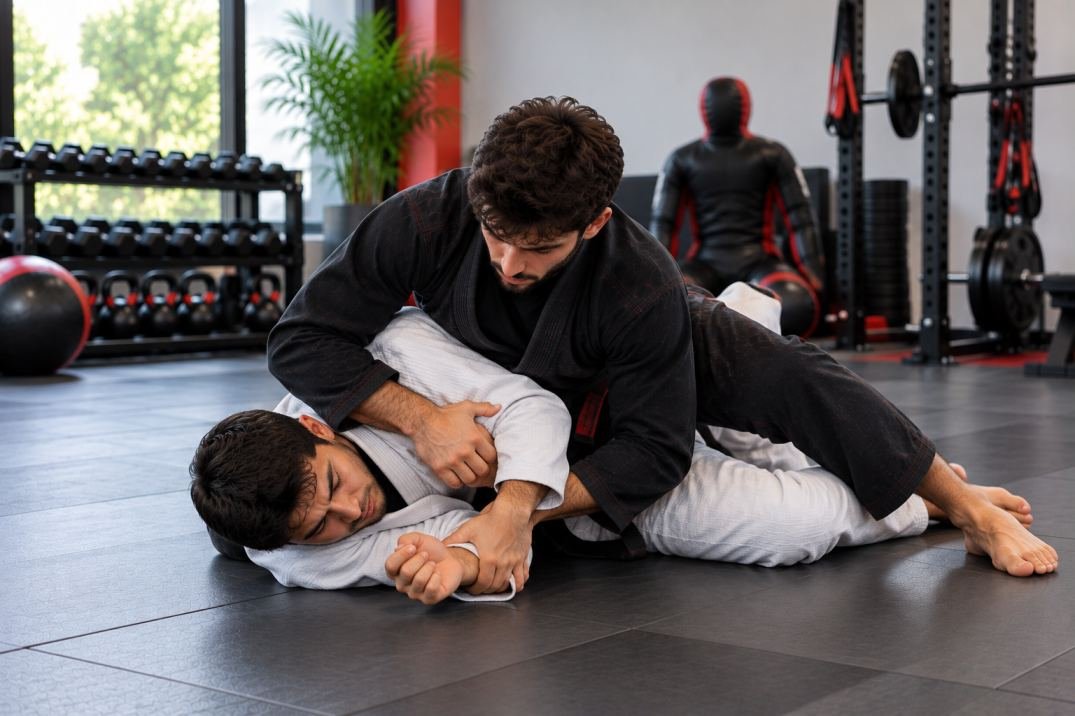
An Americana is a shoulder lock that controls an opponent's arm in a bent, figure-four grip, most often from side control or mount. Beginners train it in this order:
- Learn the control position and the figure-four grip.
- Practise arm control and pinning the arm.
- Drill slowly with a cooperative partner.
- Add positional movement and entries.
- Introduce light, controlled resistance.
- Integrate the movement into live grappling.
What is an Americana in BJJ?
An Americana in BJJ is a shoulder lock that bends the opponent's arm into an "L" shape and uses a figure-four grip to rotate it, applying controlled pressure to the shoulder joint until they tap. It's commonly taught from side control and mount, and is also called a keylock or "V-lock."
The Americana is one of the first submissions many beginners learn, because it flows naturally out of two positions they already train — side control and mount — and it teaches core arm-control and shoulder-control concepts. Like every submission, though, it's a position before it's a finish: without a solid pin and a controlled arm, the grip simply slips. This page is the Americana-specific corner of the broader topic of submission grappling drills.
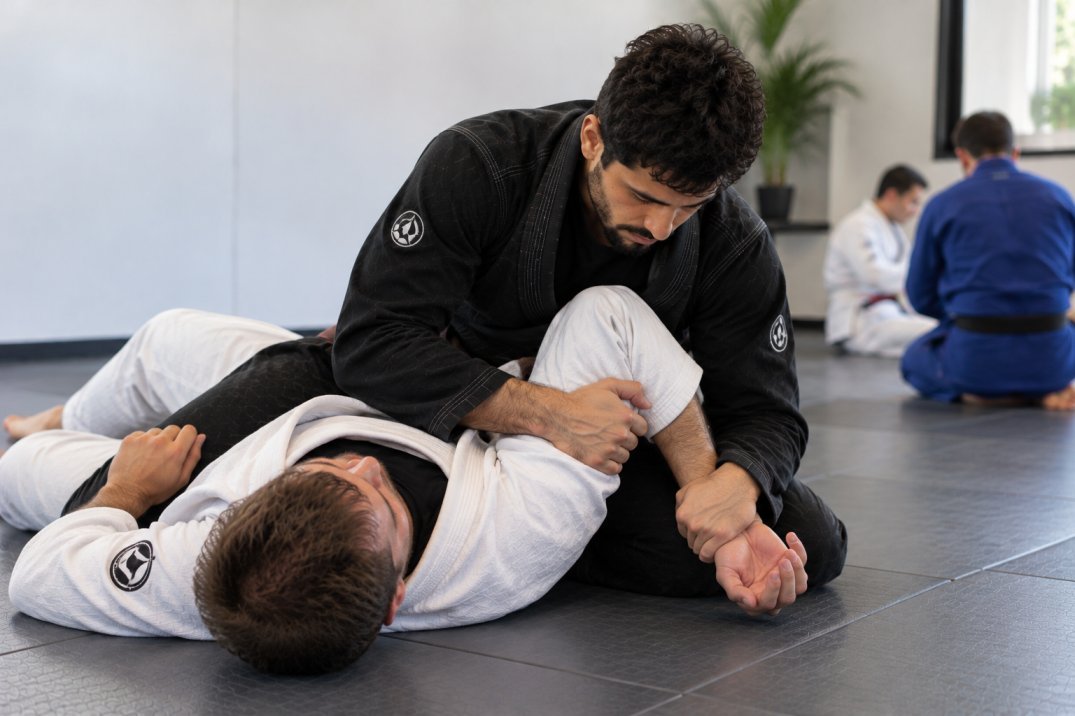
Why train the Americana?
Training the Americana develops far more than one submission — it builds transferable control skills.
- Arm-control awareness — isolating and pinning an arm is a foundational skill.
- Positional control — the Americana rewards a heavy, stable pin, reinforcing good top habits.
- Grip awareness — the figure-four teaches practical grip mechanics.
- Shoulder-control concepts — that carry into other attacks.
- Mount and side-control development — its two home positions.
- Submission and transition awareness — reading openings and reactions.
- Submission chaining — it connects to the kimura, armbar and back-takes.
- Defensive understanding — learning the attack teaches you to defend it.
Americana fundamentals for beginners
Ten principles that make the Americana work — learn these before worrying about finishing speed.
- Position before submission — a solid pin comes first, always.
- Arm control — the arm must be isolated and pinned before the grip.
- Grip fundamentals — the figure-four grip is the engine of the lock.
- Maintaining positional control — keep the pin as you set the grip.
- Body position — chest and weight organised over the arm.
- Creating appropriate angles — small angle changes make the grip work.
- Balance and stability — stay based so you aren't bridged off.
- Timing — the opening appears as your opponent reacts, not on demand.
- Transition awareness — know the exits if the arm straightens out.
- Safe training and tapping — apply slowly, and release instantly on a tap. Tapping early is smart.
Americana training progression
A clear order to build the skill — each stage sets up the next.
- Understand the positionKnow where the Americana lives (side control, mount).
- Learn the gripBuild a reliable figure-four.
- Practise controlPin the arm and hold it under small movement.
- Drill slowlyClean, unhurried reps with a cooperative partner.
- Practise entriesRecognise and enter from your pin.
- Practise positional variationsFrom side control and mount.
- Practise transitionsFlow to another position when the arm escapes.
- Introduce controlled resistanceAdd a little, gradually.
- Practise defensive awarenessRecognise and defend the same attack.
- Integrate into live grapplingApply it under appropriate supervision.
Best BJJ Americana drills for beginners
Controlled, technique-focused drills — movement and objectives, not injury mechanics. Drill slowly and reset often.
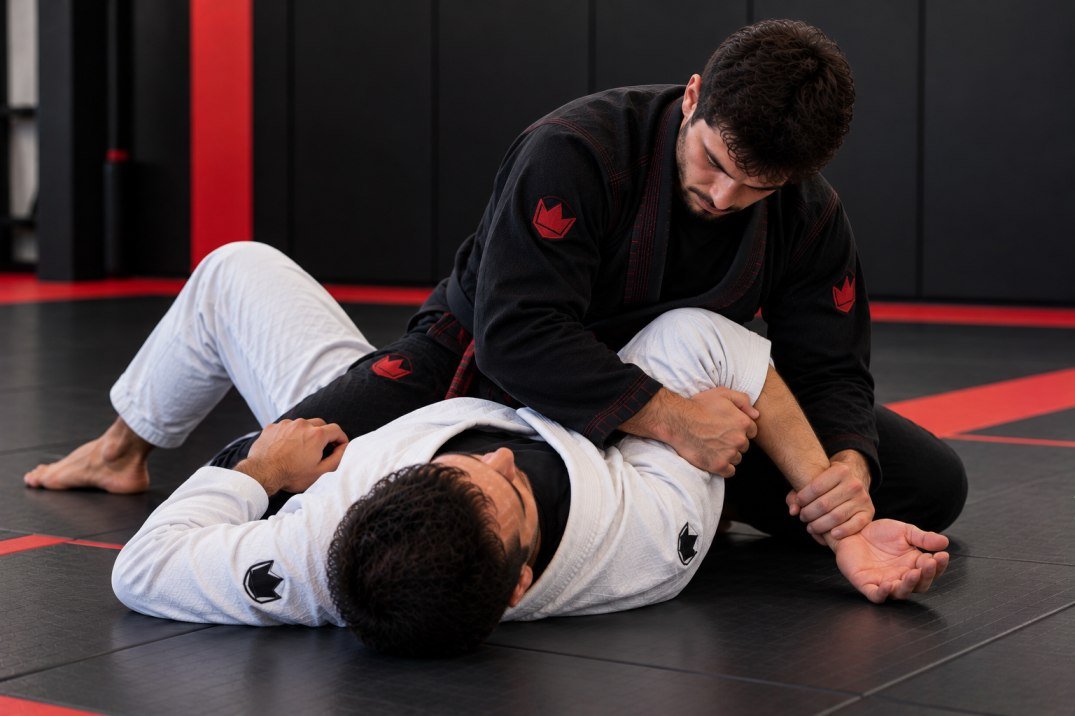
Americana Grip Familiarisation
BeginnerPurpose: build a reliable figure-four grip.
Starting position: a controlled top pin.
Movement concept: set and re-set the figure-four.
Objective: a consistent, connected grip.
Partner: cooperative partner or dummy.
Reps/time: 8–10 grip sets each side. Beginner mod: practise the grip on a still arm.
Common mistake / safety: gripping before the arm is pinned — pin first; no pressure.
Americana Control-Position Drill
BeginnerPurpose: hold the finished control position.
Starting position: the settled Americana control.
Movement concept: maintain the pin and grip.
Objective: keep control as the partner shifts.
Partner: cooperative partner or dummy.
Reps/time: 3–4 minutes. Beginner mod: hold static first, then add movement.
Common mistake / safety: no rotation or pressure — position and control only.
Americana Entry Drill
Beginner–IntermediatePurpose: move from a pin into the control.
Starting position: side control.
Movement concept: isolate the arm, set the grip.
Objective: reach control without losing the pin.
Partner: cooperative partner or dummy.
Reps/time: 6–8 reps each side. Beginner mod: partner leaves the arm exposed.
Common mistake / safety: rushing the entry — stop at the position, no finish.
Arm-Control Isolation Drill
BeginnerPurpose: separate and pin one arm.
Starting position: side control or mount.
Movement concept: trap the arm to the mat.
Objective: keep the arm isolated as they move.
Partner: cooperative partner or dummy.
Reps/time: 8–10 each side. Beginner mod: slow, telegraphed movement.
Common mistake / safety: using force over position — control, don't crank.
Positional-Control Drill
BeginnerPurpose: keep a heavy pin under movement.
Starting position: side control.
Movement concept: stay chest-to-chest, no gaps.
Objective: maintain the pin the Americana needs.
Partner: cooperative partner or dummy.
Reps/time: 3–4 minutes. Beginner mod: reduce the partner's movement.
Common mistake / safety: chasing the grip and losing the pin — pin first.
Americana Movement Drill
BeginnerPurpose: groove the mechanics as a movement.
Starting position: a top pin or on a dummy.
Movement concept: pin → grip → set → release, repeat.
Objective: smooth, repeatable mechanics.
Partner: solo, dummy or partner.
Reps/time: 10 slow reps each side. Beginner mod: break it into separate steps.
Common mistake / safety: speed over quality — clean beats fast; no pressure.
Retention Drill
Beginner–IntermediatePurpose: keep control as the arm tries to straighten.
Starting position: the Americana control.
Movement concept: follow the arm, keep the angle.
Objective: maintain control under light resistance.
Partner: cooperative partner.
Reps/time: 5–6 reps each side. Beginner mod: partner resists very lightly.
Common mistake / safety: forcing a slipping grip — reset instead of cranking.
Transition Drill
IntermediatePurpose: flow to another control when the arm escapes.
Starting position: the Americana control.
Movement concept: if it fails, move to a new position.
Objective: stay dominant when the finish isn't there.
Partner: cooperative partner.
Reps/time: 5–6 reps each side. Beginner mod: pre-agree the transition.
Common mistake / safety: abandoning control to chase the grip — control first.
Chain-Awareness Drill
IntermediatePurpose: feel how the Americana links to other attacks.
Starting position: the Americana control.
Movement concept: if defended, recognise the next option.
Objective: awareness of the chain, not finishing.
Partner: cooperative partner.
Reps/time: 4–5 minutes. Beginner mod: name the next option out loud.
Common mistake / safety: forcing chains fast — keep it slow and controlled.
Defense-Awareness Drill
Beginner–IntermediatePurpose: recognise the Americana threat against you.
Starting position: pinned, arm at risk.
Movement concept: protect the arm, keep the elbow tight.
Objective: early recognition and arm protection.
Partner: cooperative partner.
Reps/time: 5–8 reps each side. Beginner mod: partner telegraphs the grip.
Common mistake / safety: waiting too long — tap early if the shoulder loads.
Americana entry drills
An "entry" is how you move from control into the Americana. Across positions, the pattern is the same: keep the pin, recognise the exposed arm, set the grip without giving up control.
- Side control — the classic entry; the near or far arm exposes as they frame or push.
- Mount — arms appear as they defend or reach; balance is the priority.
- Half guard (top) — possible when you control the upper body, though less common.
- Guard (top) — situational; usually you'd pass to a pin first.
- Transitional positions — openings appear mid-scramble; recognise without over-committing.
For each, the beginner goal is recognition and control, and the common mistake is the same: chasing the grip before the pin and the arm are secure.
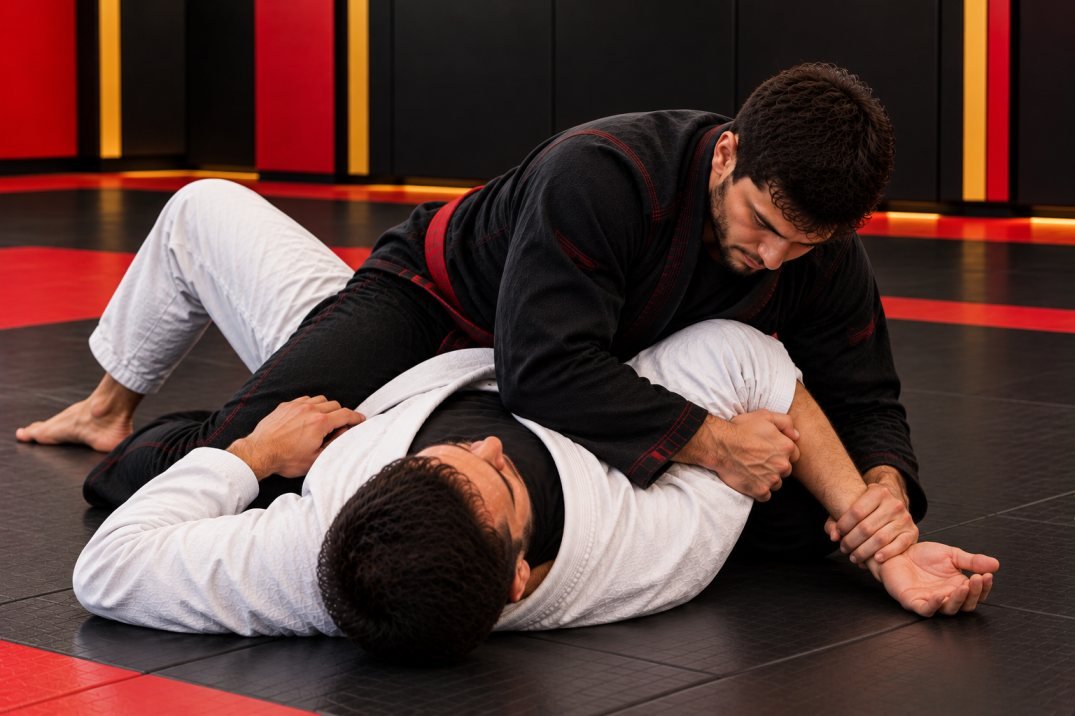
Americana from side control
Side control is the most important training context for the Americana. From a solid chest-to-chest pin, you can isolate an arm to the mat and set the figure-four while keeping your weight down. The training priorities are maintaining top control, recognising the arm-position opportunity, isolating the arm, staying based, and avoiding unnecessary force — treating the Americana as an extension of your positional control rather than a lunge for a finish. If the arm slips, transition awareness keeps you on top. A complete side-control guide is a planned separate resource.
Americana from mount
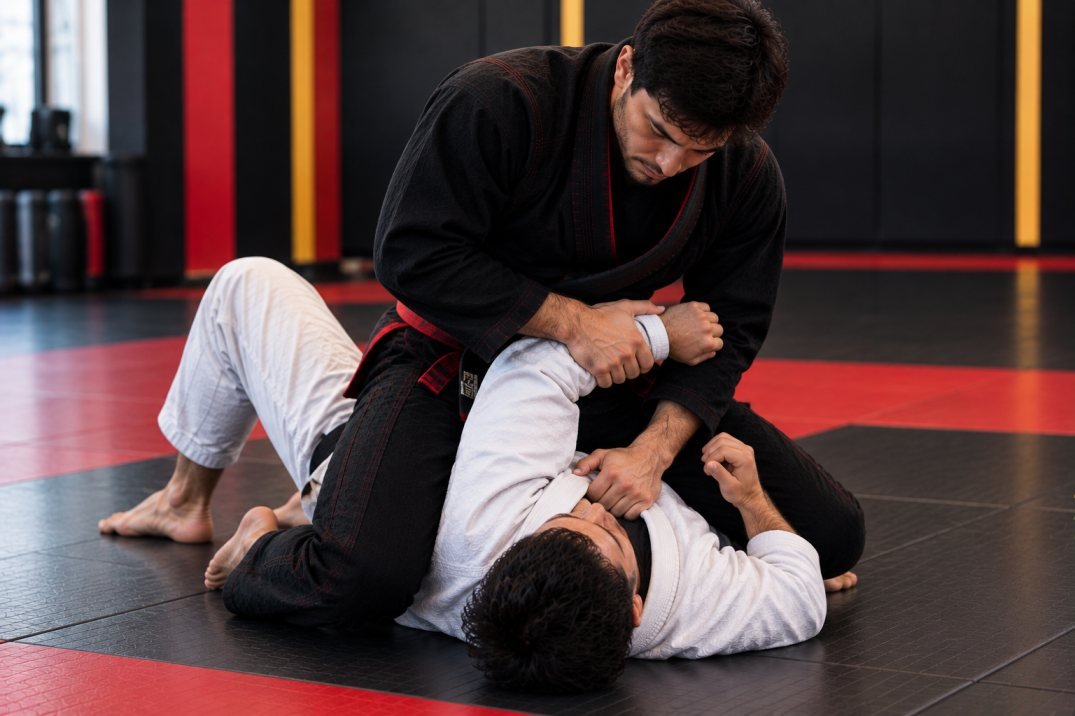
Mount offers relevant control opportunities because it's a dominant, high-control position where arms become exposed as your opponent defends. The priorities are maintaining a stable mount, arm control, and balancing the submission attempt against keeping the position — beginners often lunge for the grip and get bridged off. Keep your base, isolate the arm, and be ready to transition. A full mount guide is planned separately.
Americana from guard
Being honest about the position: the Americana is not a common or high-percentage attack from bottom guard. Guard is far more associated with attacks like the armbar, triangle and kimura. You may set Americana-style shoulder control from certain top-guard or passing situations, but for a beginner it's better to learn the Americana from its natural homes — side control and mount — rather than force it from guard just to cover the position.
Americana from half guard
From top half guard, an Americana can appear when you control the upper body and an arm is exposed — but it's situational, not a primary attack, and you're often better off advancing your position first. The training focus is upper-body and arm control, balance, and transition awareness. Don't overstate how often it occurs here; treat it as a bonus opportunity that sometimes presents itself while passing.
Americana in no-gi
The Americana works in no-gi, but the details change. Without sleeve and collar grips, control relies more on tight body connection, head and chest pressure, and a clean figure-four on the wrist and forearm. Sweat makes grips slipperier, so the pin matters even more, and the pace is often faster. The core positional principles stay the same — side control and mount, position before submission — but don't assume gi and no-gi mechanics are identical; drill both to build a complete picture.
Americana transitions and chains
The Americana is rarely an isolated move — it's part of a connected system. When it's defended, the reaction usually opens something else.
Common conceptual relationships beginners should be aware of (not full tutorials):

- Americana → kimura — if the arm straightens the other way, the grip can switch toward a kimura. See our BJJ kimura training guide (planned).
- Americana → armbar — a defensive reaction can open an armbar; see our BJJ armbar training and drills.
- Americana → back exposure — chasing the arm can turn them, exposing the back.
- Americana → improved position — a failed attempt can be used to advance the pin.
Keep these conceptual here and follow the specialist pages for the actual training — that's how each stays distinct.
Americana defense and escape awareness
Learning the Americana means learning to feel it coming. Defensive awareness covers recognising when your arm is being isolated, understanding the grip and control, maintaining defensive positioning, moving appropriately, protecting the arm, and responding safely — and, above all, tapping before pain and expecting an immediate release.
The earliest defense is prevention: when you're pinned underneath, keep your elbows tight and your arms connected to your body so the arm never gets isolated in the first place. Detailed position-specific escapes are deep enough for their own guides (planned) — here the focus is Americana-threat recognition.
Defense isn't a guarantee. Recognition and good structure reduce risk but never remove it — tap early, and never rely on toughness over a timely tap.
Partner Americana drills
A safe beginner partner-drilling routine follows an intensity ladder — don't skip rungs.
- Cooperative repetitionsPartner gives the arm; you groove pin, grip and control.
- Slow technical practiceClean reps with a controlled range of motion, no pressure.
- CommunicationAgree the pace and intensity before you start.
- Progressive resistancePartner adds a little, gradually, as control holds.
- Reset and repeatReturn to the same clean start each rep.
Throughout: apply any finishing rotation slowly and within a controlled range, tap and release immediately, avoid uncontrolled pressure, and use appropriate mats. The goal is learning, not a fast tap.

Solo Americana drills
Be realistic about solo work — it builds mechanics, not live application.
What you can practise alone: movement patterns, grip visualisation, positional movement, hip movement, arm-control shadow drills, transition visualisation and technical rehearsal. This grooves the mechanics so they feel natural when you get to a partner. For a wider solo routine, see our guide to solo BJJ training.
What solo work can't reproduce: live resistance, grip fighting, timing, opponent reactions, pressure, defensive movement and positional unpredictability. Solo Americana practice rehearses the motion — it isn't a substitute for live BJJ.
Americana drills with a grappling dummy
A grappling dummy can support Americana training through position repetition, grip practice, arm-control rehearsal, entry repetition, positional drilling, transition practice and movement repetition — building technical familiarity with a body to organise around, which is hard to do with shadow drilling alone. For a broader dummy library, see our BJJ dummy drills.
Be clear on the limits: a dummy can't reproduce live resistance, grip fighting, timing, reactions, defensive movement, coaching or live rolling. It supplements those; it never replaces them. And not every dummy suits this kind of arm-control work — flexibility and limb positioning vary — so follow the manufacturer's intended use, and see how to choose a grappling dummy if you're comparing options.
Building a home setup? A grappling dummy can be useful for grip, control and entry reps between classes. Explore the Home Gym Goals BJJ grappling dummy range to compare options suited to your space.

Americana training at home
A simple, safe home structure — complementing, never replacing, qualified instruction and live training.
- Surface & space — suitable mats and enough clear room to move.
- Warm-up — mobility and light movement first.
- Technical drilling — grip, control and entry reps (solo, dummy or partner).
- Partner training if available — cooperative, controlled reps.
- Solo movement — shadow the mechanics and transitions.
- Cool-down — mobility and a quick review of what to refine.
Never practise submissions on untrained people, and never apply the finish with speed or force during home drilling. For a full home routine, see BJJ training at home.
30-minute Americana training session
A practical beginner session. This complements — it doesn't replace — coached BJJ training.
| Activity | Time | Purpose | Format |
|---|---|---|---|
| Warm-up | 5 min | Mobility, raise heart rate | Solo |
| Grip & control practice | 5 min | Figure-four & pin | Partner / dummy |
| Americana drills | 10 min | Entries & control-position reps | Partner / dummy |
| Transitions & positional work | 5 min | Flow when the arm escapes | Partner / dummy |
| Review / controlled drilling | 5 min | Defense awareness, refine | Partner / solo |
Common Americana training mistakes
Each one: the mistake, and the better approach.
- Chasing the submission — secure the pin and arm first, then the grip.
- Ignoring positional control — no pin, no Americana; drill the pin.
- Using excessive force — control and angle beat muscle; apply slowly.
- Poor arm control — a loose arm escapes; isolate it fully first.
- Losing balance — you get bridged off; stay based and heavy.
- Drilling too quickly — speed hides errors; slow down until it's clean.
- Ignoring defensive reactions — drill the transitions for when it's defended.
- Focusing only on finishing — the control is the skill; the finish follows.
- Not practising transitions — you stall when it fails; drill the exits.
- Never practising defense — learn to recognise and escape it too.
- Treating dummy practice like live training — it's a rep tool; roll with partners.
- Skipping the warm-up — shoulders and elbows need preparing.
- Training on unsuitable surfaces — use proper mats and space.
- Ignoring coaching feedback — get your technique checked regularly.
How often should you train the Americana?
There's no universal schedule — frequency depends on consistency, technical quality, recovery, your live-training load and avoiding repetitive strain.
| Level | Practical approach |
|---|---|
| Beginner | Short, frequent grip/control reps within 1–3 weekly sessions; quality over volume. |
| Intermediate | Fold entries and transitions into regular drilling; add light positional sparring. |
| Advanced | Integrate into live rolling and chains; manage shoulder/elbow load and recovery. |
Because the Americana loads the shoulder, be especially mindful of repetitive strain — vary your training and rest when you need to.
Americana training by skill level
| Skill level | Training focus | Recommended drills | Main goal |
|---|---|---|---|
| Beginner | Position + grip + control | Drills 1–6 | Reliable pin & grip |
| Intermediate | Entries + positional applications + transitions | Drills 3, 7, 8 | Enter & keep control |
| Advanced | Chains + reactions + positional integration | Drills 8–10 + rolling | Apply it live |
Americana training equipment
Expensive equipment isn't required — coaching and mat time matter most.
| Tier | Item | Why |
|---|---|---|
| Essential | Grappling mats | Safe surface for ground drilling |
| Essential | Gi or no-gi clothing | Kit you can move and grip in |
| Essential | Training partner / coaching | The only source of live feedback |
| Useful | Grappling dummy | Grip, control & entry reps |
| Optional | Suitable training space | Room to move safely at home |
A grappling dummy and the rest of your home gym equipment round out a home setup — but equipment never replaces instruction. When you're comparing gear, you can shop all training equipment in one place.
Americana vs other submissions
How the Americana compares to its neighbours — conceptual only; follow the specialist pages for training.
| Comparison | Control concept | Common context | Beginner consideration |
|---|---|---|---|
| Americana vs kimura | Both figure-four shoulder locks, rotated opposite ways | Americana: top pins · Kimura: many positions | Learn the grip that both share |
| Americana vs armbar | Shoulder rotation vs elbow extension | Americana: side/mount · Armbar: guard/mount | Different joints; both need arm isolation |
| Americana vs triangle | Arm/shoulder lock vs leg choke | Americana: top · Triangle: guard | Very different positions |
| Americana vs rear naked choke | Shoulder lock vs choke | Americana: side/mount · RNC: back | Different position and outcome |
Americana training methods compared
Each method develops a different part of the skill — use them together.
| Method | Main focus | Beginner friendly? | Equipment | Main limitation |
|---|---|---|---|---|
| Partner drilling | Realistic control & feedback | Yes | Partner, mats | Needs a partner |
| Solo drilling | Movement & mechanics | Yes | Mats | No resistance or reactions |
| Grappling-dummy drilling | Grip, control & entry reps | Yes | Dummy, mats | No live resistance or timing |
| Positional sparring | Applying control under pressure | With coaching | Partner, mats | Needs supervision |
| Live rolling | Timing & real application | With coaching | Partner, mats | Highest intensity |
How to improve your Americana & beginner checklist
How to improve your Americana
- Improve arm control
- Improve positional control
- Improve grip awareness
- Improve balance
- Practise entries
- Practise positional variations
- Practise transitions
- Practise defensive awareness
- Drill with a cooperative partner
- Add resistance gradually
- Practise submission chains
- Review technical mistakes
- Train under qualified instruction
- Integrate into live grappling
Beginner Americana training checklist
- Understand the basic position
- Understand the grip
- Practise control
- Drill slowly
- Maintain position
- Practise entries
- Practise transitions
- Learn defense
- Communicate with partners
- Tap early
- Release immediately after a tap
- Use suitable mats
- Train safely
- Seek qualified instruction
- Combine drilling with live training
Optional 30-day progression
An example framework, not a universal prescription — adapt it to your gym, coach and schedule:
| Week | Focus |
|---|---|
| Week 1 | Americana position + grip + control |
| Week 2 | Entries + positional drills |
| Week 3 | Transitions + light controlled resistance |
| Week 4 | Chains + positional sparring + review |
BJJ Americana training: quick answers
Concise, self-contained answers to the most common questions.
- What is BJJ Americana training? Structured practice of the pin, grip, control and entries that make the Americana shoulder lock work — control before finishing.
- How is it different from submission training? Submission training is the broad system; Americana training is this one shoulder-lock's corner of it.
- How is it different from submission grappling drills? Those are the wider drill library across many submissions; this focuses only on the Americana.
- How is it different from BJJ dummy drills? Dummy drills are defined by the tool; Americana training also covers partner, solo and positional work.
- What positions is it from? Mainly side control and mount; sometimes top half guard. Rarely from bottom guard.
- Can beginners train it? Yes — it's often one of the first submissions taught, learned control-first.
- Can a grappling dummy help? Yes, for grip, control and entry reps — but it can't resist, react or replace a partner.
- What's the difference between an Americana and a kimura? Both are figure-four shoulder locks; the arm is bent and rotated in opposite directions.
- Is it safe? When drilled slowly with control and early tapping, yes — though no training is risk-free.
Add a dummy to your Americana drilling
A grappling dummy can be useful for controlled grip, control and entry reps between classes. Compare options suited to your training space.
Frequently asked questions
Short, direct answers to the questions beginners ask most about the Americana.
What is an Americana in BJJ?
An Americana is a shoulder lock that bends the opponent's arm into an "L" and uses a figure-four grip to rotate it, applying controlled pressure to the shoulder until they tap. It's most commonly trained from side control and mount, and is also called a keylock.
How do you train Americana in BJJ?
Learn the position and figure-four grip first, then drill arm control and the pin slowly with a cooperative partner, add entries and positional movement, introduce light resistance gradually, and finally integrate it into live grappling under coaching.
What are the best Americana drills for beginners?
Grip familiarisation, the control-position hold, arm-control isolation and the side-control entry drill. These build the pin, grip and control the Americana depends on before any finishing pressure.
Can you practise Americana with a grappling dummy?
Yes — a dummy is useful for grip practice, arm-control rehearsal, entries and positional reps. It can't provide resistance, reactions, live timing or feedback, so it supplements rather than replaces a partner or coach.
Can you train Americana alone?
You can rehearse the grip, movement patterns and entries solo or on a dummy, which grooves the mechanics. Live resistance, grip fighting and timing still need a training partner.
What positions can you use an Americana from?
Most commonly side control and mount, and sometimes top half guard. It's rarely a high-percentage attack from bottom guard, where the armbar, triangle and kimura are more natural.
Is the Americana useful in no-gi?
Yes, though control relies more on body connection and a clean grip on the wrist and forearm since there are no sleeve grips. Sweat makes it slipperier, so the pin matters even more. The core principles are the same.
What is the difference between an Americana and a Kimura?
Both are figure-four shoulder locks. In an Americana the hand is rotated toward the head (bent up); in a kimura it's rotated toward the hips (bent down). They also tend to come from different positions and reactions.
What is the difference between an Americana and an armbar?
An Americana rotates the shoulder with the arm bent; an armbar extends and straightens the elbow. They attack different joints from different positions, though both require isolating and controlling the arm.
How often should you drill Americana?
Short, frequent reps within your usual 1–3 weekly sessions work well for beginners. Because it loads the shoulder, vary your training and manage recovery to avoid repetitive strain.
Is Americana training suitable for beginners?
Yes — it's often one of the first submissions taught because it flows from side control and mount. Beginners should learn it control-first, with slow drilling and early tapping.
How do you safely practise the Americana?
Drill slowly with a cooperative partner, keep a controlled range of motion, communicate, apply any rotation gradually, tap early and release immediately. Use suitable mats and seek qualified instruction, especially for a shoulder lock.
Explore grappling & BJJ training resources
Continue building your submission game with these guides and equipment.
This guide provides general beginner information about BJJ Americana training and drills. It is educational and is not medical advice or a substitute for qualified, in-person coaching. Learn shoulder locks such as the Americana from a qualified instructor where possible; drill slowly within a controlled range of motion, communicate with partners, apply pressure gradually, tap early and release immediately when a partner taps. A grappling dummy is a fixed training tool that cannot provide live resistance, reactions or coaching, and which drills it suits depends on its design and the manufacturer's intended use. No training is risk-free or injury-proof, and the Americana is not presented as a guaranteed self-defense technique. Explore more at Home Gym Goals.