
Jiu Jitsu Dummy: Complete Buying and Training Guide
A jiu jitsu dummy is a human-shaped training aid used to rehearse BJJ positions, movement and transitions without a live partner. It can support solo repetition and home training, but it cannot reproduce the resistance, reactions and timing that only come from training with another person. This guide covers what a jiu jitsu dummy is, what you can realistically train with one, the main types available, and what to check before buying.
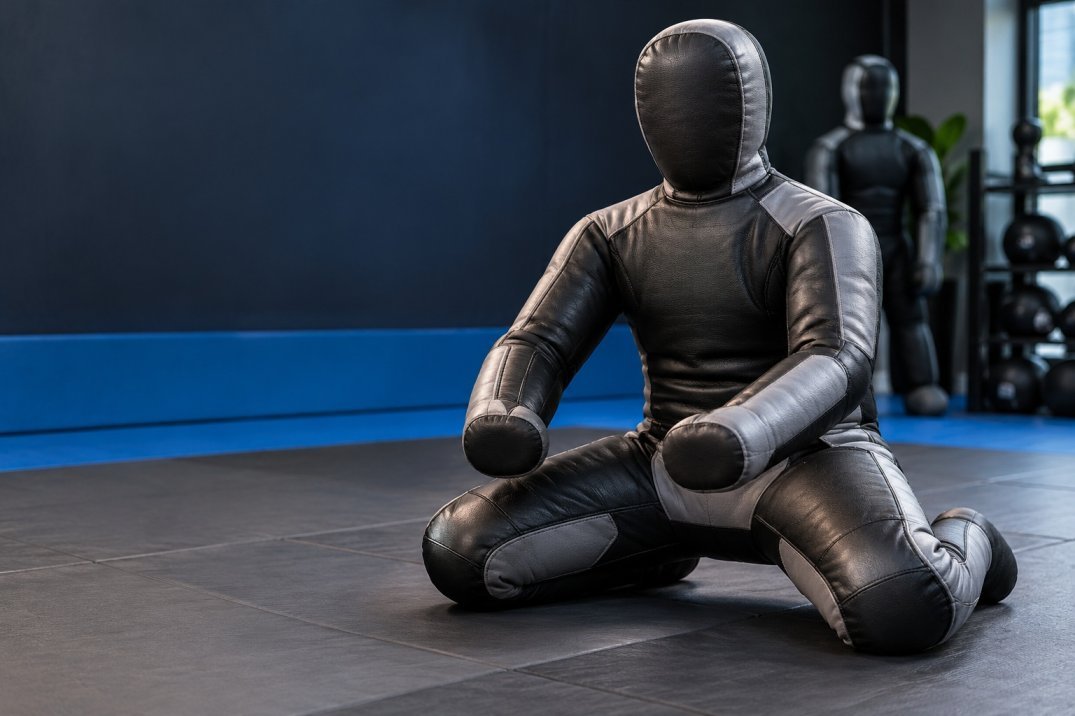
A jiu jitsu dummy is a human-shaped training aid designed to help practitioners rehearse BJJ positions, movement patterns and transitions without a live partner. It supports solo repetition and home training, but it cannot reproduce live resistance, reactions, grip fighting or the unpredictable movement of a real training partner. Construction, size, weight and filling vary by manufacturer and model.
This is an educational guide, not a substitute for qualified BJJ instruction. Use appropriate mats and adequate space, follow the manufacturer's instructions for your specific dummy, and treat live partner training and qualified coaching as essential for developing skill against real resistance.
What Is a Jiu Jitsu Dummy?
A jiu jitsu dummy is a human-shaped training aid — typically with a defined head, torso, arms and legs — built to let a BJJ practitioner rehearse positions, movement and transitions without a live partner.
"Jiu jitsu dummy" isn't a strictly standardized equipment category — it overlaps heavily with the broader term grappling dummy, and products marketed for BJJ can vary meaningfully in shape, flexibility and construction from one manufacturer to the next. What generally makes a dummy useful specifically for BJJ is ground-oriented poseability: limbs and joints that hold realistic positions for guard, mount, side control and similar work.
The key thing to understand from the outset: a dummy is a fixed, non-reactive training object. It holds whatever position you place it in. That's fundamentally different from a live partner, who moves, resists and reacts — a distinction that shapes everything else in this guide.
What Is a Jiu Jitsu Dummy Used For?
Broadly, a jiu jitsu dummy supports:
- Technique repetition — repeating a movement enough times to build familiarity.
- Positional practice — rehearsing body positioning relative to the dummy.
- Movement patterns — practicing the physical mechanics behind a technique.
- Solo drilling — training when no partner is available.
- Transitions — practicing movement between connected positions.
- Controlled practice — reviewing sequences at your own pace.
- Home training — supplementing gym sessions between classes.
For a complete breakdown of specific drills by position, see BJJ dummy drills and grappling dummy drills.
Can You Practice Jiu Jitsu With a Dummy?
Yes, for selected forms of technique repetition and movement practice. A dummy cannot reproduce live resistance, reactions, timing, grip fighting, balance changes or unpredictable movement — the elements that only develop when a real, actively moving person is involved. What can be practiced effectively includes positional movement, transitions and technical sequencing you've already learned. What requires a live partner includes anything involving genuine resistance, reactions or timing.
What Can You Practice With a Jiu Jitsu Dummy?
| Training Area | Useful With Dummy? | Why | Main Limitation |
|---|---|---|---|
| Positional movement | Yes | Fixed target supports repeated positioning | No resistance |
| Transitions | Yes | Movement between positions can be rehearsed | No reactive counter-movement |
| Solo drilling | Yes | Available without a partner | No timing or reactions |
| Takedown entries | Sometimes | Depends on whether the dummy's design supports standing use | No balance-based resistance |
| Guard-related movement | Yes | Hip and frame positioning can be rehearsed | No grip fighting |
| Mount-related practice | Yes | Balance and positioning can be practiced | No bridging resistance |
| Side-control movement | Yes | Pressure and positioning concepts can be rehearsed | No dynamic pressure changes |
| Back-control movement | Yes | Hook and chest-connection positioning can be rehearsed | No escape resistance |
| Submission positioning | Limited | Safe technical hand/body positioning only | No defensive reactions; never force finishes on a dummy or person without training |
| Movement repetition | Yes | Core benefit of dummy training | Repetition ≠ live proficiency |
Types of Jiu Jitsu Dummies
Broad design categories — exact features vary by manufacturer, and not every product fits neatly into one box.
Ground-Oriented Grappling Dummy
Built with ground poseability as the priority — generally suited to guard, mount, side control and back-control work.
Standing Grappling Dummy
Built to support standing drilling, including takedown entries and setups, sometimes with a base or reinforced stance.
Kneeling/Sitting Dummy
Designed to hold a kneeling or seated posture, which can suit certain positional or takedown-adjacent drilling.
Hanging Dummy
Suspended designs, more commonly associated with striking or clinch work than BJJ-specific ground positioning.
Filled Dummy
Sold ready to use, with filling material already inside.
Unfilled Dummy
Sold as an empty shell, letting the buyer choose filling and final firmness — see how to fill a grappling dummy.
How to Choose a Jiu Jitsu Dummy
A practical overview of the main decision factors — for a complete buying walkthrough, see how to choose a grappling dummy.
- Intended training — BJJ ground work, standing/takedown work, or a mix of both.
- Size — proportionate to your body and the positions you'll train.
- Weight — appropriate for your training goals and available space.
- Body design — limb flexibility and joint positioning suited to your intended use.
- Material — durability and feel under repeated use.
- Filling — pre-filled convenience vs unfilled customization.
- Construction — stitching and seam quality.
- Available space — how much room you have to train and store it.
- Budget — price varies by size, material and construction.
- Portability — how easily it can be moved or repositioned.
- Storage — how it fits your space when not in use.
What Size Jiu Jitsu Dummy Should You Get?
Size affects realism, how the dummy proportions to your own body during drilling, which positions feel natural to train, and how easily it stores in your available space. A dummy that's significantly larger or smaller than your own build can make certain positions feel unrealistic, and available space at home is a practical constraint worth checking before buying. For a full sizing walkthrough, see what size grappling dummy should I buy?
What Weight Should a Jiu Jitsu Dummy Be?
Weight affects stability during drilling, how easy the dummy is to handle and reposition, realism for certain movements, portability, and storage. There's no single universal weight recommendation — heavier dummies tend to feel more stable but are harder to move and reposition, while lighter dummies are easier to handle but may feel less realistic for certain positional work. For a full weight-selection guide, see what weight grappling dummy should I get?
What Materials Are Used in Jiu Jitsu Dummies?
Common construction materials include canvas, vinyl, synthetic leather and reinforced fabric, though exact construction varies by manufacturer and product line. No single material is universally best — canvas and reinforced fabrics tend to prioritize durability under repeated grip and friction, while vinyl and synthetic leather options vary in feel and grip depending on the specific product. For a full material comparison, see best material for a grappling dummy.
Filled vs Unfilled Jiu Jitsu Dummies
Filled dummies are ready to train with depending on the specific product, tend to be heavier at the point of purchase, can be more convenient out of the box, but may be harder to move or store and can involve higher shipping costs due to weight. Unfilled dummies ship lighter, let you control the exact filling and firmness, but require preparation before first use, and final weight depends entirely on what and how much you fill them with.
For detailed guidance, see filled vs unfilled grappling dummy, how to fill a grappling dummy, grappling dummy filler and how much filling does a grappling dummy need?
Standing vs Ground-Oriented Jiu Jitsu Dummies
Standing-oriented designs tend to be more useful for takedown-related practice, standing entries, and wrestling crossover training. Ground-oriented designs tend to be more useful for ground positioning, positional repetition and BJJ-focused practice specifically. Neither is universally better — the actual product's construction and intended use matter more than the marketing label attached to it, so check the specific design rather than assuming from the category name alone.
How to Use a Jiu Jitsu Dummy for Training
For a complete walkthrough of usage technique, see how to use a grappling dummy.
Jiu Jitsu Dummy Training Ideas
- Positional repetition — rehearsing correct positioning in a given position.
- Transition practice — moving between two connected positions.
- Movement patterns — isolating a specific physical motion.
- Technique sequencing — running through a multi-step technique in order.
- Solo repetition — consistent practice without needing a partner present.
- Controlled conditioning — light conditioning work incorporated around technical drilling.
For detailed drills, see BJJ dummy drills, grappling dummy drills and submission grappling drills.
Benefits of Training With a Jiu Jitsu Dummy
- Solo practice — training available without needing a partner present.
- Repetition — consistent, repeatable practice of a given movement.
- Convenience — train on your own schedule.
- Home training — supports practice between gym sessions.
- Technique familiarity — reinforcing what was taught in a recent class.
- Movement repetition — building comfort with specific physical patterns.
- Confidence with sequences — reviewing multi-step techniques at your own pace.
- Supplemental training — adding to, not replacing, your regular training.
Limitations of a Jiu Jitsu Dummy
A jiu jitsu dummy cannot reproduce:
- Live resistance — a real opponent pushes back; a dummy does not.
- Unpredictable reactions — a dummy holds exactly the position you place it in.
- Grip fighting — a dynamic, contested skill requiring another set of active hands.
- Timing — only develops against real, moving resistance.
- Balance changes — a partner's balance shifts dynamically; a dummy's does not.
- Weight shifting — real pressure changes only come from an actual person.
- Live rolling — the open-ended, reactive practice that ties skills together.
- Coaching feedback — real-time correction from a qualified instructor.
- Communication — the back-and-forth exchange that happens with a training partner.
- Realistic resistance — the overarching limitation behind everything above.
The core distinction — A jiu jitsu dummy is a supplement to live BJJ training, not a replacement for it. It cannot guarantee self-defense outcomes on its own.
Are Jiu Jitsu Dummies Worth It?
Value depends on your training frequency, available space, access to partners, training goals, budget and willingness to practice solo.
Likely Worth It If...
- You train regularly and want extra repetition
- Gym or partner access is sometimes limited
- You have adequate space to use and store one
- You want to reinforce class material between sessions
- You have realistic expectations about its role
May Not Be Worth It If...
- You expect it to replace live training entirely
- You don't have adequate space to use it properly
- You're primarily looking for striking practice
- You don't have a clear training purpose for it
- You rarely train BJJ at all
For a fuller discussion of value across grappling dummies generally, see are grappling dummies worth it?
How Much Does a Jiu Jitsu Dummy Cost?
Price varies based on size, material, construction, filling status, brand, shipping and current market conditions. Rather than quoting a specific price range that could quickly become outdated or inaccurate, the practical approach is to compare listed prices from current retailers at the time you're buying, factoring in whether the price includes filling, shipping costs (which can be significant for heavier, pre-filled models), and what construction quality that price reflects.
What to Check Before Buying a Jiu Jitsu Dummy
Jiu Jitsu Dummy vs Other Training Equipment
A jiu jitsu dummy is generally built for ground-oriented BJJ positioning and movement. A broader grappling dummy may be marketed for multiple grappling disciplines. A wrestling dummy often prioritizes standing stability and takedown drilling over ground poseability. A heavy bag serves an entirely different purpose — striking impact rather than positional grappling practice. For detailed comparisons, see grappling dummy vs wrestling dummy and grappling dummy vs heavy bag.
Jiu Jitsu Dummy for Home Training
A dummy can work well in a home-gym environment when you have adequate space to move around it safely, suitable flooring or mats, a plan for storage when it's not in use, and realistic expectations about noise if you're training in a shared or multi-level space. Training frequency and equipment placement are worth thinking through before buying — a dummy that's awkward to store or set up tends to get used less over time. For a fuller approach to home BJJ training, see BJJ training at home and solo BJJ training.
HomeGymGoals Jiu Jitsu / BJJ Dummy Options
If you've decided a jiu jitsu dummy fits your training goals, you can explore BJJ grappling dummy options based on your preferred training style, design, size, weight, filling and available space at Home Gym Goals' BJJ dummy collection. Compare the specific construction and intended use of any model against the buying factors covered in this guide before deciding.
Buyer Decision Table
| If You Want... | Look For... |
|---|---|
| General BJJ practice | A ground-oriented design with flexible, poseable limbs |
| Ground-focused practice | Realistic hip and joint positioning for guard, mount and side control |
| Takedown practice | A standing-capable or hybrid design built for that use |
| Home solo training | A size and weight that fit your available space and storage |
| Easy storage | A lighter, more compact unfilled option |
| More control over final weight | An unfilled dummy you fill yourself |
| Ready-to-use equipment | A pre-filled dummy from a reputable manufacturer |
Buyer Checklist
Before buying a jiu jitsu dummy, check:
Ready to compare options?
If you're ready to compare BJJ-focused grappling dummy options, explore the Home Gym Goals BJJ dummy collection and choose a design that fits your training goals, space and preferred setup.
Frequently Asked Questions
Direct answers to the questions people ask about jiu jitsu dummies.
What is a jiu jitsu dummy?
A human-shaped training aid designed to help BJJ practitioners rehearse positions, movement and transitions without a live partner. Design and construction vary by manufacturer.
What is a jiu jitsu dummy used for?
Technique repetition, positional practice, movement patterns, solo drilling, transitions and home training between BJJ classes.
Is a BJJ dummy the same as a grappling dummy?
The terms overlap heavily and are often used interchangeably. Some products are specifically designed with BJJ-style ground positioning in mind; others are marketed more broadly across grappling disciplines.
Can you learn BJJ at home with a dummy?
A dummy can support supplemental repetition at home, but fully learning BJJ requires qualified instruction and live training against real resistance that a dummy can't replicate.
Can a jiu jitsu dummy replace a partner?
No. A dummy cannot reproduce live resistance, reactions, timing, grip fighting or balance changes — all things that require a real training partner.
What type of dummy is best for BJJ?
Ground-oriented designs with flexible, poseable limbs generally suit BJJ-specific positional training best, though the right choice depends on your specific training goals.
Should a BJJ dummy be filled?
Filled dummies are ready to use immediately; unfilled models let you customize firmness and weight but require assembly. Neither is universally better.
How heavy should a jiu jitsu dummy be?
It depends on your size, training goals and available space — heavier dummies feel more stable but are harder to move, while lighter ones are easier to handle.
What size dummy should I get?
A size proportionate to your own body and the positions you plan to train, while also fitting your available storage space.
What material is best?
No single material is universally best — durability, grip and feel vary between canvas, vinyl, synthetic leather and reinforced fabric options depending on the specific product.
Are jiu jitsu dummies worth it?
For regular practitioners wanting extra repetition or supplemental home training with realistic expectations, generally yes. They're less valuable if expected to replace live training entirely.
Can wrestlers use BJJ dummies?
Yes, though wrestling-specific training may benefit more from a standing-oriented design built for takedown drilling rather than a purely ground-focused BJJ dummy.
Can MMA athletes use jiu jitsu dummies?
Yes, for grappling and ground-positioning repetition. Striking-specific training requires equipment explicitly designed for impact, which not all grappling dummies support.
How much does a jiu jitsu dummy cost?
Price varies by size, material, construction, filling status and brand. Compare current listings from retailers rather than relying on a fixed price range.
What should I check before buying?
Dimensions, weight, material, construction, filling status, intended training position, available space, storage, shipping, warranty, return policy and manufacturer guidance.
Jiu Jitsu Dummy: Quick Answers
What is a jiu jitsu dummy?
A human-shaped training aid used to rehearse BJJ positions and movement without a live partner.
Is a jiu jitsu dummy the same as a grappling dummy?
The terms overlap significantly; BJJ-marketed products often emphasize ground poseability specifically.
Can you practice BJJ alone with a dummy?
Yes, for positional movement and technical repetition — not for resistance-based skills.
What can you practice with a jiu jitsu dummy?
Positional movement, transitions, guard, mount, side-control and back-control positioning, and safe technical rehearsal.
Should I buy a filled or unfilled dummy?
Filled is more convenient immediately; unfilled lets you control final weight and firmness.
Can a jiu jitsu dummy replace a training partner?
No — it provides no resistance, reactions or timing feedback.
Can a wrestling dummy be used for BJJ?
Sometimes, but wrestling-oriented designs often prioritize standing use over ground poseability.
How much does a jiu jitsu dummy cost?
It varies by size, material, construction and brand — compare current retailer listings directly.
Shop BJJ & Grappling Training Equipment
Once you know what to look for, explore BJJ-focused dummy options for solo drilling and positional repetition.
This guide provides general educational information about jiu jitsu dummies and is not a substitute for qualified instruction. A jiu jitsu dummy supports solo repetition and positional practice, but it cannot reproduce the resistance, reactions, timing or unpredictability of a live training partner. Prices, specifications and product availability vary by retailer and change over time — always confirm current details with the manufacturer or seller before purchasing. Explore more at Home Gym Goals.