
Can You Learn Jiu Jitsu at Home? What You Can and Cannot Learn
Yes — you can learn and practice certain aspects of Jiu Jitsu at home. No — home practice alone is not enough to develop complete BJJ skill. BJJ is a resistance-based grappling art, and real skill depends on timing, reactions, live resistance and feedback that only come from training with other people. Home practice can be a genuinely useful supplement — this article explains exactly where the line sits.
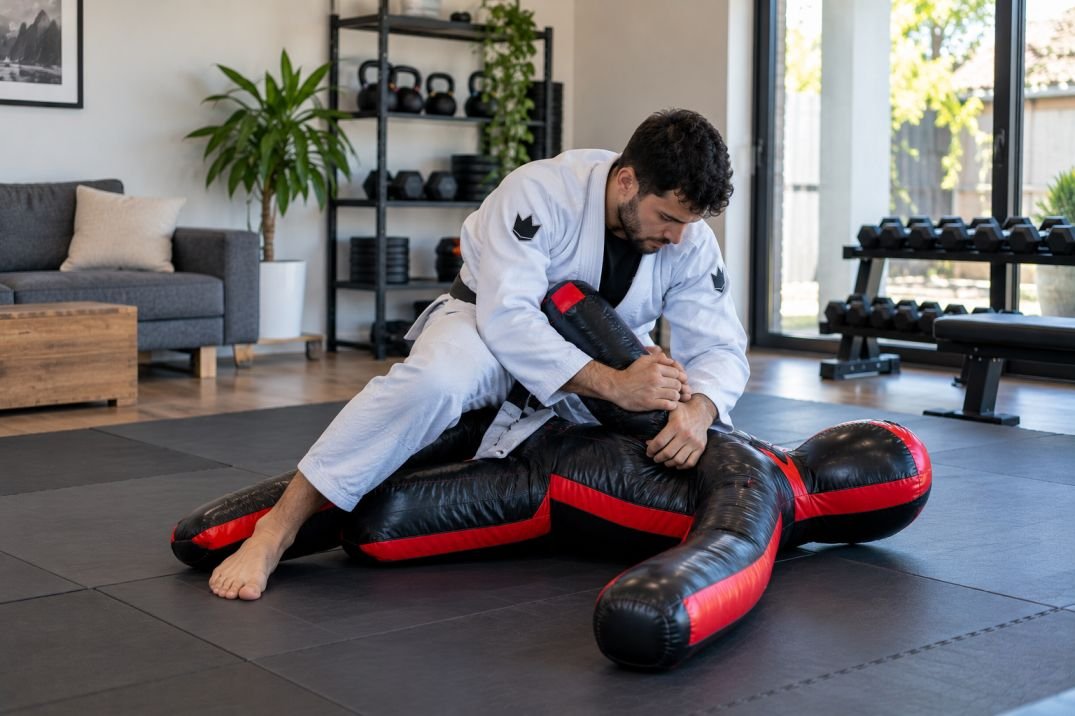
You can learn some BJJ concepts, movements and techniques at home, but home practice alone cannot reproduce the live resistance, timing, reactions and feedback required to develop complete Jiu Jitsu skill. The most effective approach combines qualified instruction and live training with home practice used for repetition and reinforcement.
This is an educational guide, not a substitute for qualified BJJ instruction. Learn technique properly from a qualified instructor, use appropriate mats and space, and never apply submissions to another person without their informed consent and proper training. Home training cannot guarantee self-defense outcomes.
Can You Learn Jiu Jitsu at Home?
There's an important difference between learning a technique and becoming proficient at BJJ. At home, you can learn terminology, concepts, movement principles, positional awareness and even some technical sequences. What you can't fully develop at home is the ability to apply those things successfully against someone who's actively resisting you.
Technical understanding doesn't equal live proficiency. Resistance changes the entire problem: a movement that looks and feels correct against no resistance can behave completely differently the moment a real person is reacting, adjusting and pushing back. That's the core reason BJJ is generally learned through a cycle rather than a single event:
Home practice fits naturally into the "practice" and "refine" parts of that cycle. It can't replace the "receive feedback" or "apply against resistance" parts on its own.
What Can You Learn About BJJ at Home?
At home, you can reasonably build real understanding of:
- BJJ terminology — the vocabulary used to describe positions, techniques and concepts.
- Basic positions — guard, mount, side control, back control and how they relate to each other.
- Positional hierarchy — which positions are generally considered more dominant and why.
- Fundamental concepts — distance, base, posture, frames and control.
- Movement principles — the underlying mechanics that show up across many techniques.
- Basic strategy — how positions, escapes and submissions connect to each other.
- Common techniques — what a technique looks like and the general sequence involved.
- Transitions — how practitioners move between positions.
- Defensive concepts — general principles behind protecting position and avoiding danger.
- Training theory — how BJJ practitioners typically structure learning and progression.
All of this is genuinely useful. But understanding a concept is different from performing it successfully against someone actively trying to stop you — that gap is exactly what live training closes.
What BJJ Skills Can You Practice Alone?
Categories only — for a complete drill library, see solo BJJ training: drills you can practice without a partner.
- Hip movement — the foundational movement pattern behind much of BJJ's ground game.
- Bridging — a core movement used in escapes and off-balancing.
- Technical movement — rehearsing the physical mechanics of a technique in isolation.
- Positional movement — practicing how your body should move within a given position.
- Body coordination — general athleticism that supports BJJ movement.
- Mobility — the range of motion many BJJ positions and transitions require.
- Movement transitions — practicing the connections between positions.
- Shadow drilling — rehearsing sequences without a partner or dummy present.
- Technique visualization — mentally rehearsing sequences and decision points.
- Controlled repetition — repeating a movement pattern enough times to build familiarity.
Can You Practice BJJ Without a Partner?
Yes — certain components can be practiced alone, including movement, conditioning, mobility, technical visualization, solo drills, positional movement and dummy-based drilling. What's missing without a partner is resistance, reactions, timing and partner feedback — the elements that only develop when another person is actively involved and responding to what you do.
What Can You NOT Fully Learn Alone?
This is the most important section on this page.
- Live resistance — how a technique holds up when someone is genuinely trying to stop it.
- Grip fighting — a dynamic, contested skill that requires another set of hands actively working against yours.
- Timing — recognizing the right moment to act, which only develops against real, unpredictable movement.
- Scrambling — fast, reactive exchanges that happen only between two moving people.
- Positional sparring — testing specific positions under limited live resistance.
- Defensive reactions — genuine defense requires someone actually trying to prevent what you're doing.
- Pressure management — adjusting to another person's real, shifting weight and pressure.
- Live escapes — escaping a position that's being actively maintained against you.
- Live submission defense — recognizing and responding to a genuine submission attempt.
- Adaptation to different body types — learning how techniques feel and adjust against different sizes, builds and styles.
Why Live Training Matters in Brazilian Jiu Jitsu
BJJ is fundamentally different from non-contact movement practice because it's built around resistance, unpredictability and real-time decision-making. Live training introduces variables that solo or dummy practice simply cannot: genuine fatigue, a partner's unpredictable reactions, shifting body positioning, and the need to adapt technique on the fly as circumstances change.
A technique performed perfectly on a stationary dummy may behave very differently against a person who's actively resisting, reacting and adjusting their weight and position in response to what you're doing. This is not a criticism of solo or dummy practice — it's simply the nature of what those tools can and can't provide.
Can You Really Learn BJJ From Videos?
The honest answer — Videos can help you understand techniques and concepts, but watching a technique is not the same as successfully applying it against resistance. Knowledge, skill and live performance are three different things — videos primarily build knowledge, drilling builds early skill, and live training is what tests and develops real performance.
Instructional videos are a genuinely useful component of learning BJJ — most practitioners, including experienced ones, use them to study technique and review detail. The mistake is treating video study as a substitute for live training rather than one part of a broader learning process.
BJJ Home Training Reality Check
What Home Training Can Do
- Reinforce movement patterns
- Improve familiarity with techniques
- Support conditioning
- Provide repetition
- Help review class material
- Support solo practice
- Provide convenient training
What Home Training Cannot Fully Replace
- Live resistance
- Partner reactions
- Rolling
- Positional sparring
- Coaching feedback
- Unpredictable movement
- Grip fighting
- Live defensive reactions
Can a Grappling Dummy Help You Learn BJJ?
A grappling dummy can help reinforce certain aspects of BJJ training — repetition, positioning, movement, transitions, drilling sequences and reviewing techniques between classes. It cannot replace live training: it provides no resistance, no reactions and no timing feedback, since it's a fixed object rather than a responsive training partner.
For a full explanation of what a BJJ training dummy is and how it fits into a training setup, see Brazilian Jiu Jitsu training dummy: complete guide. For specific drill ideas, see BJJ dummy drills and how to use a grappling dummy. If you're considering one for home training, explore BJJ grappling dummies.
What Is the Best Equipment for Learning BJJ at Home?
Keep this simple. The essentials are:
- Suitable training mats — appropriate cushioning for grappling movement.
- Comfortable training clothing — a gi or no-gi clothing depending on your training context.
- A grappling dummy, where appropriate — useful for positioning and repetition, not essential for everyone.
- Space for movement — enough room to move freely without obstacles.
- Optional instructional resources — videos or written material to support what you've learned in class.
- Basic conditioning equipment, if relevant — supports general fitness alongside technical practice.
None of this equipment replaces qualified instruction — it supports the practice that instruction and live training make possible.
Can Beginners Learn BJJ at Home?
Beginners can learn about BJJ and practice selected movements at home, but they should not rely entirely on unsupervised home practice to learn the art. Qualified instruction, beginner classes, supervised training and controlled partner practice matter especially early on — home practice works best as reinforcement of what's already been taught correctly. Beginner feedback is particularly important because early mistakes in body mechanics can become habits that are harder to correct later.
How to Start Learning BJJ at Home as a Beginner
Learn basic terminology and concepts
Build a working vocabulary and understanding of positions before anything else.
Learn foundational movements from reliable instruction
Use qualified sources rather than inventing technique independently.
Practice basic solo movements
Build comfort with hip movement, mobility and basic positioning.
Use a grappling dummy for appropriate repetition, if useful
Support positioning and technical familiarity between classes.
Attend live BJJ training when possible
This is where real skill development against resistance happens.
Use home sessions to reinforce what was learned
Revisit and repeat what your instructor covered in class.
Return to live training and get feedback
Test what you've reinforced and get correction from a coach or partner.
How Many Days a Week Should You Practice BJJ at Home?
There's no single perfect schedule — it depends on your experience, training intensity, recovery, available time, gym attendance and goals. If you're attending BJJ classes two to three times per week, short home sessions for reinforcement generally work well alongside that live training. If gym access is limited, home practice can carry more of the load for movement, conditioning, visualization and dummy work — but live training should still be prioritized whenever it's available.
Example Beginner BJJ Home Session
A simple 20–30 minute example. The technical content should be based on techniques you've already learned properly — this isn't a substitute for that instruction.
BJJ at Home vs BJJ at a Gym
| Training Factor | Home Training | Gym Training |
|---|---|---|
| Movement Practice | Excellent | Excellent |
| Technique Review | Good | Excellent |
| Live Resistance | Limited/None | Excellent |
| Partner Reactions | None without partner | Excellent |
| Coaching Feedback | Limited | Excellent |
| Solo Conditioning | Excellent | Good |
| Repetition | Excellent | Excellent |
| Live Rolling | No | Yes |
| Convenience | High | Lower |
| Skill Testing | Limited | Excellent |
Can You Become Good at BJJ Without Training With Other People?
Not realistically. BJJ proficiency requires experience against resisting partners — that's where timing, reactions and pressure management actually develop. That said, home practice isn't worthless: it can make live training more productive by reinforcing movement and concepts between classes, so the time you do spend training with others goes further.
Common Mistakes People Make When Learning BJJ at Home
- Relying entirely on videos — treating video study as a complete substitute for live training.
- Never training with partners — missing the resistance and feedback that develop real skill.
- Practicing techniques without feedback — reinforcing mechanics that may be subtly incorrect.
- Focusing only on submissions — neglecting the positional fundamentals submissions depend on.
- Skipping fundamentals — jumping to advanced technique before basics are solid.
- Training too fast — rushing repetitions and reinforcing sloppy mechanics.
- Ignoring movement quality — prioritizing repetition count over technical accuracy.
- Assuming a dummy behaves like a person — expecting resistance or reactions it can't provide.
- Copying advanced techniques without context — attempting complex sequences without the fundamentals they build on.
- Neglecting safety — training on unsuitable surfaces or without adequate space.
- Believing home practice can replace rolling — the single most common misconception in home BJJ training.
How to Combine Home Training With BJJ Classes
The most effective model treats home training and class time as connected, not separate:
This cycle is more effective than home-only training because it closes the loop that solo practice can't close on its own — real feedback and testing against resistance. For a complete approach to structuring the home side of this cycle, see BJJ training at home.
Is Learning BJJ at Home Worth It?
Home training is worthwhile when gym access is limited, when you want additional repetition, when you want to reinforce class material, when you enjoy solo training, or when you want to build general movement familiarity. It's less effective when it's used as the only form of BJJ training, when it's used instead of live practice rather than alongside it, when it's based entirely on random online techniques with no instructor context, or when it's performed without appropriate space or equipment.
Beginner Decision Framework
If you have access to a BJJ gym:
→ Train at the gym and use home practice as reinforcement.
If you have limited gym access:
→ Use home training to maintain movement and review concepts while attending live training whenever possible.
If you have no partner:
→ Focus on solo movement, conditioning, visualization and appropriate dummy practice.
If you are completely new:
→ Prioritize qualified instruction before attempting advanced techniques on your own.
Frequently Asked Questions
Direct answers to the questions people ask about learning Jiu Jitsu at home.
Can you learn Jiu Jitsu at home?
You can learn concepts, terminology, movement patterns and some technique at home, but developing real BJJ skill requires live resistance, timing and feedback that only come from training with other people.
Can you learn BJJ by yourself?
You can build knowledge and practice certain movements by yourself, but proficiency — the ability to apply BJJ successfully against resistance — generally requires live training with partners and coaching.
Can you learn BJJ without a partner?
You can learn concepts and practice solo movement without a partner, but grip fighting, timing, reactions and live resistance all require another person to develop.
How do you practice Jiu Jitsu at home?
Through solo movement drills, mobility work, technical repetition of material learned properly in class, visualization, and optionally a grappling dummy for positional practice.
Can beginners learn BJJ at home?
Beginners can learn concepts and practice selected movements at home, but should prioritize qualified instruction and supervised partner practice, using home training as reinforcement rather than a primary learning method.
Can you learn BJJ from YouTube?
Videos can help you understand techniques and concepts, but watching a technique isn't the same as applying it successfully against resistance. Videos work best alongside, not instead of, live instruction and training.
Can a grappling dummy teach you BJJ?
A grappling dummy can help with repetition, positioning and movement, but it cannot teach BJJ on its own — it provides no resistance, reactions or feedback.
Can you practice BJJ alone?
Yes, for movement, conditioning, mobility, visualization and dummy-based drilling. Live resistance, timing and reactions cannot be practiced alone.
Is home BJJ training effective?
It's effective as a supplement — reinforcing movement and technique between classes — but not as a replacement for live training against resistance.
How often should you practice BJJ at home?
There's no universal frequency — it depends on your gym attendance, experience and goals. Short, focused sessions alongside regular live training generally work well.
Can you become good at BJJ without rolling?
Not realistically. Rolling and live resistance are what develop timing, reactions and real proficiency — home practice alone cannot replace that experience.
What equipment do you need to practice BJJ at home?
Suitable mats, comfortable training clothing, adequate space, and optionally a grappling dummy for positional repetition. Equipment supports practice but doesn't replace instruction.
Can a BJJ dummy replace a training partner?
No. A dummy cannot reproduce live resistance, reactions, timing or grip fighting — all things that require a real training partner.
Should you learn BJJ at home before joining a gym?
You can learn basic terminology and concepts beforehand, but joining a gym and learning from a qualified instructor early on generally leads to better technical habits than starting entirely alone.
What BJJ skills can you practice alone?
Hip movement, bridging, mobility, positional movement, technical visualization, shadow drilling and controlled repetition are all realistic to practice alone.
Can You Learn Jiu Jitsu at Home: Quick Answers
Can you learn Jiu Jitsu at home?
You can learn concepts and practice some movement at home, but developing full BJJ skill requires live resistance and feedback from training with others.
Can you learn BJJ by yourself?
You can build knowledge and movement familiarity alone, but proficiency against resistance generally requires live partner training.
Can you learn BJJ without a partner?
Concepts and solo movement, yes. Grip fighting, timing and live resistance require a partner.
Can a grappling dummy teach BJJ?
A dummy supports repetition and positioning but provides no resistance or reactions, so it cannot teach BJJ on its own.
Can you become good at BJJ without rolling?
Not realistically — rolling and live resistance are what develop timing and real proficiency.
Is BJJ home training effective?
Yes, as a supplement to live training — for reinforcing movement and reviewing technique between classes.
What is the difference between learning BJJ and practicing BJJ?
Learning involves building conceptual and technical understanding; practicing tests and refines that understanding, ideally against real resistance.
Does home training replace a BJJ gym?
No — home training is a supplement. Live training at a gym remains essential for developing skill against resistance.
Shop BJJ & Grappling Training Equipment
If home practice fits your training goals, a suitable dummy can support the solo side of your training between classes.
This guide provides general educational information about learning Brazilian Jiu Jitsu at home and is not a substitute for qualified instruction. Home training — including solo practice and grappling-dummy drilling — is a supplement to live BJJ training, not a replacement for it. Learn technique from a qualified instructor, never apply submissions to another person without their informed consent and proper training, and use appropriate mats and space. Explore more at Home Gym Goals.